Stem Cell Res Ther. 2013 Dec 24;4(6):150. doi: 10.1186/scrt380.
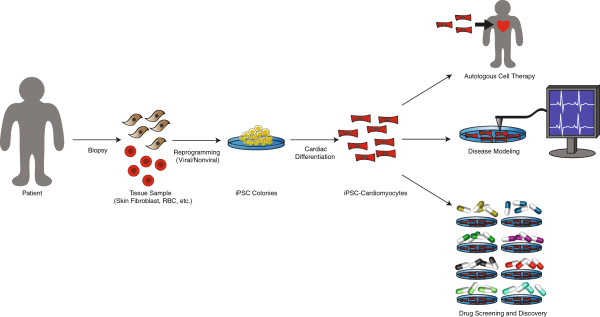
Human induced pluripotent stem cells (hiPSCs) have emerged as a novel tool for drug discovery and therapy in cardiovascular medicine. hiPSCs are functionally similar to human embryonic stem cells (hESCs) and can be derived autologously without the ethical challenges associated with hESCs. Given the limited regenerative capacity of the human heart following myocardial injury, cardiomyocytes derived from hiPSCs (hiPSC-CMs) have garnered significant attention from basic and translational scientists as a promising cell source for replacement therapy. However, ongoing issues such as cell immaturity, scale of production, inter-line variability, and cell purity will need to be resolved before human clinical trials can begin. Meanwhile, the use of hiPSCs to explore cellular mechanisms of cardiovascular diseases in vitro has proven to be extremely valuable. For example, hiPSC-CMs have been shown to recapitulate disease phenotypes from patients with monogenic cardiovascular disorders. Furthermore, patient-derived hiPSC-CMs are now providing new insights regarding drug efficacy and toxicity. This review will highlight recent advances in utilizing hiPSC-CMs for cardiac disease modeling in vitro and as a platform for drug validation. The advantages and disadvantages of using hiPSC-CMs for drug screening purposes will be explored as well.
人类诱导多能干细胞(hiPSCs)已成为心血管医学中药物发现和治疗的新工具。hiPSCs 在功能上与人类胚胎干细胞(hESCs)相似,并且可以自体衍生,没有与 hESCs 相关的伦理挑战。鉴于心肌损伤后人类心脏的再生能力有限,hiPSCs 衍生的心肌细胞(hiPSC-CMs)作为替代治疗的有前途的细胞来源,引起了基础和转化科学家的极大关注。然而,在开始人体临床试验之前,需要解决细胞不成熟、生产规模、细胞间变异性和细胞纯度等问题。同时,hiPSCs 在体外探索心血管疾病的细胞机制已被证明具有极高的价值。例如,hiPSC-CMs 已被证明可重现单基因心血管疾病患者的疾病表型。此外,患者来源的 hiPSC-CMs 现在为药物疗效和毒性提供了新的见解。本综述将重点介绍利用 hiPSC-CMs 进行体外心脏疾病建模以及作为药物验证平台的最新进展。还将探讨使用 hiPSC-CMs 进行药物筛选的优缺点。