Requena Antonio, Cruz María, Ruiz Francisco J, García-Velasco Juan A
Reproductive Medicine Department, Instituto Valenciano de Infertilidad IVI Madrid, Avenida del Talgo 68-70, Aravaca, Madrid 28023, Spain.
Reprod Biol Endocrinol. 2014 Jan 29;12:10. doi: 10.1186/1477-7827-12-10.
Luteinizing hormone (LH) activity in human menopausal gonadotropin (hMG) preparations is derived from human chorionic gonadotropin (hCG) rather than LH. Therefore, we aimed to determine whether there are similarities in the endocrine and follicular profiles of serum and follicular fluid from controlled ovarian stimulation with the recombinant gonadotropins follicle-stimulating hormone plus luteinizing hormone (rFSH + rLH) or highly purified human menopausal gonadotropin (HP-hMG).
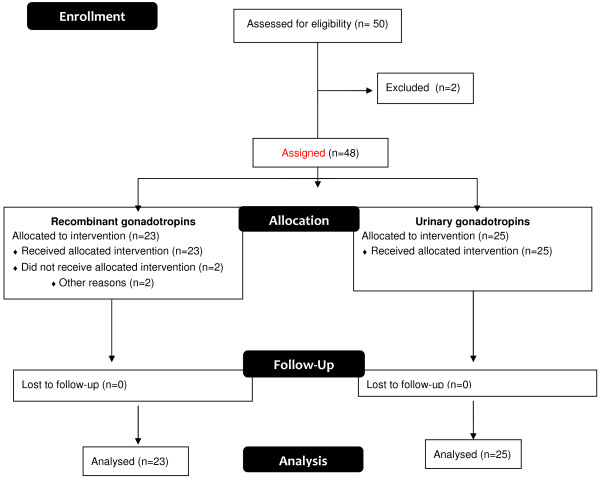
We performed a prospective observational study with 50 oocyte donors that received either a combination of recombinant gonadotropins (rFSH + rLH) or a mixture of urinary gonadotropins (HP-hMG) plus purified urinary FSH (uFSH). Results were analyzed using Student's t-test to compare continuous variables and the chi-squared test to compare proportions. P-values < 0.05 were considered statistically significant.
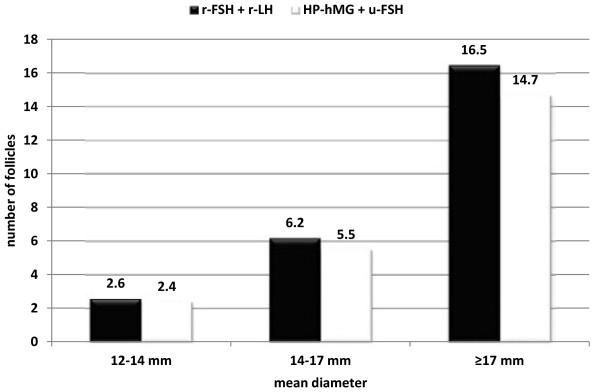
Although more oocytes were retrieved after treatment with recombinant than urinary gonadotropins (16.5 vs. 11.8; P = 0.049), a higher proportion of metaphase II ova (71.2% vs. 80.6%; P = 0.003) were obtained using urinary gonadotropins. On day 6 and on the day of triggering, serum steroid hormone levels were slightly but not significantly elevated in the recombinant group compared with the urinary group. In follicular fluid, no statistical differences were observed for intra-follicular levels of steroid hormones between the two protocols; ongoing pregnancy rates were similar (46.1% vs. 46.1%).
Our data suggest that endocrinological and follicular profiles do not differ between rFSH + rLH and HP-hMG stimulation.
人绝经期促性腺激素(hMG)制剂中的促黄体生成素(LH)活性源自人绒毛膜促性腺激素(hCG)而非LH。因此,我们旨在确定使用重组促性腺激素促卵泡生成素加促黄体生成素(rFSH + rLH)或高度纯化的人绝经期促性腺激素(HP-hMG)进行控制性卵巢刺激时,血清和卵泡液的内分泌及卵泡特征是否存在相似性。
我们对50名卵母细胞捐赠者进行了一项前瞻性观察研究,这些捐赠者接受了重组促性腺激素组合(rFSH + rLH)或尿促性腺激素混合物(HP-hMG)加纯化尿促卵泡生成素(uFSH)。使用Student's t检验分析连续变量结果,使用卡方检验比较比例。P值<0.05被认为具有统计学意义。
尽管使用重组促性腺激素治疗后回收的卵母细胞比尿促性腺激素更多(16.5对11.8;P = 0.049),但使用尿促性腺激素获得的中期II期卵子比例更高(71.2%对80.6%;P = 0.003)。在第6天和触发日,重组组的血清类固醇激素水平与尿促性腺激素组相比略有升高,但无统计学意义。在卵泡液中,两种方案之间卵泡内类固醇激素水平未观察到统计学差异;持续妊娠率相似(46.1%对46.1%)。
我们的数据表明,rFSH + rLH和HP-hMG刺激之间的内分泌和卵泡特征没有差异。