Department of Anesthesia and Pain Medicine, School of Medicine, Pusan National University, Yangsan, Korea.
Department of Plastic Surgery, School of Medicine, Dongguk University, Gyeongju, Korea.
Korean J Pain. 2014 Jan;27(1):54-62. doi: 10.3344/kjp.2014.27.1.54. Epub 2013 Dec 31.
The recently known analgesic action mechanisms of nefopam (NFP) are similar to those of anticonvulsants and antidepressants in neuropathic pain treatment. It is difficult to prescribe high doses of oral neuropathic drugs without titration due to adverse effects. Unfortunately, there are few available intravenous analgesics for the immediate management of acute flare-ups of the chronic neuropathic pain. The aim of this study was to determine the additional analgesic effects for neuropathic pain of NFP and its adverse effects during the titration of oral medications for neuropathic pain among inpatients with postherpetic neuralgia (PHN).
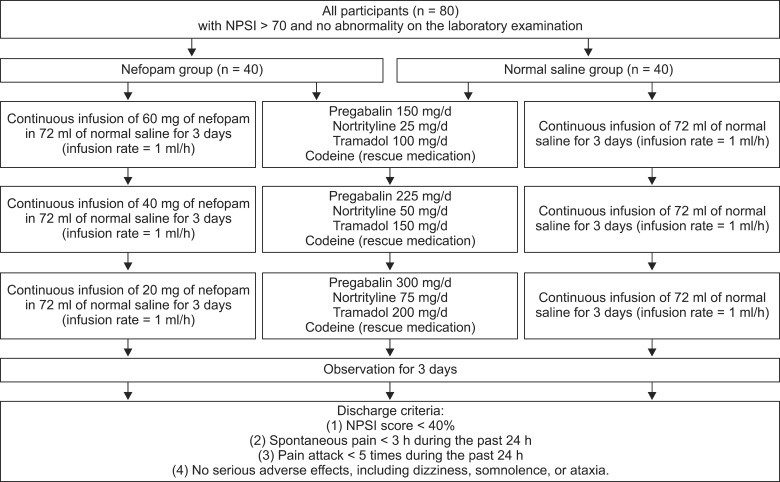
Eighty inpatients with PHN were randomly divided into either the NFP or normal saline (NS) groups. Each patient received a 3-day intravenous continuous infusion of either NFP with a consecutive dose reduction of 60, 40, and 20 mg/d, or NS simultaneously while dose titrations of oral medications for neuropathic pain gradually increased every 3 days. The efficacy of additional NFP was evaluated by using the neuropathic pain symptom inventory (NPSI) score for 12 days. Adverse effects were also recorded.
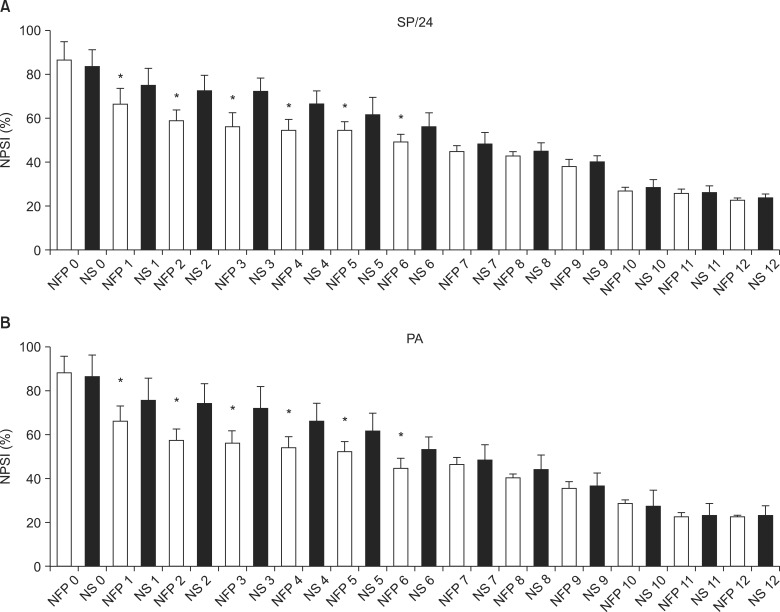
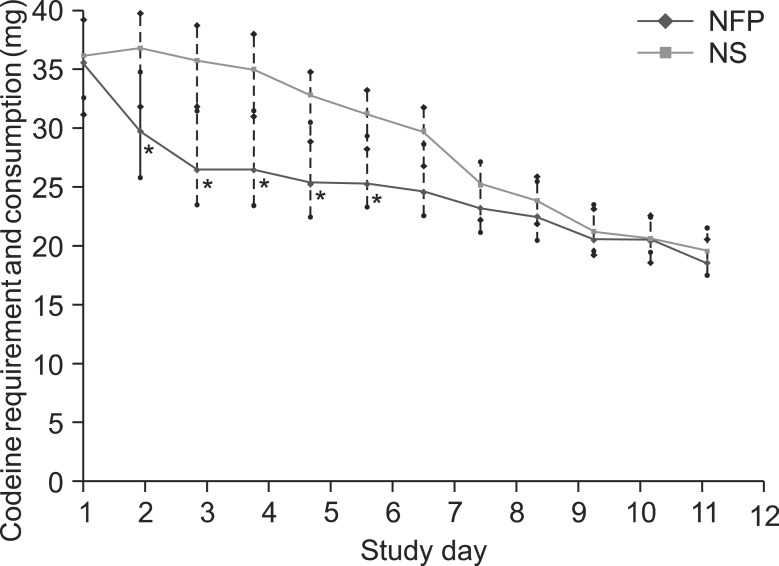
The median NPSI score was significantly lower in the NFP group from days 1 to 6 of hospitalization. The representative alleviating symptoms of pain after using NFP were both spontaneous and evoked neuropathic pain. Reported common adverse effects were nausea, dizziness, and somnolence, in order of frequency.
An intravenous continuous infusion of NFP reduces spontaneous and evoked neuropathic pain with tolerable adverse effects during the titration of oral medications in inpatients with PHN.
奈福泮(NFP)的新近发现的镇痛作用机制与抗惊厥药和抗抑郁药在治疗神经性疼痛方面的作用机制相似。由于副作用的原因,在没有滴定的情况下,很难开出口服神经性药物的高剂量。不幸的是,对于慢性神经性疼痛的急性发作,几乎没有可用的静脉内镇痛药来进行即时管理。本研究的目的是确定奈福泮在带状疱疹后神经痛(PHN)住院患者口服神经性药物滴定过程中对神经性疼痛的额外镇痛作用及其不良反应。
80 例 PHN 住院患者被随机分为 NFP 组或生理盐水(NS)组。每位患者接受 3 天静脉内连续输注 NFP,剂量逐渐减少 60、40 和 20mg/d,或同时输注 NS,同时逐渐增加口服神经性药物的剂量,每 3 天增加一次。通过神经性疼痛症状清单(NPSI)评分评估额外 NFP 的疗效,共评估 12 天。还记录了不良反应。
NFP 组住院第 1 至 6 天的 NPSI 评分中位数明显较低。使用 NFP 后缓解疼痛的代表性症状是自发性和诱发性神经性疼痛。报告的常见不良反应依次为恶心、头晕和嗜睡。
在 PHN 住院患者口服药物滴定过程中,静脉内持续输注 NFP 可减轻自发性和诱发性神经性疼痛,且不良反应可耐受。