Phillips Gemma, Bottomley Christian, Schmidt Elena, Tobi Patrick, Lais Shahana, Yu Ge, Lynch Rebecca, Lock Karen, Draper Alizon, Moore Derek, Clow Angela, Petticrew Mark, Hayes Richard, Renton Adrian
Institute for Health and Human Development, University of East London, London,UK.
Department of Infectious Disease Epidemiology, London School of Hygiene and Tropical Medicine, London, UK.
J Epidemiol Community Health. 2014 Jul;68(7):606-14. doi: 10.1136/jech-2013-202505. Epub 2014 Jan 31.
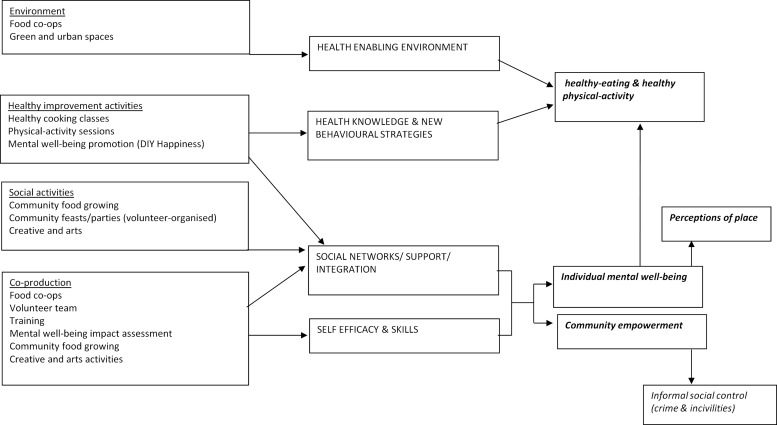
We report the main results, among adults, of a cluster-randomised-trial of Well London, a community-engagement programme promoting healthy eating, physical activity and mental well-being in deprived neighbourhoods. The hypothesis was that benefits would be neighbourhood-wide, and not restricted to intervention participants. The trial was part of a multicomponent process/outcome evaluation which included non-experimental components (self-reported behaviour change amongst participants, case studies and evaluations of individual projects) which suggested health, well-being and social benefits to participants.
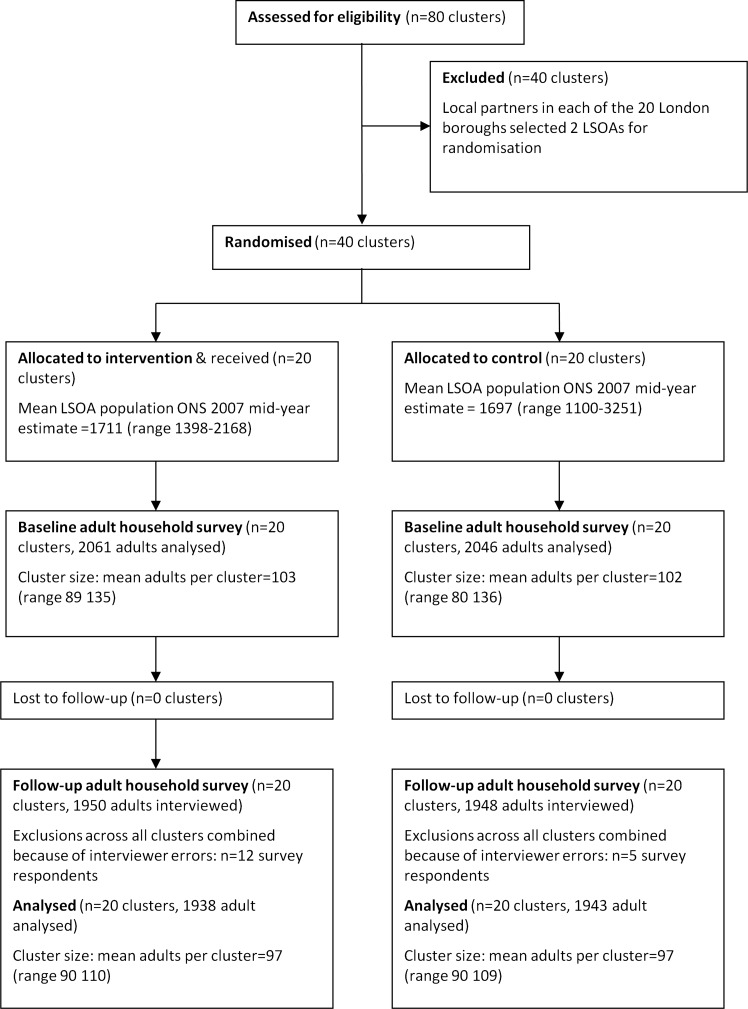
Twenty matched pairs of neighbourhoods in London were randomised to intervention/control condition. Primary outcomes (five portions fruit/vegetables/day; 5×30 m of moderate intensity physical activity/week, abnormal General Health Questionnaire (GHQ)-12 score and Warwick-Edinburgh Mental Well-being Scale (WEMWBS) score) were measured by postintervention questionnaire survey, among 3986 adults in a random sample of households across neighbourhoods.
There was no evidence of impact on primary outcomes: healthy eating (relative risk [RR] 1.04, 95% CI 0.93 to 1.17); physical activity (RR:1.01, 95% CI 0.88 to 1.16); abnormal GHQ12 (RR:1.15, 95% CI 0.84 to 1.61); WEMWBS (mean difference [MD]: -1.52, 95% CI -3.93 to 0.88). There was evidence of impact on some secondary outcomes: reducing unhealthy eating-score (MD: -0.14, 95% CI -0.02 to 0.27) and increased perception that people in the neighbourhood pulled together (RR: 1.92, 95% CI 1.12 to 3.29).
The trial findings do not provide evidence supporting the conclusion of non-experimental components of the evaluation that intervention improved health behaviours, well-being and social outcomes. Low participation rates and population churn likely compromised any impact of the intervention. Imprecise estimation of outcomes and sampling bias may also have influenced findings. There is a need for greater investment in refining such programmes before implementation; new methods to understand, longitudinally different pathways residents take through such interventions and their outcomes, and new theories of change that apply to each pathway.
我们报告了“健康伦敦”(Well London)一项整群随机试验在成年人中的主要结果。“健康伦敦”是一项社区参与计划,旨在贫困社区促进健康饮食、体育活动和心理健康。研究假设是该计划的益处将覆盖整个社区,而非仅限于干预参与者。该试验是多成分过程/结果评估的一部分,其中包括非实验性成分(参与者自我报告的行为变化、案例研究以及对各个项目的评估),这些非实验性成分表明该计划对参与者有健康、幸福和社会效益。
伦敦的20对匹配社区被随机分配至干预组/对照组。通过干预后问卷调查,对来自各社区随机抽取家庭中的3986名成年人测量主要结局(每日5份水果/蔬菜;每周5次、每次30分钟的中等强度体育活动;一般健康问卷(GHQ)-12得分异常以及沃里克 - 爱丁堡心理健康量表(WEMWBS)得分)。
没有证据表明对主要结局有影响:健康饮食(相对风险[RR]1.04,95%置信区间0.93至1.17);体育活动(RR:1.01,95%置信区间0.88至1.16);GHQ12得分异常(RR:1.15,95%置信区间0.84至1.61);WEMWBS(平均差值[MD]:-1.52,95%置信区间 -3.93至0.88)。有证据表明对一些次要结局有影响:降低不健康饮食得分(MD:-0.14,95%置信区间 -0.02至0.27)以及增强对邻里团结的感知(RR:1.92,95%置信区间1.12至3.29)。
试验结果并未提供证据支持评估中非实验性成分得出的干预改善了健康行为、幸福感和社会结局的结论。低参与率和人口流动可能削弱了干预的任何影响。结局的不精确估计和抽样偏差也可能影响了研究结果。在实施此类计划之前,需要加大投入进行改进;需要新的方法来纵向了解居民通过此类干预及其结局所采取的不同途径,以及适用于每种途径的新变革理论。