Berge J, Båtnes A S, Johnsen G, Blackwell S M, Moline M A
University Centre on Svalbard, PB 156, 9171 Longyearbyen, Norway ; Faculty of Biosciences, Fisheries and Economics, University of Tromsø, 9037 Tromsö, Norway.
University Centre on Svalbard, PB 156, 9171 Longyearbyen, Norway ; Department of Biology, Norwegian University of Science and Technology, 7491 Trondheim, Norway.
Mar Biol. 2012;159(1):231-237. doi: 10.1007/s00227-011-1798-0. Epub 2011 Sep 27.
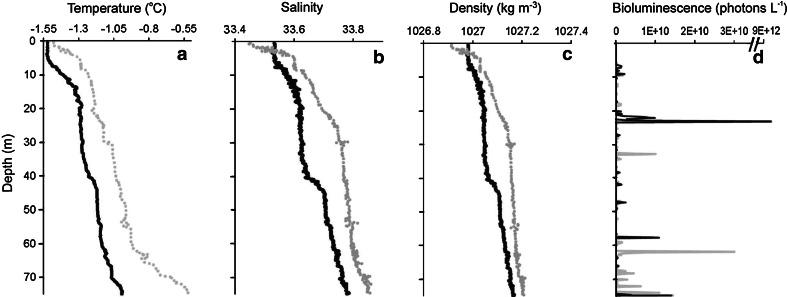
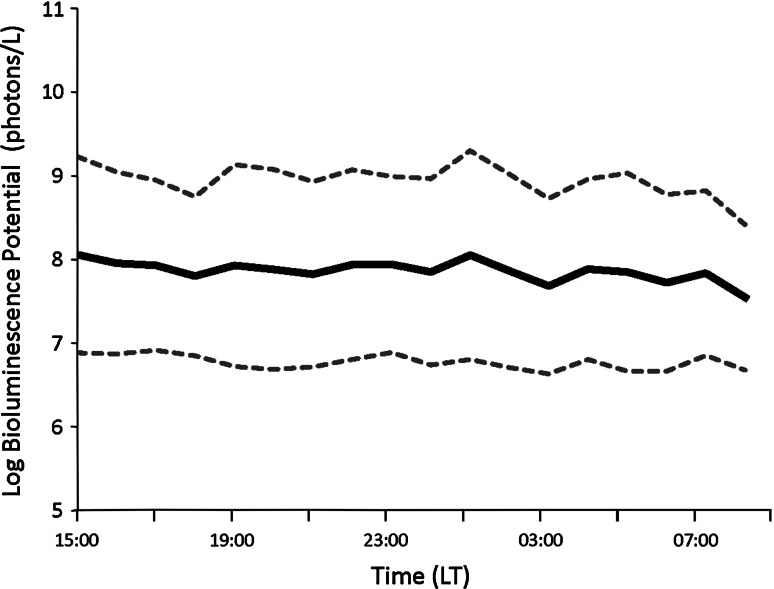
This study examines the composition and activity of the planktonic community during the polar night in the high Arctic Kongsfjord, Svalbard. Our results are the first published evidence of bioluminescence among zooplankton during the Arctic polar night. The observations were collected by a bathyphotometer detecting bioluminescence, integrated into an autonomous underwater vehicle, to determine the concentration and intensity of bioluminescent flashes as a function of time of day and depth. To further understand community dynamics and composition, plankton nets were used to collect organisms passing through the bathyphotometer along with traditional vertical net tows. Additionally, using a moored bathyphotometer closed to the sampling site, the bioluminescence potential itself was shown not to have a diurnal or circadian rhythm. Rather, our results provide evidence for a diel vertical migration of bioluminescent zooplankton that does not correspond to any externally detectable changes in illumination.
本研究调查了北极斯瓦尔巴群岛孔斯峡湾极夜期间浮游生物群落的组成和活动情况。我们的研究结果首次发表了北极极夜期间浮游动物生物发光现象的证据。观测数据由一台集成在自主水下航行器中的用于检测生物发光的深海光度计收集,以确定生物发光闪光的浓度和强度随时间和深度的变化情况。为了进一步了解群落动态和组成,使用浮游生物网收集通过深海光度计的生物,同时进行传统的垂直拖网采样。此外,在靠近采样点处使用一台系留式深海光度计,结果表明生物发光本身没有昼夜节律或昼夜生物钟节律。相反,我们的研究结果为生物发光浮游动物的昼夜垂直迁移提供了证据,这种迁移与任何外部可检测到的光照变化均不对应。