
2007 - 2010年参与津巴布韦国家抗逆转录病毒治疗项目的HIV感染患者的留存率、临床结局及与退出相关的因素
Patient retention, clinical outcomes and attrition-associated factors of HIV-infected patients enrolled in Zimbabwe's National Antiretroviral Therapy Programme, 2007-2010.
作者信息
Mutasa-Apollo Tsitsi, Shiraishi Ray W, Takarinda Kudakwashe C, Dzangare Janet, Mugurungi Owen, Murungu Joseph, Abdul-Quader Abu, Woodfill Celia J I
机构信息
AIDS and TB Department, Zimbabwe Ministry of Health and Child Care, Harare, Zimbabwe.
Division of Global HIV/AIDS, Center for Global Health, Centers for Disease Control and Prevention (CDC), Atlanta, Georgia, United States of America.
出版信息
PLoS One. 2014 Jan 29;9(1):e86305. doi: 10.1371/journal.pone.0086305. eCollection 2014.
BACKGROUND
Since establishment of Zimbabwe's National Antiretroviral Therapy (ART) Programme in 2004, ART provision has expanded from <5,000 to 369,431 adults by 2011. However, patient outcomes are unexplored.
OBJECTIVE
To determine improvement in health status, retention and factors associated with attrition among HIV-infected patients on ART.
METHODS
A retrospective review of abstracted patient records of adults ≥ 15 years who initiated ART from 2007 to 2009 was done. Frequencies and medians were calculated for rates of retention in care and changes in key health status outcomes at 6, 12, 24 and 36 months respectively. Cox proportional hazards models were used to determine factors associated with attrition.
RESULTS
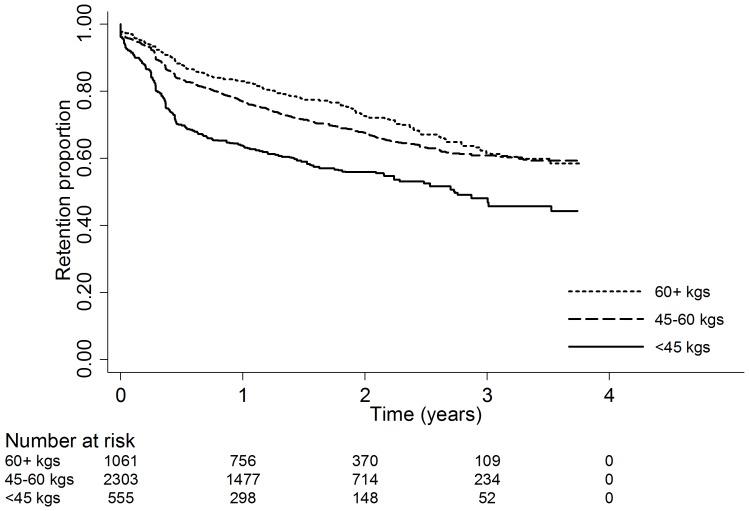
Of the 3,919 patients, 64% were female, 86% were either WHO clinical stage III or IV. Rates of patient retention at 6, 12, 24 and 36 months were 90.7%, 78.1%, 68.8% and 64.4%, respectively. After ART initiation, median weight gains at 6, 12, and 24 months were 3, 4.5, and 5.0 kgs whilst median CD4+ cell count gains at 6, 12 and 24 months were 122, 157 and 279 cells/µL respectively. Factors associated with an increased risk of attrition included male gender (AHR 1.2; 95% CI, 1.1-1.4), baseline WHO stage IV (AHR 1.7; 95% CI, 1.1-2.6), lower baseline body weight (AHR 2.0; 95% CI, 1.4-2. 8) and accessing care from higher level healthcare facilities (AHR 3.5; 95% 1.1-11.2).
CONCLUSIONS
Our findings with regard to retention as well as clinical and immunological improvements following uptake of ART, are similar to what has been found in other settings. Factors influencing attrition also mirror those found in other parts of sub-Saharan Africa. These findings suggest the need to strengthen earlier diagnosis and treatment to further improve treatment outcomes. Whilst decentralisation improves ART coverage it should be coupled with strategies aimed at improving patient retention.
背景
自2004年津巴布韦国家抗逆转录病毒治疗(ART)项目设立以来,接受抗逆转录病毒治疗的成年人数量已从不到5000人增加到2011年的369,431人。然而,患者的治疗效果尚未得到研究。
目的
确定接受抗逆转录病毒治疗的艾滋病毒感染患者的健康状况改善情况、治疗留存率以及与治疗中断相关的因素。
方法
对2007年至2009年开始接受抗逆转录病毒治疗的15岁及以上成年人的患者记录摘要进行回顾性分析。分别计算了6个月、12个月、24个月和36个月时的治疗留存率以及关键健康状况指标变化的频率和中位数。使用Cox比例风险模型确定与治疗中断相关的因素。
结果
在3919名患者中,64%为女性,86%处于世界卫生组织临床分期III期或IV期。6个月、12个月、24个月和36个月时的患者留存率分别为90.7%、78.1%、68.8%和64.4%。开始接受抗逆转录病毒治疗后,6个月、12个月和24个月时体重中位数增加分别为3千克、4.5千克和5.0千克,而6个月、12个月和24个月时CD4+细胞计数中位数增加分别为122个/微升、157个/微升和279个/微升。与治疗中断风险增加相关的因素包括男性(风险比1.2;95%置信区间,1.1 - 1.4)、基线世界卫生组织IV期(风险比1.7;95%置信区间,1.1 - 2.6)、较低的基线体重(风险比2.0;95%置信区间,1.4 - 2.8)以及从高级别医疗机构获取治疗(风险比3.5;95%置信区间,1.1 - 11.2)。
结论
我们关于治疗留存率以及接受抗逆转录病毒治疗后临床和免疫改善情况的研究结果与其他地区的情况相似。影响治疗中断的因素也与撒哈拉以南非洲其他地区的情况相符。这些结果表明需要加强早期诊断和治疗,以进一步改善治疗效果。虽然分散化提高了抗逆转录病毒治疗的覆盖率,但应辅之以旨在提高患者留存率的策略。

 Zotero 插件