Pollatos Olga, Laubrock Jochen, Wittmann Marc
Health Psychology, Institute of Psychology, University of Ulm, Ulm, Germany.
Department of Psychology, University of Potsdam, Potsdam, Germany.
PLoS One. 2014 Jan 29;9(1):e86934. doi: 10.1371/journal.pone.0086934. eCollection 2014.
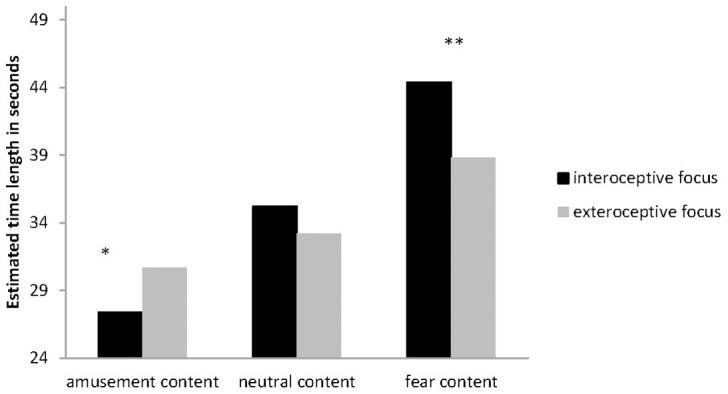
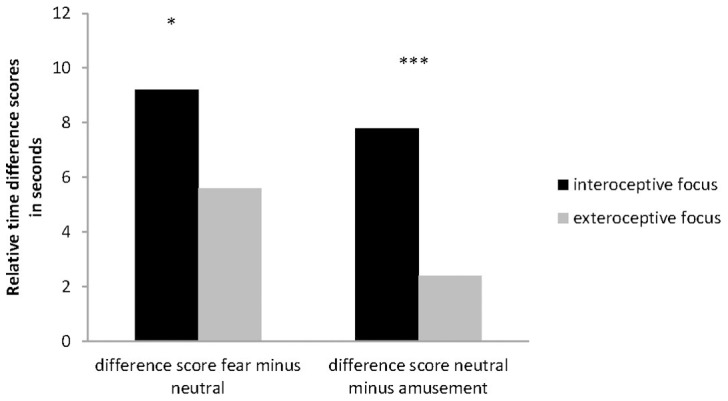
The perception of time is a fundamental part of human experience. Recent research suggests that the experience of time emerges from emotional and interoceptive (bodily) states as processed in the insular cortex. Whether there is an interaction between the conscious awareness of interoceptive states and time distortions induced by emotions has rarely been investigated so far. We aimed to address this question by the use of a retrospective time estimation task comparing two groups of participants. One group had a focus on interoceptive states and one had a focus on exteroceptive information while watching film clips depicting fear, amusement and neutral content. Main results were that attention to interoceptive processes significantly affected subjective time experience. Fear was accompanied with subjective time dilation that was more pronounced in the group with interoceptive focus, while amusement led to a quicker passage of time which was also increased by interoceptive focus. We conclude that retrospective temporal distortions are directly influenced by attention to bodily responses. These effects might crucially interact with arousal levels. Sympathetic nervous system activation affecting memory build-up might be the decisive factor influencing retrospective time judgments. Our data substantially extend former research findings underscoring the relevance of interoception for the effects of emotional states on subjective time experience.
对时间的感知是人类体验的一个基本组成部分。最近的研究表明,时间体验源自于脑岛皮质处理的情绪和内感受(身体)状态。到目前为止,内感受状态的意识觉知与情绪引起的时间扭曲之间是否存在相互作用,很少有人进行研究。我们旨在通过使用一项回顾性时间估计任务来比较两组参与者,以解决这个问题。一组关注内感受状态,另一组在观看描绘恐惧、娱乐和中性内容的电影片段时关注外感受信息。主要结果是,对内感受过程的关注显著影响主观时间体验。恐惧伴随着主观时间膨胀,在关注内感受的组中更为明显,而娱乐则导致时间流逝更快,这在内感受关注组中也有所增加。我们得出结论,回顾性时间扭曲直接受到对身体反应的关注的影响。这些效应可能与唤醒水平产生关键的相互作用。影响记忆形成的交感神经系统激活可能是影响回顾性时间判断的决定性因素。我们的数据极大地扩展了以前的研究结果,强调了内感受对于情绪状态对主观时间体验影响的相关性。