Hall Michael E, Rocco Michael V, Morgan Timothy M, Hamilton Craig A, Edwards Matthew S, Jordan Jennifer H, Hurie Justin B, Hundley W Gregory
Department of Medicine, Section on Cardiology, Wake Forest University School of Medicine, Winston-Salem, USA.
J Cardiovasc Magn Reson. 2014 Feb 3;16(1):17. doi: 10.1186/1532-429X-16-17.
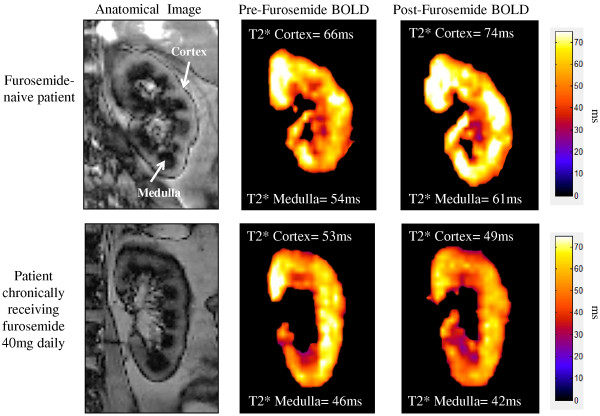
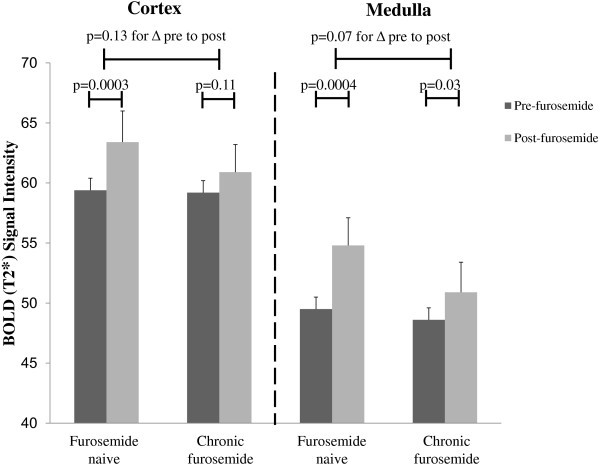
Blood Oxygen Level Dependent (BOLD) magnetic resonance (MR) is a novel imaging tool that detects changes in tissue oxygenation. Increases in renal oxygenation in response to a standard 20 mg intravenous furosemide stimulus have been evaluated to assess kidney viability in patients with renal artery stenosis (RAS). The effect of prior exposure to furosemide on the ability of BOLD MR techniques to evaluate renal function is unknown.This study tested the hypothesis that chronic loop diuretic therapy is associated with attenuated responses in renal tissue oxygenation as measured by BOLD MR with an acute 20 mg intravenous furosemide stimulus in participants undergoing evaluation for RAS.
Thirty-eight participants referred for evaluation of RAS were recruited for this study. We examined renal cortical and medullary BOLD signal (T2*) intensities before and after a 20 mg intravenous furosemide stimulus. Additionally, we measured changes in renal artery blood flow using phase contrast techniques.
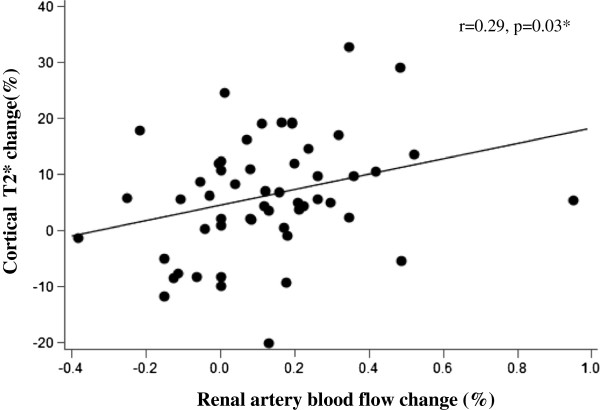
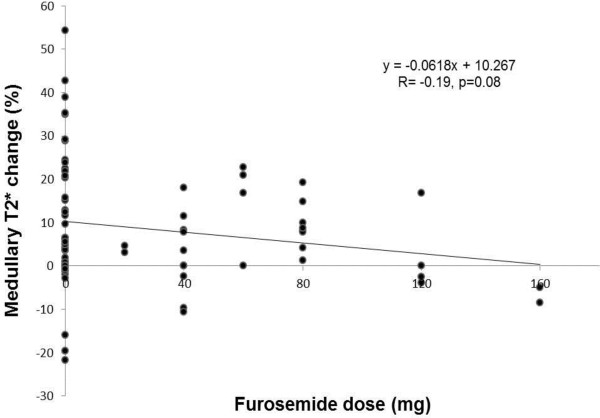
After controlling for covariates age, race, gender, diabetes, glomerular filtration rate, body mass index, and stenosis severity, daily oral furosemide dose was an independent, negative predictor of renal medullary T2* response (p=0.01) to a standard 20 mg intravenous furosemide stimulus. Stenosis severity and ethnicity were also significant independent predictors of changes in T2* signal intensity in response to an acute furosemide challenge. Changes in renal blood flow in response to acute furosemide administration were correlated with changes in T2* in the renal cortex (r=0.29, p=0.03) but not the medulla suggesting changes in renal medullary oxygenation were not due to reduced renal medullary blood flow.
Chronic furosemide therapy attenuates BOLD MR responses to an acute furosemide stimulus in patients with RAS being evaluated for renal artery revascularization procedures. Thus, patients who are chronically administered loop diuretics may need a different dosing strategy to accurately detect changes in renal oxygenation with BOLD MR in response to a furosemide stimulus.
血氧水平依赖(BOLD)磁共振(MR)是一种检测组织氧合变化的新型成像工具。已评估了静脉注射20mg标准速尿刺激后肾氧合增加情况,以评估肾动脉狭窄(RAS)患者的肾脏活力。速尿预先暴露对BOLD MR技术评估肾功能能力的影响尚不清楚。本研究检验了这样一个假设:在接受RAS评估的参与者中,慢性袢利尿剂治疗与通过BOLD MR测量的急性静脉注射20mg速尿刺激后肾组织氧合反应减弱有关。
招募了38名因RAS评估而转诊的参与者进行本研究。我们在静脉注射20mg速尿刺激前后检查了肾皮质和髓质的BOLD信号(T2*)强度。此外,我们使用相位对比技术测量了肾动脉血流的变化。
在控制了协变量年龄、种族、性别、糖尿病、肾小球滤过率、体重指数和狭窄严重程度后,每日口服速尿剂量是肾髓质T2对标准静脉注射20mg速尿刺激反应的独立负预测因子(p=0.01)。狭窄严重程度和种族也是急性速尿激发后T2信号强度变化的重要独立预测因子。急性速尿给药后肾血流的变化与肾皮质T2*的变化相关(r=0.29,p=0.03),但与髓质无关,这表明肾髓质氧合的变化不是由于肾髓质血流减少所致。
慢性速尿治疗会减弱接受肾动脉血运重建术评估的RAS患者对急性速尿刺激的BOLD MR反应。因此,长期服用袢利尿剂的患者可能需要不同的给药策略,以便在速尿刺激下用BOLD MR准确检测肾氧合的变化。