Zeng Yanmei, Li Chenzhong, Guan Meiping, Zheng Zongji, Li Jingjing, Xu Wenwei, Wang Ling, He Feiying, Xue Yaoming
Department of Endocrinology and Metabolism, Nanfang Hospital, Southern Medical University, Guangzhou 510150, China.
Cardiovasc Diabetol. 2014 Feb 4;13:32. doi: 10.1186/1475-2840-13-32.
The dipeptidyl peptidase-4 inhibitor sitagliptin, a new anti-diabetic medicine, is effective in treating type 2 diabetes mellitus by increasing the activation and duration of action of glucagon-like peptide-1. Since atherosclerosis is the main pathological feature of diabetic cardiovascular complications, it is important to investigate the anti-atherosclerotic effect of sitagliptin and explore the relevant mechanisms.
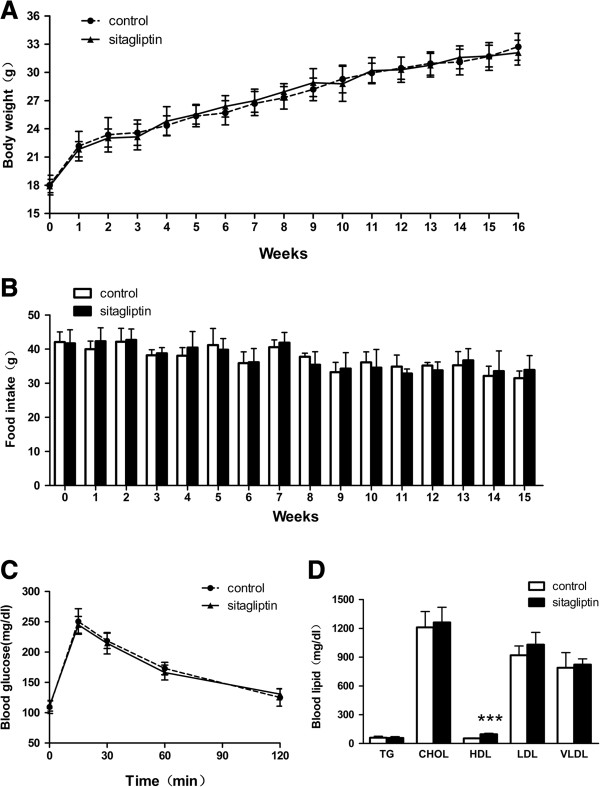
Male apolipoprotein-E-knockout mice were randomly divided into two groups and fed either high-fat diet (HFD) or HFD plus sitagliptin at a concentration of 0.3% for 16 weeks. Body weight, food intake, blood glucose, serum lipids and adhesion molecules were measured. The atherosclerotic plaque area and its histological composition were analyzed using Sudan staining and immunohistochemistry. The expression of inflammatory cytokines (monocyte chemoattractant protein (MCP)-1 and interleukin (IL)-6) and the activation of AMP-activated protein kinase (AMPK) and mitogen-activated protein kinase (MAPK) in the aortas were determined using quantitative polymerase chain reaction and western blot, respectively.
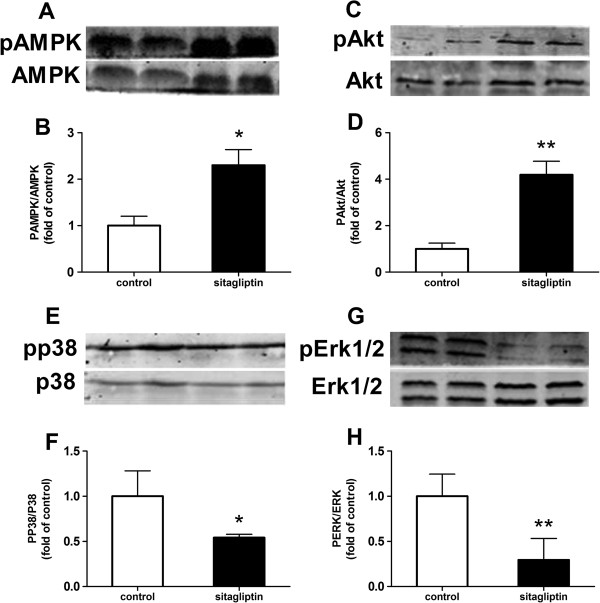
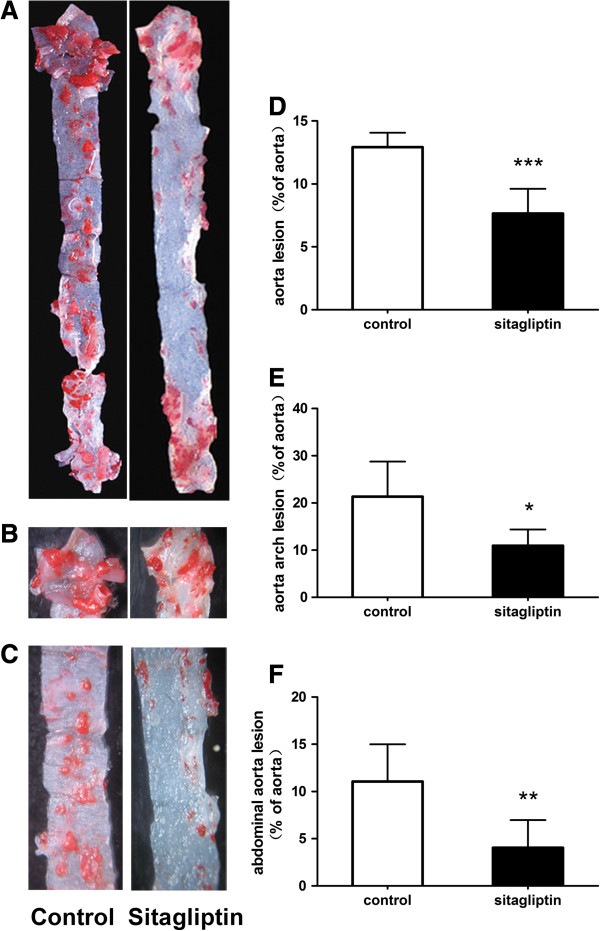
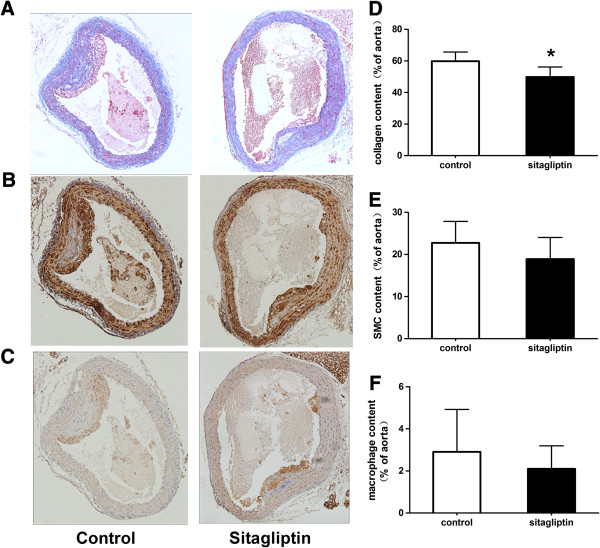
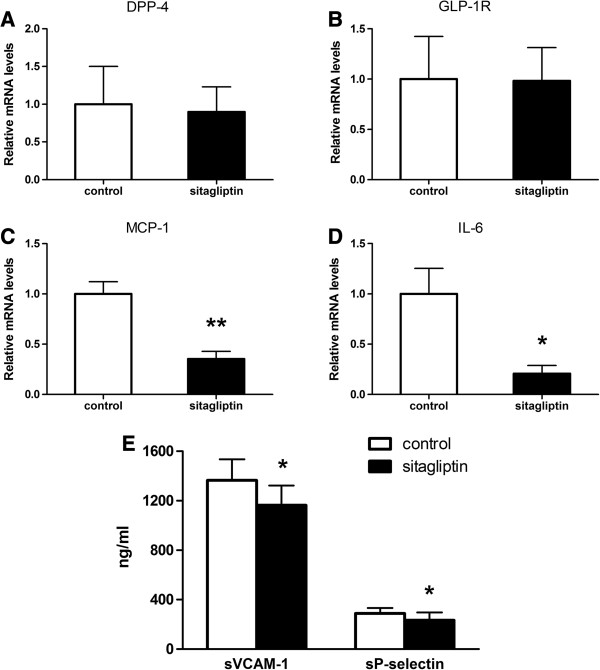
Mice treated with sitagliptin developed fewer atherosclerotic plaques than the control group (7.64 ± 1.98% vs 12.91 ± 1.15%, p < 0.001), particularly in the aortic arch and abdominal aorta, where plaques were decreased 1.92- and 2.74-fold, respectively (p < 0.05 and p < 0.01). Sitagliptin significantly reduced the content of collagen fiber in plaques 1.2-fold (p < 0.05). Moreover, sitagliptin significantly reduced the expression of monocyte chemoattractant protein-1 and interleukin-6 in the aorta (p < 0.01 and p < 0.05), as well as the serum levels of soluble vascular cell adhesion molecule-1 and P-selectin (both p < 0.05). In addition, Sitagliptin induced phosphorylation of AMPK and Akt (p < 0.05 and p < 0.01), while suppressed phosphorylation of p38 and extracellular signal-regulated kinase (Erk) 1/2 (p < 0.05 and p < 0.01) in aortas.
Our present study indicates that sitagliptin can reduce the area of the atherosclerotic lesion, possibly by regulating the AMPK and MAPK pathways and then reducing leukocyte -endothelial cell interaction and inflammation reactions. These actions are independent of weight loss and glucose-reducing effects.
二肽基肽酶-4抑制剂西他列汀是一种新型抗糖尿病药物,通过增加胰高血糖素样肽-1的活性和作用持续时间来有效治疗2型糖尿病。由于动脉粥样硬化是糖尿病心血管并发症的主要病理特征,因此研究西他列汀的抗动脉粥样硬化作用并探索相关机制具有重要意义。
将雄性载脂蛋白E基因敲除小鼠随机分为两组,分别给予高脂饮食(HFD)或添加浓度为0.3%西他列汀的高脂饮食,持续16周。测量体重、食物摄入量、血糖、血脂和黏附分子。使用苏丹染色和免疫组织化学分析动脉粥样硬化斑块面积及其组织学组成。分别使用定量聚合酶链反应和蛋白质印迹法测定主动脉中炎性细胞因子(单核细胞趋化蛋白(MCP)-1和白细胞介素(IL)-6)的表达以及AMP活化蛋白激酶(AMPK)和丝裂原活化蛋白激酶(MAPK)的活性。
与对照组相比,接受西他列汀治疗的小鼠动脉粥样硬化斑块更少(7.64±1.98%对12.91±1.15%,p<0.001),特别是在主动脉弓和腹主动脉,斑块分别减少了1.92倍和2.74倍(p<0.05和p<0.01)。西他列汀使斑块中胶原纤维含量显著降低1.2倍(p<0.05)。此外,西他列汀显著降低主动脉中单核细胞趋化蛋白-1和白细胞介素-6的表达(p<0.01和p<0.05),以及血清中可溶性血管细胞黏附分子-1和P-选择素的水平(均为p<0.05)。此外,西他列汀诱导主动脉中AMPK和Akt的磷酸化(p<0.05和p<0.01),同时抑制p38和细胞外信号调节激酶(Erk)1/2的磷酸化(p<0.05和p<0.01)。
我们目前的研究表明,西他列汀可以减少动脉粥样硬化病变面积,可能是通过调节AMPK和MAPK途径,进而减少白细胞与内皮细胞的相互作用和炎症反应。这些作用独立于体重减轻和降糖作用。