Jørgensen Rikke, Munk-Jørgensen Povl, Lysaker Paul H, Buck Kelly D, Hansson Lars, Zoffmann Vibeke
Unit for Psychiatric Research, Aalborg Psychiatric Hospital, Aalborg University Hospital, Mølleparkvej 10, 9000 Aalborg, Denmark.
BMC Psychiatry. 2014 Feb 3;14:28. doi: 10.1186/1471-244X-14-28.
Recruitment is one of the most serious challenges in performing randomized controlled trials. Often clinical trials with participants diagnosed with schizophrenia are terminated prematurely because of recruitment challenges resulting in a considerable waste of resources in the form of time, funding, and the participants' efforts. Dropout rates in schizophrenia trials are also high.Recruitment challenges are often due to patients not wanting to participate in research but can also be due to clinicians' concerns regarding individuals diagnosed with schizophrenia as participants in research. This paper reports how overcoming recruitment challenges not related to patients revealed high readiness to take part and low dropout rates in a one year long randomized controlled trial testing Guided Self-Determination (GSD) among outpatients with schizophrenia receiving treatment in Assertive Outreach Teams in the northern part of Denmark.
GSD is a shared decision-making and mutual problem-solving method using reflection sheets, which was developed in diabetes care and adjusted for this study and utilized by patients with schizophrenia. Descriptive data on strategies to overcome recruitment challenges were derived from notes and observations made during the randomized controlled trial testing of GSD in six outpatient teams.
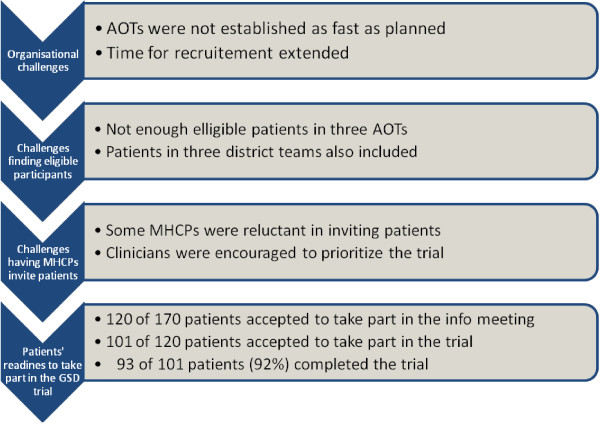
Three types of recruitment challenges not related to patients were identified and met during the trial: 1) organizational challenges, 2) challenges with finding eligible participants and 3) challenges with having professionals invite patients to participate. These challenges were overcome through: 1) extension of time, 2) expansion of the clinical recruitment area and 3) encouragement of professionals to invite patients to the study. Through overcoming these challenges, we identified a remarkably high patient-readiness to take part (101 of 120 asked accepted) and a low dropout rate (8%).
Distinction between recruitment challenges was important in discovering the readiness among patients with schizophrenia to take part in and complete a trial with the GSD-intervention.
招募是进行随机对照试验时最严峻的挑战之一。通常,针对被诊断为精神分裂症患者的临床试验会因招募困难而提前终止,这导致时间、资金以及参与者的努力等资源的大量浪费。精神分裂症试验中的脱落率也很高。招募困难往往是因为患者不想参与研究,但也可能是由于临床医生对被诊断为精神分裂症的个体参与研究存在顾虑。本文报告了在丹麦北部积极外展团队中接受治疗的精神分裂症门诊患者中,一项为期一年的测试引导式自我决定(GSD)的随机对照试验如何克服与患者无关的招募挑战,从而发现患者参与意愿高且脱落率低的情况。
GSD是一种使用反思表的共同决策和共同解决问题的方法,该方法最初在糖尿病护理中开发,本研究对其进行了调整并供精神分裂症患者使用。关于克服招募挑战策略的描述性数据来自在六个门诊团队对GSD进行随机对照试验测试期间所做的记录和观察。
在试验期间识别并应对了三种与患者无关的招募挑战:1)组织方面的挑战,2)寻找符合条件参与者的挑战,3)让专业人员邀请患者参与的挑战。通过以下方式克服了这些挑战:1)延长时间,2)扩大临床招募区域,3)鼓励专业人员邀请患者参与研究。通过克服这些挑战,我们发现患者参与意愿非常高(120名被邀请者中有101名接受邀请)且脱落率低(8%)。
区分招募挑战对于发现精神分裂症患者参与并完成GSD干预试验的意愿很重要。