Sanders Alison P, Miller Sloane K, Nguyen Viet, Kotch Jonathan B, Fry Rebecca C
Department of Environmental Sciences and Engineering, Gillings School of Global Public Health, University of North Carolina - Chapel Hill, Chapel Hill, North Carolina, USA.
BMC Public Health. 2014 Feb 4;14:114. doi: 10.1186/1471-2458-14-114.
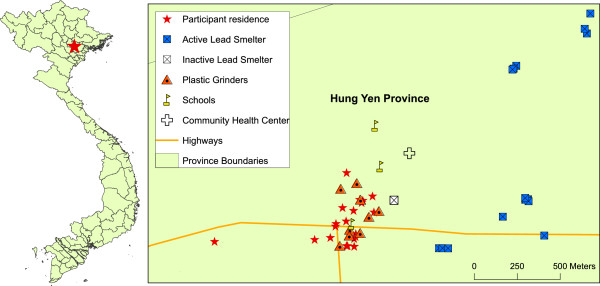
In Vietnam, environmental pollution caused by small-scale domestic smelting of automobile batteries into lead ingot is a growing concern. The village of Nghia Lo is a smelting craft village located roughly 25 km southeast of Hanoi in the Red River Delta. Despite the concern of toxic metal exposure in the village, biomonitoring among susceptible populations, such as children, has not been previously conducted. The aim of this study was to determine the body burden of toxic metals in children residing in a smelting craft village.
Twenty children from Nghia Lo, Vietnam, ages 18 months to four years were selected for capillary whole blood and toenail biomonitoring. Whole blood lead levels (BLLs) were measured using a portable lead analyzer, and toenail levels of arsenic, cadmium, chromium, lead, manganese, and mercury were analyzed with inductively coupled plasma-mass spectrometry.
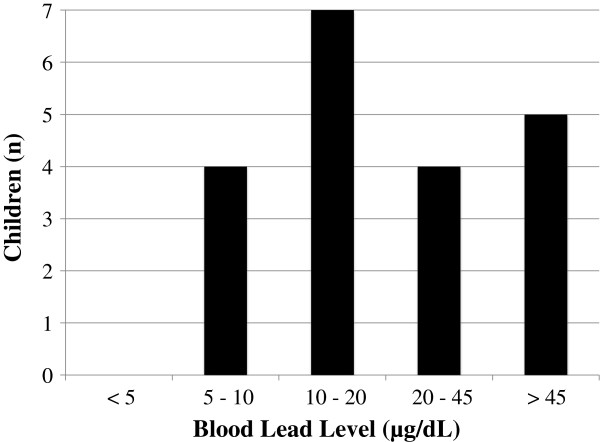
The findings show that all of the 20 children had detectable BLLs, and every child had levels that exceeded the Centers for Disease Control and Prevention guideline level of 5 μg/dL. Eighty percent of tested subjects had BLLs higher than 10 μg/dL. Five children (25%) had BLLs greater than 45 μg/dL, the level of recommended medical intervention. In addition to blood lead, all of the children had detectable levels of arsenic, cadmium, chromium, lead, manganese, and mercury in toenail samples. Notably, average toenail lead, manganese, and mercury levels were 157 μg/g, 7.41 μg/g, and 2.63 μg/g respectively, well above levels previously reported in children. Significant Spearman's rank correlations showed that there were relationships between blood and toenail lead levels (r = 0.65, p < 0.05), toenail levels of lead and cadmium (r = 0.66, p < 0.05), and toenail levels of manganese and chromium (r = 0.72, p < 0.001). Linear regression showed that reducing the distance to the nearest active smelter by half was associated with a 116% increase in BLL (p < 0.05).
The results suggest that children in battery recycling and smelting craft villages in Vietnam are co-exposed to toxic metals. There is an urgent need for mitigation to control metal exposure related to domestic smelting.
在越南,小规模家庭将汽车电池冶炼成铅锭所造成的环境污染问题日益受到关注。义路村是一个位于红河三角洲、河内东南约25公里处的冶炼工艺村。尽管该村存在有毒金属暴露的问题,但此前尚未对儿童等易感人群进行生物监测。本研究的目的是确定居住在冶炼工艺村的儿童体内有毒金属的负荷量。
选取了20名年龄在18个月至4岁之间、来自越南义路村的儿童进行毛细血管全血和趾甲生物监测。使用便携式铅分析仪测量全血铅水平(BLLs),并采用电感耦合等离子体质谱法分析趾甲中的砷、镉、铬、铅、锰和汞含量。
研究结果显示,20名儿童的BLLs均可检测到,且每个儿童的水平都超过了美国疾病控制与预防中心5μg/dL的指导水平。80%的受试对象BLLs高于10μg/dL。5名儿童(25%)的BLLs大于45μg/dL,这是推荐进行医学干预的水平。除血铅外,所有儿童趾甲样本中的砷、镉、铬、铅、锰和汞含量均可检测到。值得注意的是,趾甲中铅、锰和汞的平均含量分别为157μg/g、7.41μg/g和2.63μg/g,远高于此前报道的儿童水平。显著的斯皮尔曼等级相关性表明,血铅与趾甲铅水平之间(r = 0.65,p < 0.05)、趾甲铅与镉水平之间(r = 0.66,p < 0.05)以及趾甲锰与铬水平之间(r = 0.72,p < 0.001)均存在关联。线性回归显示,将与最近的活跃冶炼厂的距离减半与BLL增加116%相关(p < 0.05)。
结果表明,越南电池回收和冶炼工艺村的儿童同时暴露于多种有毒金属。迫切需要采取缓解措施来控制与家庭冶炼相关的金属暴露。