
真核生物中人类蛋白质串联重复的深度保守性。
Deep conservation of human protein tandem repeats within the eukaryotes.
机构信息
Department of Computer Science, ETH Zürich, Zürich, Switzerland.
出版信息
Mol Biol Evol. 2014 May;31(5):1132-48. doi: 10.1093/molbev/msu062. Epub 2014 Feb 3.
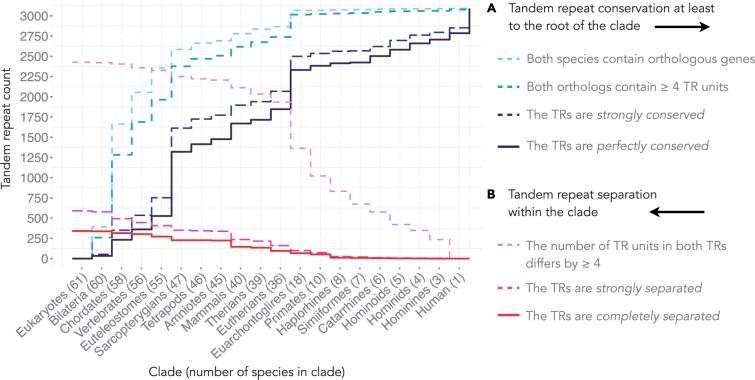
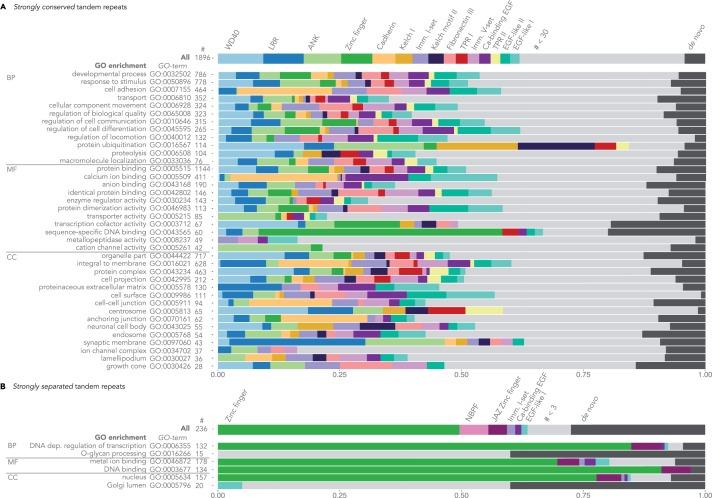
Tandem repeats (TRs) are a major element of protein sequences in all domains of life. They are particularly abundant in mammals, where by conservative estimates one in three proteins contain a TR. High generation-scale duplication and deletion rates were reported for nucleic TR units. However, it is not known whether protein TR units can also be frequently lost or gained providing a source of variation for rapid adaptation of protein function, or alternatively, tend to have conserved TR unit configurations over long evolutionary times. To obtain a systematic picture, we performed a proteome-wide analysis of the mode of evolution for human protein TRs. For this purpose, we propose a novel method for the detection of orthologous TRs based on circular profile hidden Markov models. For all detected TRs, we reconstructed bispecies TR unit phylogenies across 61 eukaryotes ranging from human to yeast. Moreover, we performed additional analyses to correlate functional and structural annotations of human TRs with their mode of evolution. Surprisingly, we find that the vast majority of human TRs are ancient, with TR unit number and order preserved intact since distant speciation events. For example, ≥ 61% of all human TRs have been strongly conserved at least since the root of all mammals, approximately 300 Ma. Further, we find no human protein TR that shows evidence for strong recent duplications and deletions. The results are in contrast to the high generation-scale mutability of nucleic TRs. Presumably, most protein TRs fold into stable and conserved structures that are indispensable for the function of the TR-containing protein. All of our data and results are available for download from http://www.atgc-montpellier.fr/TRE.
串联重复(TRs)是所有生命领域的蛋白质序列中的主要元素。它们在哺乳动物中尤其丰富,据保守估计,三分之一的蛋白质含有 TR。核酸 TR 单元的高代际复制和缺失率已经有报道。然而,尚不清楚蛋白质 TR 单元是否也可以频繁丢失或获得,从而为蛋白质功能的快速适应提供变异来源,或者是否在长的进化时间内倾向于具有保守的 TR 单元配置。为了获得系统的图片,我们对人类蛋白质 TR 的进化模式进行了全蛋白质组分析。为此,我们提出了一种基于循环轮廓隐马尔可夫模型的同源 TR 检测的新方法。对于所有检测到的 TR,我们在跨越 61 种真核生物(从人类到酵母)的双物种 TR 单元系统发育中进行了重建。此外,我们还进行了额外的分析,将人类 TR 的功能和结构注释与它们的进化模式相关联。令人惊讶的是,我们发现绝大多数人类 TR 都是古老的,自远缘物种分化事件以来,TR 单元数量和顺序保持完整。例如,≥61%的所有人类 TR 自所有哺乳动物的根部以来至少被强烈保守,大约 300 Ma。此外,我们没有发现任何人类蛋白质 TR 显示出强烈的近期重复和缺失的证据。这些结果与核酸 TR 的高代际可变性形成对比。据推测,大多数蛋白质 TR 折叠成稳定和保守的结构,这对于含有 TR 的蛋白质的功能是不可或缺的。我们所有的数据和结果都可以从 http://www.atgc-montpellier.fr/TRE 下载。


 Zotero 插件