Mekelle University, College of Health Science, Department of Public Health, Mekelle, Ethiopia.
PLoS One. 2014 Jan 31;9(1):e87392. doi: 10.1371/journal.pone.0087392. eCollection 2014.
Since launching of antiretroviral (ART) treatment, the numbers of patients enrolled in to ART are increasing in many developing countries. But many studies done across Africa including Ethiopia on antiretroviral therapy programs have shown higher mortality at the first six months of treatment initiation. But the factors associated with this high mortality are poorly characterized. So this study aims to determine mortality and identify predictors of it among patients on ART.
Retrospective cohort study was employed among a total of 520 records of patients who were enrolled on antiretroviral therapy in Aksum hospital from September 2006 to August 2011. Baseline patient records were extracted from electronic and paper based medical records database and analysed using Kaplan Meier survival and Cox proportional hazard model to identify the independent predictors of mortality of patients on ART.
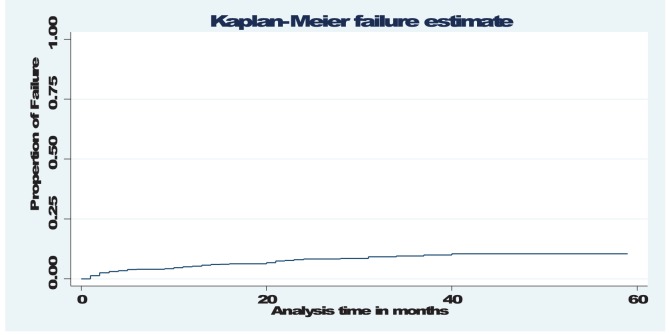
A total of 46 (8.85%) deaths was observed giving an overall mortality rate of 3.2 per 100 person-years. The independent predictor of mortality identified for this cohort were haemoglobin level <11 mg/dl (Hazard Ratio (HR) = 1.9, 95%-CI = 1.01, 3.52), CD4 cell counts lower than 50 cells/µl (HR = 2.1, 95%- CI = 1.13,3.89), Male gender (HR = 1.9, 95%-CI = 1.01,3.52), Weight <40 kg (HR = 2.3,95% CI = 1.24,4.55), primary level of education and lower (HR = 2.6, 95%- CI = 1.29,5.55).
The over all mortality of adults patients on ART was low but higher in the early months of ART initiation. low levels of haemoglobin <11 gm/dl, lower CD4 cell count, male gender, weight <40 Kg and individuals who have primary level of education and lower were identified as the independent predictors of mortality. For this reason, early initiation of ART despite the CD4 count and method of HIV diagnosis, nutritional support and close monitoring of patients in the early periods of ART treatment initiation is very crucial to improve patient survival.
自启动抗逆转录病毒(ART)治疗以来,许多发展中国家接受 ART 治疗的患者人数不断增加。但在包括埃塞俄比亚在内的非洲各地进行的许多抗逆转录病毒治疗方案研究表明,在开始治疗的头六个月死亡率较高。但是,与这种高死亡率相关的因素描述得很差。因此,本研究旨在确定接受 ART 治疗的患者的死亡率,并确定其预测因素。
采用回顾性队列研究,共纳入 2006 年 9 月至 2011 年 8 月在阿克苏医院接受抗逆转录病毒治疗的 520 例患者的记录。从电子和纸质病历数据库中提取基线患者记录,并使用 Kaplan-Meier 生存分析和 Cox 比例风险模型进行分析,以确定 ART 患者死亡率的独立预测因素。
共观察到 46 例(8.85%)死亡,总死亡率为每 100 人年 3.2 例。确定该队列的死亡率的独立预测因素是血红蛋白水平<11mg/dl(危险比(HR)=1.9,95%-CI=1.01,3.52),CD4 细胞计数低于 50 个/μl(HR=2.1,95%-CI=1.13,3.89),男性(HR=1.9,95%-CI=1.01,3.52),体重<40kg(HR=2.3,95%-CI=1.24,4.55),受教育程度较低(HR=2.6,95%-CI=1.29,5.55)。
接受 ART 治疗的成年患者的总体死亡率较低,但在 ART 开始后的早期几个月较高。较低的血红蛋白水平<11gm/dl、较低的 CD4 细胞计数、男性、体重<40kg 以及受教育程度较低的个体被确定为死亡率的独立预测因素。因此,尽管 CD4 计数和 HIV 诊断方法不同,但在开始 ART 治疗早期启动 ART,以及在治疗早期为患者提供营养支持和密切监测,对于提高患者生存率非常重要。