Reks Sarah E, McIlvain Vera, Zhuo Xinming, Knox Barry E
Departments of Neuroscience & Physiology, Ophthalmology and Biochemistry & Molecular Biology, State University of New York Upstate Medical University, Syracuse, NY 13210, USA.
BMC Mol Biol. 2014 Feb 6;15:4. doi: 10.1186/1471-2199-15-4.
In vertebrates, rod photoreceptor-specific gene expression is regulated by the large Maf and Pax-like transcription factors, Nrl/LNrl and Crx/Otx5. The ubiquitous occurrence of their target DNA binding sites throughout rod-specific gene promoters suggests that multiple transcription factor interactions within the promoter are functionally important. Cooperative action by these transcription factors activates rod-specific genes such as rhodopsin. However, a quantitative mechanistic explanation of transcriptional rate determinants is lacking.
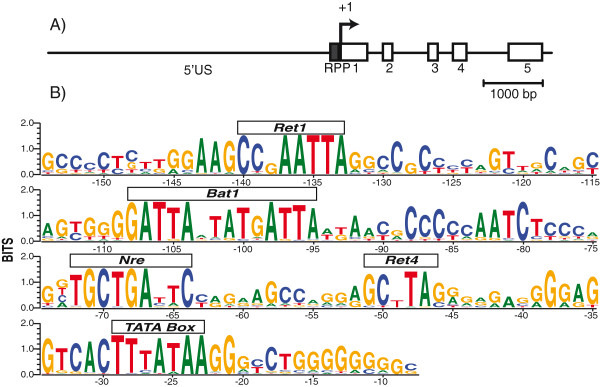
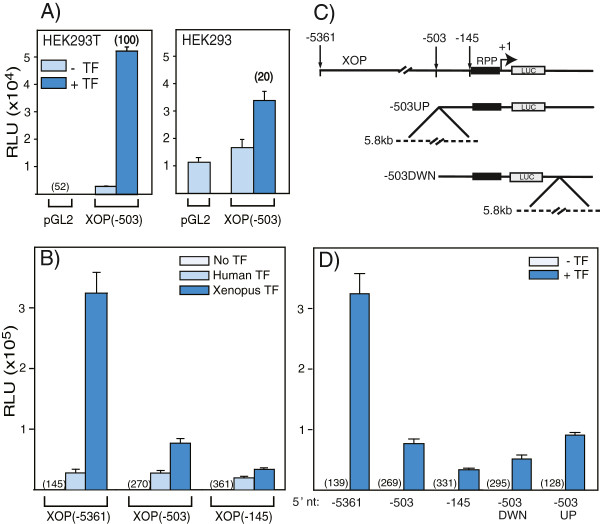
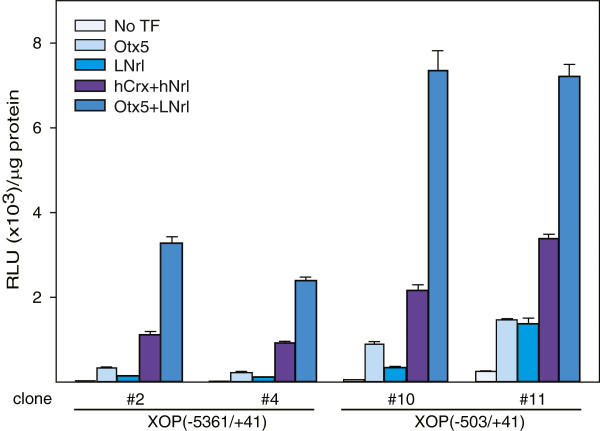
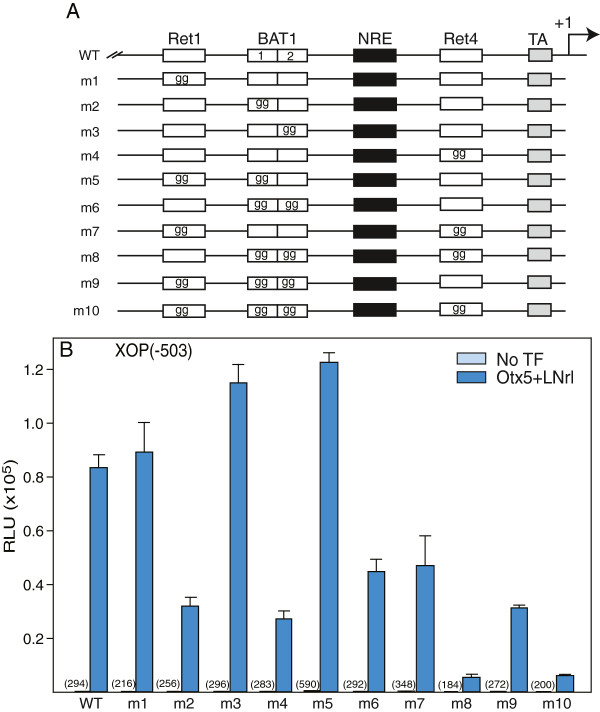
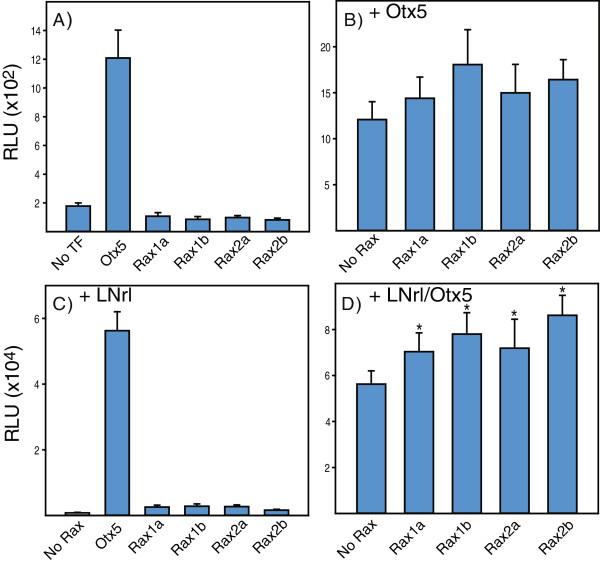
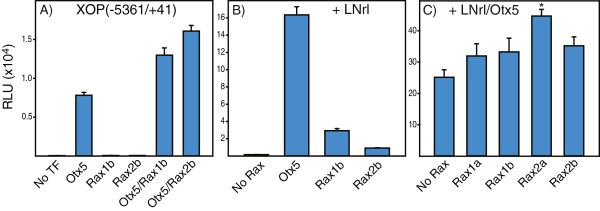
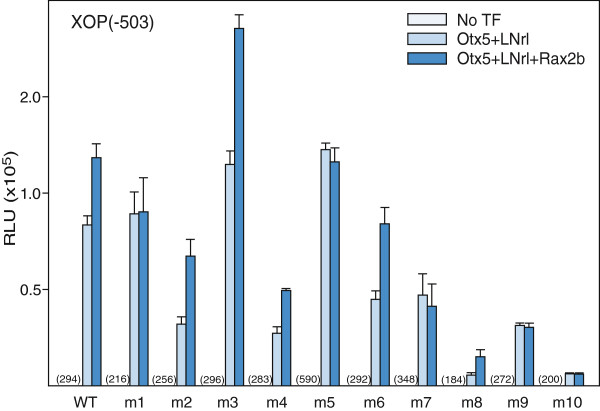
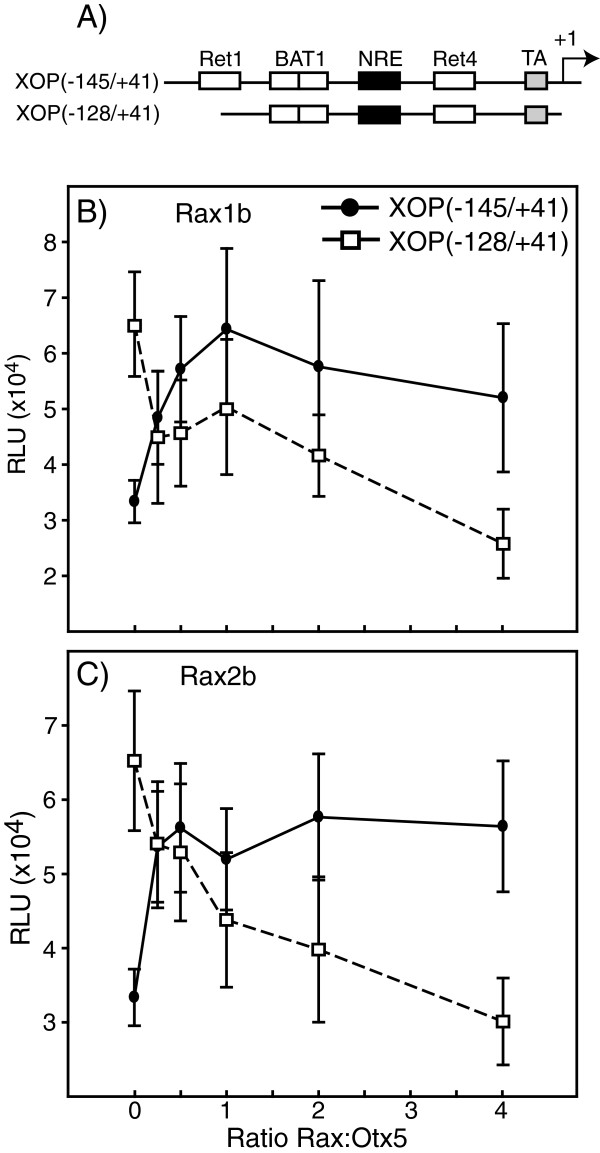
We investigated the contributions of various paired-like transcription factors and their cognate cis-elements to rhodopsin gene activation using cultured cells to quantify activity. The Xenopus rhodopsin promoter (XOP) has a bipartite structure, with ~200 bp proximal to the start site (RPP) coordinating cooperative activation by Nrl/LNrl-Crx/Otx5 and the adjacent 5300 bp upstream sequence increasing the overall expression level. The synergistic activation by Nrl/LNrl-Crx/Otx5 also occurred when XOP was stably integrated into the genome. We determined that Crx/Otx5 synergistically activated transcription independently and additively through the two Pax-like cis-elements, BAT1 and Ret4, but not through Ret1. Other Pax-like family members, Rax1 and Rax2, do not synergistically activate XOP transcription with Nrl/LNrl and/or Crx/Otx5; rather they act as co-activators via the Ret1 cis-element.
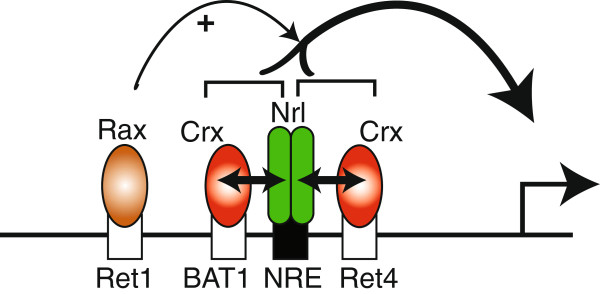
We have provided a quantitative model of cooperative transcriptional activation of the rhodopsin promoter through interaction of Crx/Otx5 with Nrl/LNrl at two paired-like cis-elements proximal to the NRE and TATA binding site. Further, we have shown that Rax genes act in cooperation with Crx/Otx5 with Nrl/LNrl as co-activators of rhodopsin transcription.
在脊椎动物中,视杆光感受器特异性基因的表达受大型Maf和类Pax转录因子Nrl/LNrl以及Crx/Otx5调控。它们的靶DNA结合位点普遍存在于整个视杆特异性基因启动子中,这表明启动子内多种转录因子相互作用在功能上很重要。这些转录因子的协同作用可激活视杆特异性基因,如视紫红质。然而,目前缺乏对转录速率决定因素的定量机制解释。
我们利用培养细胞来量化活性,研究了各种成对的转录因子及其同源顺式元件对视紫红质基因激活的贡献。非洲爪蟾视紫红质启动子(XOP)具有二分结构,起始位点近端约200bp的区域(RPP)协调Nrl/LNrl-Crx/Otx5的协同激活,而相邻的上游5300bp序列可提高整体表达水平。当XOP稳定整合到基因组中时,Nrl/LNrl-Crx/Otx5也会发生协同激活。我们确定Crx/Otx5通过两个类Pax顺式元件BAT1和Ret4独立且累加地协同激活转录,但不通过Ret1。其他类Pax家族成员Rax1和Rax2不会与Nrl/LNrl和/或Crx/Otx5协同激活XOP转录;相反,它们通过Ret1顺式元件作为共激活因子发挥作用。
我们通过Crx/Otx5与Nrl/LNrl在靠近NRE和TATA结合位点的两个成对顺式元件处的相互作用,提供了视紫红质启动子协同转录激活的定量模型。此外,我们还表明Rax基因与Crx/Otx5协同作用,Nrl/LNrl作为视紫红质转录的共激活因子。