Department of Ecology and Evolutionary Biology, Cornell University, Ithaca, NY 14853, USA.
Evodevo. 2014 Feb 5;5(1):7. doi: 10.1186/2041-9139-5-7.
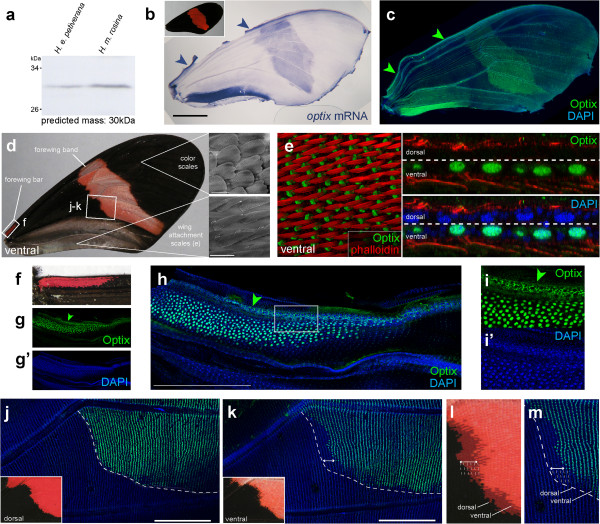
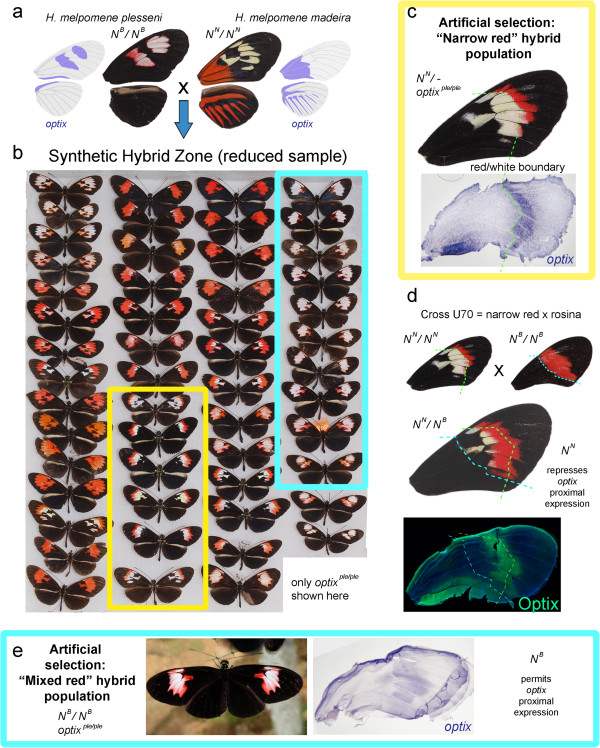
While the ecological factors that drive phenotypic radiations are often well understood, less is known about the generative mechanisms that cause the emergence and subsequent diversification of novel features. Heliconius butterflies display an extraordinary diversity of wing patterns due in part to mimicry and sexual selection. Identifying the genetic drivers of this crucible of evolution is now within reach, as it was recently shown that cis-regulatory variation of the optix transcription factor explains red pattern differences in the adaptive radiations of the Heliconius melpomene and Heliconius erato species groups.
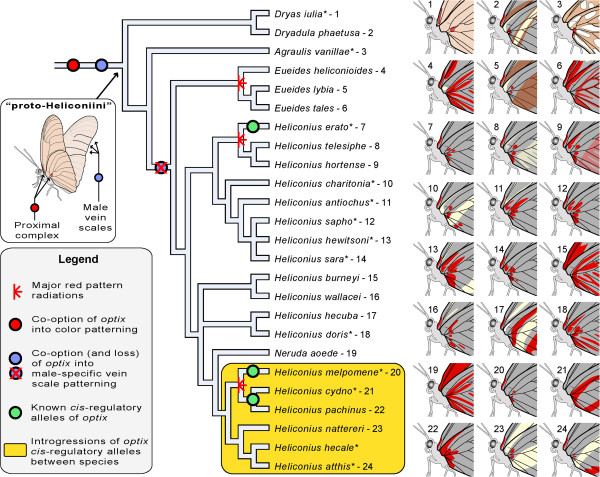
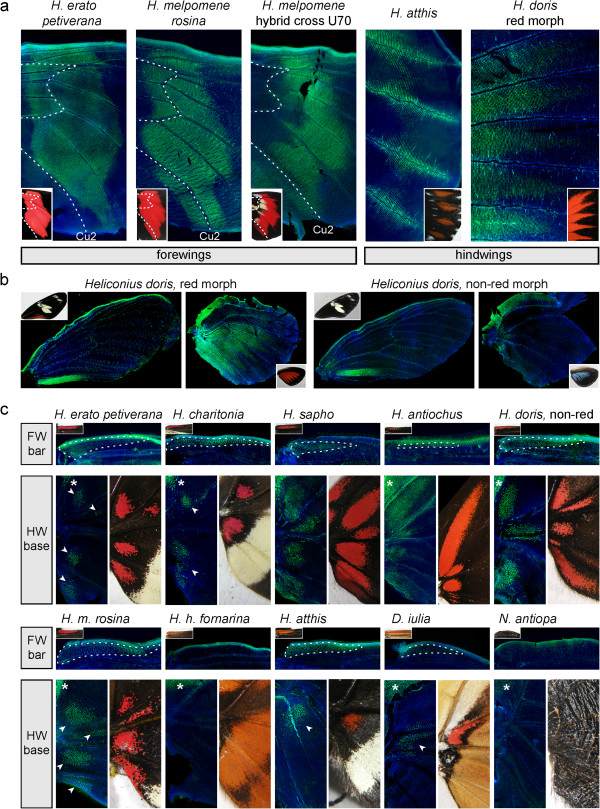
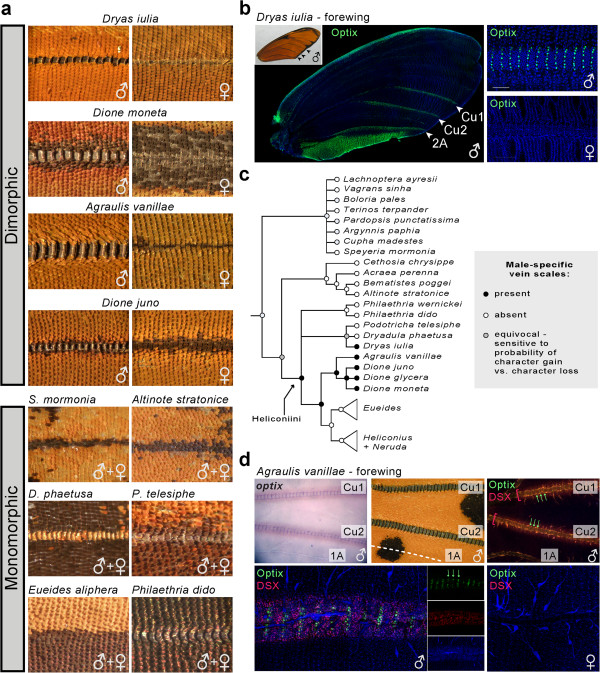
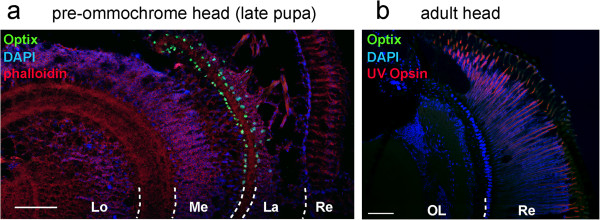
Here, we compare the developmental expression of the Optix protein across a large phylogenetic sample of butterflies and infer that its color patterning role originated at the base of the neotropical passion-vine butterfly clade (Lepidoptera, Nymphalidae, Tribe: Heliconiini), shortly predating multiple Optix-driven wing pattern radiations in the speciose Heliconius and Eueides genera. We also characterize novel Optix and Doublesex expression in the male-specific pheromone wing scales of the basal heliconiines Dryas and Agraulis, thus illustrating that within the Heliconinii lineage, Optix has been evolutionarily redeployed in multiple contexts in association with diverse wing features.
Our findings reveal that the repeated co-option of Optix into various aspects of wing scale specification was associated with multiple evolutionary novelties over a relatively short evolutionary time scale. In particular, the recruitment of Optix expression in colored scale cell precursors was a necessary condition to the explosive diversification of passion-vine butterfly wing patterns. The novel deployment of a gene followed by spatial modulation of its expression in a given cell type could be a common mode of developmental innovation for triggering phenotypic radiations.
虽然推动表型辐射的生态因素通常被很好地理解,但对于导致新特征出现和随后多样化的生成机制知之甚少。由于拟态和性选择,海伦娜蝴蝶的翅膀图案表现出非凡的多样性。由于最近表明,Optix 转录因子的顺式调控变异解释了 Heliconius melpomene 和 Heliconius erato 物种组的适应性辐射中的红色图案差异,因此识别这个进化的关键因素现在已成为可能。
在这里,我们比较了 Optix 蛋白在蝴蝶大系统发育样本中的发育表达,并推断其颜色图案作用起源于新热带攀缘植物蝴蝶(鳞翅目,蛱蝶科,族:Heliconiini)的基础,这发生在多种 Optix 驱动的翅膀图案辐射之前在多产的 Heliconius 和 Eueides 属中。我们还在基础的 heliconiines Dryas 和 Agraulis 的雄性特有的信息素翅膀鳞片中对新的 Optix 和 Doublesex 表达进行了特征描述,从而说明了在 Heliconiini 谱系中,Optix 已经在与各种翅膀特征相关的多种背景下被重新用于进化。
我们的研究结果揭示了 Optix 多次被共同用于翅膀鳞片特化的各个方面,这与相对较短的进化时间尺度内的多种进化新颖性有关。特别是,Optix 表达在有色鳞片细胞前体中的募集是 passion-vine 蝴蝶翅膀图案爆炸式多样化的必要条件。一个基因的新部署及其在特定细胞类型中的空间调节表达可能是引发表型辐射的发育创新的常见模式。