Kaska Lukasz, Proczko Monika, Stefaniak Tomasz, Kobiela Jarek, Sledziński Zbigniew
Department of General, Endocrine and Transplant Surgery, Medical University of Gdansk, Gdansk, Poland.
Wideochir Inne Tech Maloinwazyjne. 2013 Dec;8(4):289-300. doi: 10.5114/wiitm.2011.34797. Epub 2013 May 7.
In recent years, laparoscopic sleeve gastrectomy (LSG) is becoming increasingly popular. The quite simple technique, lack of anastomoses, fully stapling course of the resection and the laparoscopic approach influence the attractiveness of the procedure from the surgeon's perspective. Though the feasibility of LSG is appreciated, the range of complications seems to be considerable.
To prospectively evaluate modification of the bariatric process in LSG patients.
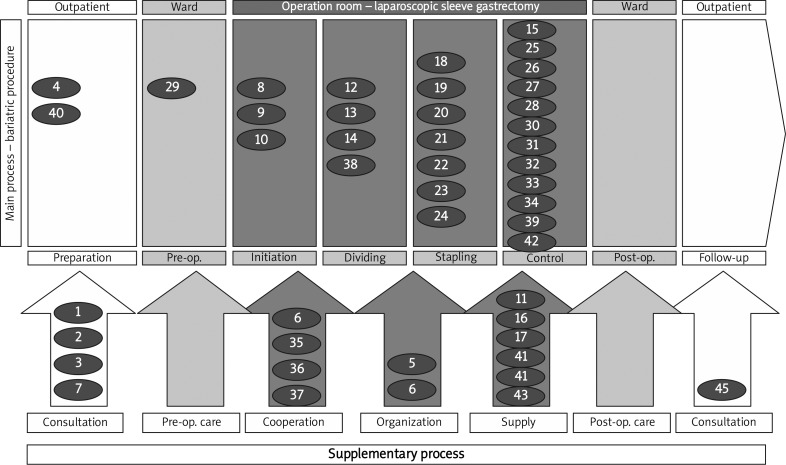
The initial results of the first series of LSG patients (G1) were unacceptable and led to redefinition, based on risk analysis, of the entire bariatric process. A number of corrective and preventive actions were implemented into the process. The impact of innovations on the outcomes of the next 100 LSGs (G2) was assessed. Complications, intraoperative difficulties and postoperative adverse events were registered.
The total complication rate of the G1 group was 32% (8/25 patients). When several corrective and preventive actions were implemented in the subsequent process, there were no postoperative complications observed in the G2 group. Sixteen intraoperative difficulties were encountered in group G2 but resolved intraoperatively and did not affect the postoperative course.
The systemic approach to the LSG procedure by innovating the entire process significantly reduced the rate of complications. The 'learning curve' should not be limited only to the manual operative training. Preventive actions based on risk analysis should be considered as the core component in redesigning the process.
近年来,腹腔镜袖状胃切除术(LSG)越来越受欢迎。该技术相当简单,无需吻合,切除过程完全采用吻合器,且为腹腔镜手术方式,从外科医生的角度来看,这些因素增加了该手术的吸引力。尽管LSG的可行性得到认可,但并发症的范围似乎相当广泛。
前瞻性评估LSG患者减重手术过程的改进。
第一组LSG患者(G1)的初步结果不理想,基于风险分析对整个减重手术过程进行了重新定义。在该过程中实施了一些纠正和预防措施。评估这些创新措施对接下来100例LSG患者(G2)手术结果的影响。记录并发症、术中困难和术后不良事件。
G1组的总并发症发生率为32%(25例患者中有8例)。在后续过程中实施了多项纠正和预防措施后,G2组未观察到术后并发症。G2组术中遇到16次困难,但均在术中解决,未影响术后进程。
通过对LSG手术的整个过程进行创新,采用系统方法显著降低了并发症发生率。“学习曲线”不应仅限于手动手术训练。基于风险分析的预防措施应被视为重新设计手术过程的核心组成部分。