Seong Hwa-Yeon, Park Eal-Whan, Cheong Yoo-Seock, Choi Eun-Young, Kim Ki-Sung, Seo Sang-Wook
Department of Family Medicine, Dankook University College of Medicine, Cheonan, Korea.
Yonsei Family Clinic, Cheonan, Korea.
Korean J Fam Med. 2014 Jan;35(1):19-27. doi: 10.4082/kjfm.2014.35.1.19. Epub 2014 Jan 23.
In the 1990s the primary focus of medicine was shifted to disease prevention. Accordingly, it became the responsibility of primary-care physicians to educate and counsel the general population not only on disease prevention specifically but health promotion generally as well. Moreover, it was, and is still today, considered important that physicians provide positive examples of health-promotion behaviors to patients. The purpose of this study was to investigate physicians' health-promotion behaviors and to identify the factors that influence them.
We conducted a postal and e-mail survey of the 371 members of the Physician Association of Cheonan City between May 16th and June 25th, 2011. The questionnaire consisted of 18 items, including questions relating to sociodemographic factors, screening tests for adult diseases and cancer, and health habits.
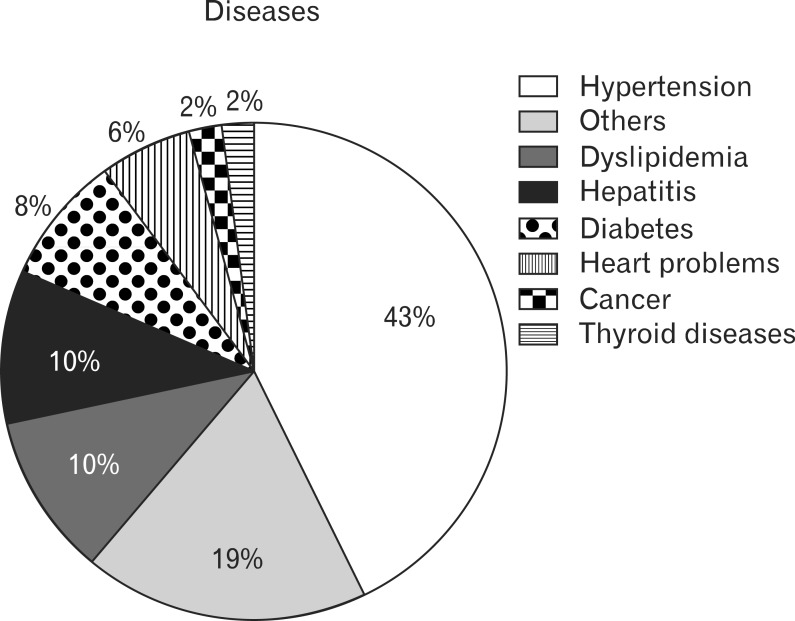
There were 127 respondents. The gender breakdown was 112 men (88.2%) and 15 women (11.8%), and the mean age was 47.8 years. Fifty-nine (46.4%) were family physicians or interns, and 68 (53.6%) were surgeons. Twenty-six percent (26%) were smokers, and 74.8% were drinkers; 53.5% did exercise; 37% had chronic diseases; 44.9% took periodic cancer screening tests, and 72.4% took periodic screening tests for adult diseases.
It was found that general characteristics and other health-promotion behaviors of physicians do not affect physicians' practice of undergoing periodic health examination.
20世纪90年代,医学的主要重点转向疾病预防。因此,初级保健医生不仅有责任就具体的疾病预防,而且还要就一般的健康促进对普通民众进行教育和咨询。此外,过去乃至如今,医生为患者提供健康促进行为的积极范例仍被视为很重要。本研究的目的是调查医生的健康促进行为,并确定影响这些行为的因素。
2011年5月16日至6月25日,我们对天安城市医师协会的371名成员进行了邮寄和电子邮件调查。问卷包括18个项目,涉及社会人口统计学因素、成人疾病和癌症筛查测试以及健康习惯等问题。
有127名受访者。性别分布为男性112人(88.2%),女性15人(11.8%),平均年龄为47.8岁。59人(46.4%)是家庭医生或实习生,68人(53.6%)是外科医生。26%的人吸烟,74.8%的人饮酒;53.5%的人进行锻炼;37%的人患有慢性病;44.9%的人进行定期癌症筛查测试,72.4%的人进行成人疾病定期筛查测试。
研究发现,医生的一般特征和其他健康促进行为不会影响医生进行定期健康检查的做法。