Division of Endocrinology and Centre for Research in Anabolic Skeletal Targets in Health and Illness (ASTHI), Lucknow, India.
Division of Medicinal & Process Chemistry, CSIR-Central Drug Research Institute, B.S. 10/1, Sector-10, Jankipuram Extension, Lucknow, India.
Cell Death Dis. 2014 Feb 6;5(2):e1050. doi: 10.1038/cddis.2014.4.
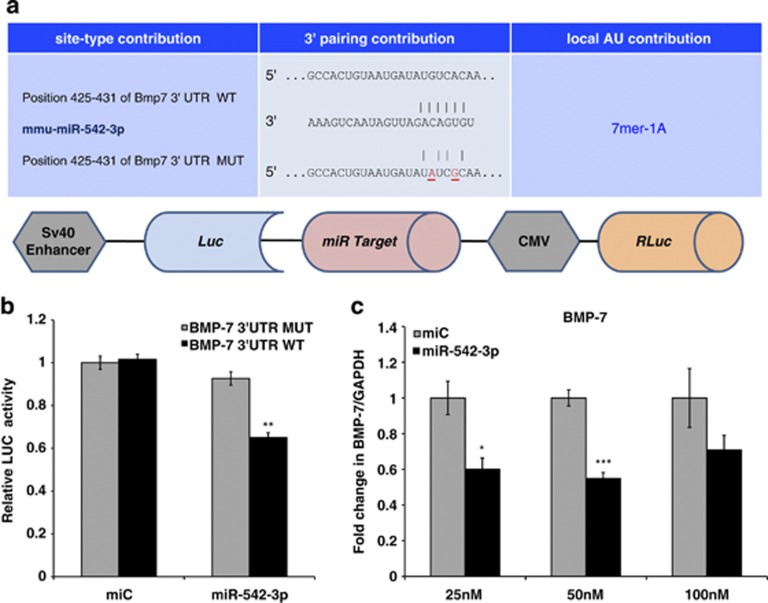
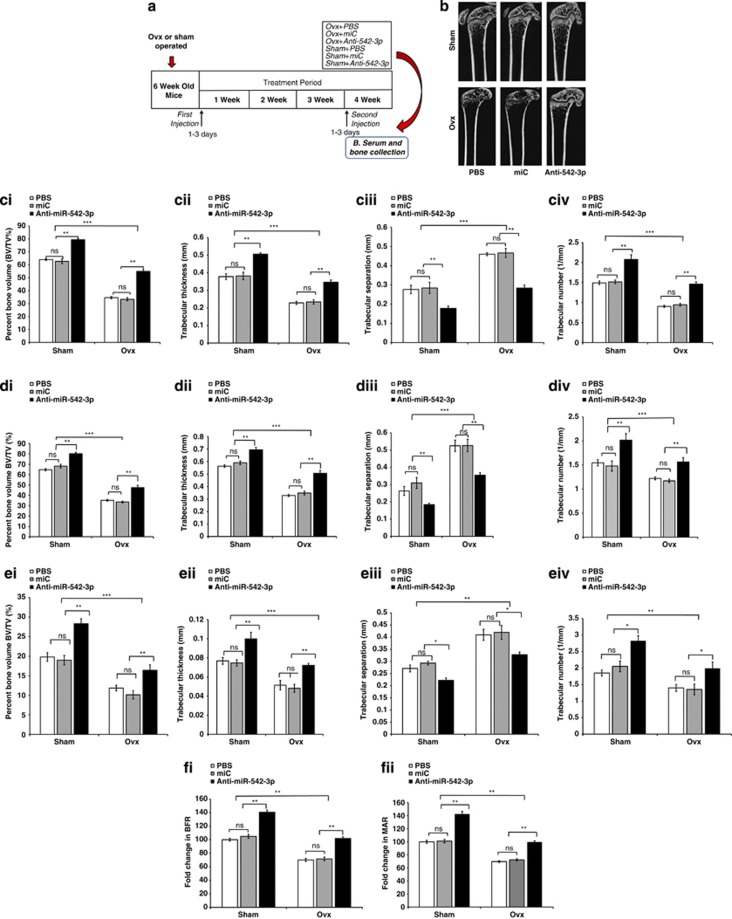
MicroRNAs (miRNAs) are short non-coding RNAs that interfere with translation of specific target mRNAs and thereby regulate diverse biological processes. Recent studies have suggested that miRNAs might have a role in osteoblast differentiation and bone formation. Here, we show that miR-542-3p, a well-characterized tumor suppressor whose downregulation is tightly associated with tumor progression via C-src-related oncogenic pathways, inhibits osteoblast proliferation and differentiation. miRNA array profiling in Medicarpin (a pterocarpan with proven bone-forming effects) induced mice calvarial osteoblast cells and further validation by quantitative real-time PCR revealed that miR-542-3p was downregulated during osteoblast differentiation. Over-expression of miR-542-3p inhibited osteoblast differentiation, whereas inhibition of miR-542-3p function by anti-miR-542-3p promoted expression of osteoblast-specific genes, alkaline phosphatase activity and matrix mineralization. Target prediction analysis tools and experimental validation by luciferase 3' UTR reporter assay identified BMP-7 (bone morphogenetic protein 7) as a direct target of miR-542-3p. It was seen that over-expression of miR-542-3p leads to repression of BMP-7 and inhibition of BMP-7/PI3K- survivin signaling. This strongly suggests that miR-542-3p suppresses osteogenic differentiation and promotes osteoblast apoptosis by repressing BMP-7 and its downstream signaling. Furthermore, silencing of miR-542-3p led to increased bone formation, bone strength and improved trabecular microarchitecture in sham and ovariectomized (Ovx) mice. Although miR-542-3p is known to be a tumor repressor, we have identified second complementary function of miR-542-3p where it inhibits BMP-7-mediated osteogenesis. Our findings suggest that pharmacological inhibition of miR-542-3p by anti-miR-542-3p could represent a therapeutic strategy for enhancing bone formation in vivo.
微小 RNA(miRNA)是一种短的非编码 RNA,可干扰特定靶 mRNA 的翻译,从而调节多种生物过程。最近的研究表明,miRNA 可能在成骨细胞分化和骨形成中发挥作用。在这里,我们显示 miR-542-3p,一种特征明确的肿瘤抑制因子,其下调与通过 C-src 相关致癌途径的肿瘤进展紧密相关,可抑制成骨细胞增殖和分化。在 Medicarpin(一种具有已证实的成骨作用的蝶豆素)诱导的小鼠颅骨成骨细胞中进行 miRNA 芯片分析,并通过定量实时 PCR 进一步验证,发现 miR-542-3p 在成骨细胞分化过程中下调。miR-542-3p 的过表达抑制成骨细胞分化,而抗 miR-542-3p 抑制 miR-542-3p 功能则促进成骨细胞特异性基因、碱性磷酸酶活性和基质矿化的表达。靶预测分析工具和通过荧光素酶 3'UTR 报告基因测定的实验验证表明,BMP-7(骨形态发生蛋白 7)是 miR-542-3p 的直接靶标。结果表明,miR-542-3p 的过表达导致 BMP-7 抑制和 BMP-7/PI3K-存活素信号抑制。这强烈表明 miR-542-3p 通过抑制 BMP-7 及其下游信号来抑制成骨细胞分化并促进成骨细胞凋亡。此外,miR-542-3p 的沉默导致 sham 和卵巢切除(Ovx)小鼠的骨形成增加、骨强度提高和小梁微结构改善。尽管 miR-542-3p 是已知的肿瘤抑制剂,但我们已经确定了 miR-542-3p 的第二个互补功能,它抑制 BMP-7 介导的成骨作用。我们的研究结果表明,通过抗 miR-542-3p 抑制 miR-542-3p 的药理学抑制可能代表一种增强体内骨形成的治疗策略。