Brain and Mind Research Institute, University of Sydney, Sydney, New South Wales, Australia.
BMC Psychiatry. 2014 Feb 8;14:33. doi: 10.1186/1471-244X-14-33.
The circadian abnormality of delayed sleep phase has been suggested to characterise a subgroup of depressed young adults with different risk factors and course of illness. We aim to assess the prevalence and factors, particularly substance use, associated with such delay in a large help-seeking cohort of young people with mental health problems.
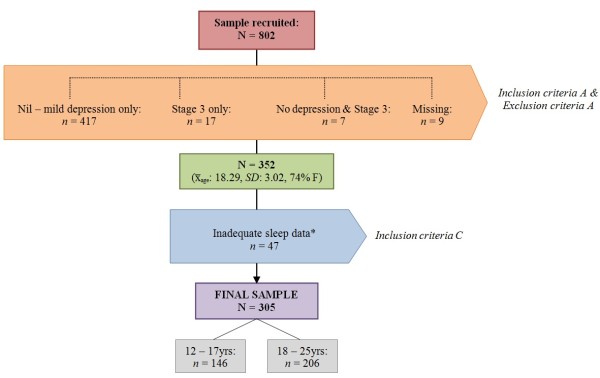
From a consecutively recruited sample of 802 help-seeking young people, 305 (38%) had at least moderate depressive symptoms (QIDS-C16 >10), sleep data and did not have a chronic severe mental illness. Demographic and clinical characteristics were evaluated through self report and clinical interview. Delayed sleep phase was defined as a sleep onset between the hours of 02:00 a.m. - 06:00 a.m. and the characteristics of this group were compared to normal phase sleepers.
Delayed sleep onset was reported amongst 18% (n = 56/305) of the depressed group compared to 11% of the non-depressed young people. Amongst the depressed group, delayed sleep onset was associated with tobacco, alcohol and cannabis misuse and short sleep duration (x̅: 5.8 hrs vs. x̅: 7.8 hrs). There were no differences in demographic factors, personality traits or symptoms. Tobacco smoking was very common: In logistic regression analyses only tobacco use (OR 2.28, 95% CI: 1.04 - 5.01) was associated with delayed sleep onset. There was no interaction with age.
Delayed sleep onset was twice as common in depressed young people as the general population and young people with other mental health problems, and is a potential marker for a subgroup of mood disorders. Those with delayed sleep onset were not more severely depressed but had short sleep duration, a risk for chronic psychological ill health, and higher levels of tobacco use. Nicotine use was common in this group, has biological evidence as a sleep disrupter, and requires specifically addressing in this population.
睡眠时相延迟已被认为是具有不同风险因素和疾病病程的年轻抑郁患者亚群的特征。我们旨在评估在一个寻求帮助的大量年轻精神健康问题人群中,存在这种睡眠时相延迟的患病率和相关因素,特别是物质使用情况。
从连续招募的 802 名寻求帮助的年轻人中,有 305 名(38%)有至少中度抑郁症状(QIDS-C16>10)、睡眠数据且没有慢性严重精神疾病。通过自我报告和临床访谈评估人口统计学和临床特征。将睡眠时相延迟定义为入睡时间在凌晨 2:00 至 6:00 之间,将该组的特征与正常睡眠者进行比较。
在抑郁组中,有 18%(n=56/305)报告存在睡眠起始延迟,而非抑郁的年轻人群中这一比例为 11%。在抑郁组中,睡眠起始延迟与烟草、酒精和大麻滥用以及睡眠时间短有关(x̅:5.8 小时比 x̅:7.8 小时)。在人口统计学因素、人格特质或症状方面没有差异。烟草吸烟非常普遍:在逻辑回归分析中,只有烟草使用(OR 2.28,95%CI:1.04-5.01)与睡眠起始延迟相关。与年龄无交互作用。
在年轻的抑郁症患者中,睡眠起始延迟的发生率是普通人群和其他精神健康问题患者的两倍,这可能是一种心境障碍亚群的标志物。睡眠起始延迟的患者抑郁程度并不严重,但睡眠时间短,存在慢性心理健康不良的风险,且烟草使用水平较高。该人群中尼古丁使用普遍,有生物学证据表明其可扰乱睡眠,因此需要在该人群中专门解决。