Department of Psychiatry, University of Michigan, Ann Arbor, Michigan, USA.
Department of Ophthalmology and Visual Sciences, University of Illinois at Chicago, Chicago, Illinois, USA.
Alcohol Clin Exp Res. 2022 Jul;46(7):1181-1191. doi: 10.1111/acer.14872. Epub 2022 Jul 31.
Numerous studies have reported that eveningness is associated with increased alcohol consumption. However, biological markers of circadian timing, such as dim light melatonin onset (DLMO) and circadian photoreceptor responsivity (post-illumination pupil response, PIPR), have rarely been assessed in the context of habitual alcohol consumption. This study aimed to examine sleep, circadian timing, and photoreceptor responsivity in adult alcohol drinkers.
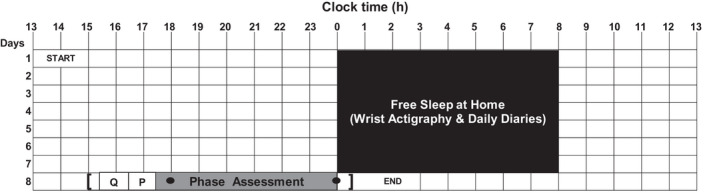
Participants (21 to 45 years) included 28 light and 50 heavy drinkers. The 8-day study consisted of a week of ad lib sleep monitored with wrist actigraphy, followed by a 9-h laboratory session with a photoreceptor responsivity and circadian phase assessment.
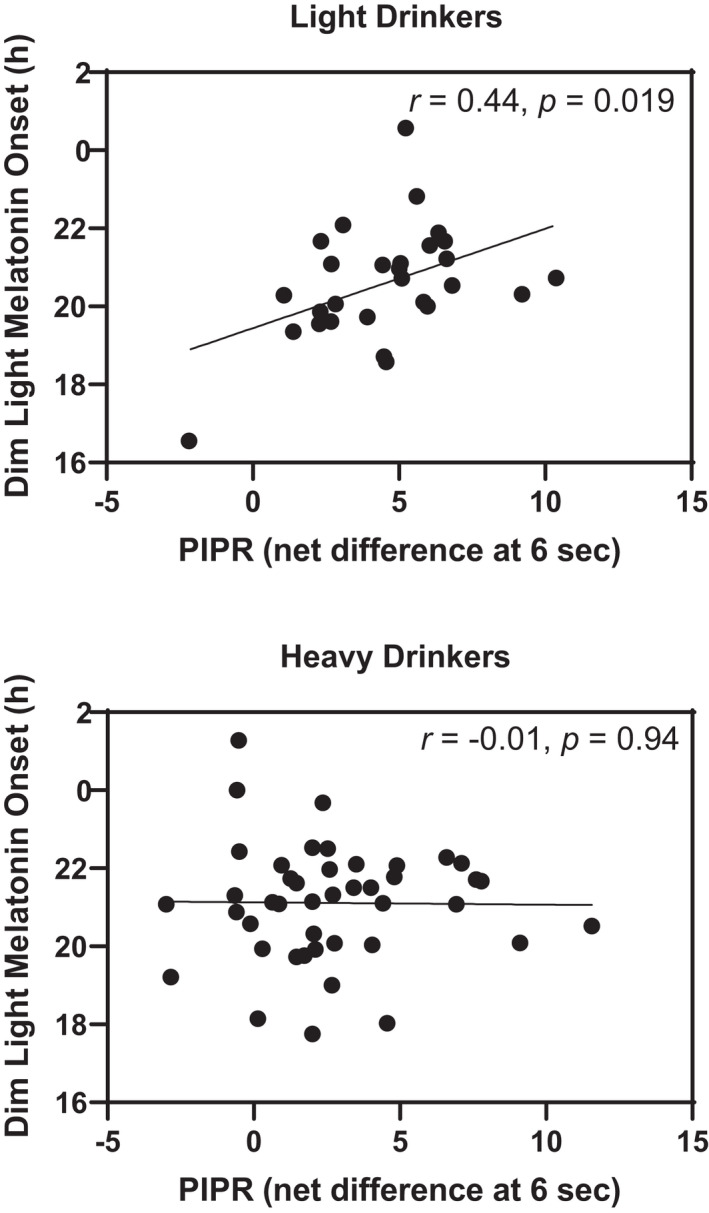
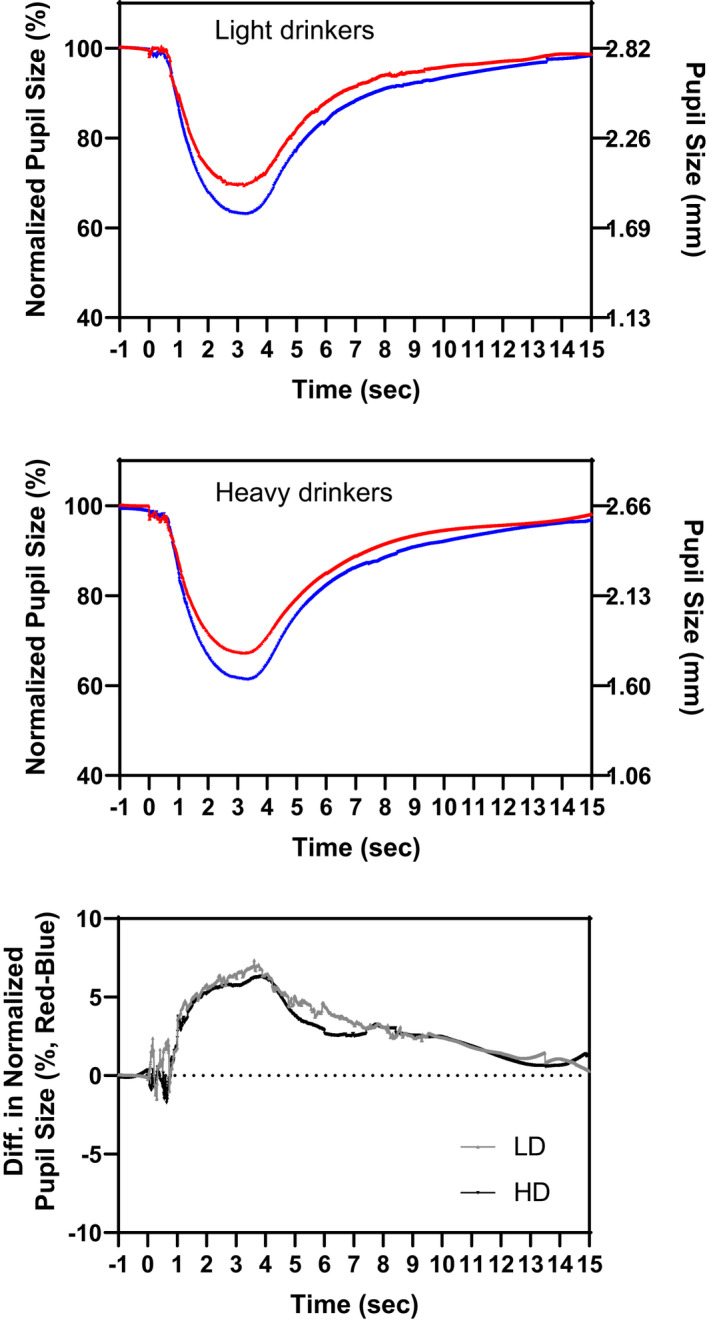
The heavy drinkers obtained on average 28 more minutes of sleep (p = 0.002) and reported more eveningness than the light drinkers (p = 0.029). There was a trend for a shorter DLMO-midsleep interval (p = 0.059) in the heavy drinkers, reflecting a tendency for them to sleep at an earlier circadian phase. The PIPR in the heavy drinkers was significantly smaller than in the light drinkers (p = 0.032), suggesting reduced circadian photoreceptor responsivity in the heavy drinkers. A larger PIPR was significantly associated with a later DLMO in the light drinkers (r = 0.44, p = 0.019), but this relationship was absent in the heavy drinkers (r = -0.01, p = 0.94).
These results are consistent with earlier reports of more eveningness and a shorter DLMO-midsleep interval being associated with heavier alcohol drinking. The novel finding of reduced circadian photoreceptor responsivity in heavy drinkers is consistent with prior rodent studies. Future studies should explore the impact of habitual alcohol consumption on other measures of circadian photoreceptor responsivity.
许多研究报告称,晚睡与饮酒量增加有关。然而,在习惯性饮酒的背景下,很少评估生物钟时间的生物标志物,如暗光褪黑素起始时间(DLMO)和昼夜节律光感受器反应性(光照后瞳孔反应,PIPR)。本研究旨在检查成年饮酒者的睡眠、昼夜节律时间和光感受器反应性。
参与者(21 至 45 岁)包括 28 名轻度饮酒者和 50 名重度饮酒者。为期 8 天的研究包括一周的自由睡眠监测腕动图,随后是 9 小时的实验室评估,包括光感受器反应性和昼夜节律相位评估。
重度饮酒者平均多获得 28 分钟的睡眠(p=0.002),并且比轻度饮酒者报告更多的晚型(p=0.029)。重度饮酒者的 DLMO-睡眠中期间隔较短(p=0.059),这反映了他们倾向于更早的生物钟相位睡眠。重度饮酒者的 PIPR 明显小于轻度饮酒者(p=0.032),表明重度饮酒者的昼夜节律光感受器反应性降低。在轻度饮酒者中,较大的 PIPR 与较晚的 DLMO 显著相关(r=0.44,p=0.019),但在重度饮酒者中这种关系不存在(r=-0.01,p=0.94)。
这些结果与更早的报告一致,即更晚型和较短的 DLMO-睡眠中期间隔与更重度的饮酒有关。在重度饮酒者中发现的昼夜节律光感受器反应性降低的新发现与先前的啮齿动物研究一致。未来的研究应该探索习惯性饮酒对其他昼夜节律光感受器反应性测量的影响。