Department of Respiratory Medicine, Beijing Friendship Hospital, Capital Medical University, No, 95 Yong An Road, Xichen District, Beijing 100050, China.
BMC Pulm Med. 2014 Feb 7;14:16. doi: 10.1186/1471-2466-14-16.
A higher slow vital capacity (VC) compared with forced vital capacity (FVC) indicates small airway collapse and air trapping. We hypothesized that a larger difference between VC and FVC (VC-FVC) would predict impaired exercise capacity in patients with chronic obstructive pulmonary disease (COPD).
Pulmonary function and incremental cardiopulmonary exercise responses were assessed in 97 COPD patients. Patients were then divided into two groups: one in which VC > FVC (n = 77) and the other in which VC ≤ FVC (n = 20).
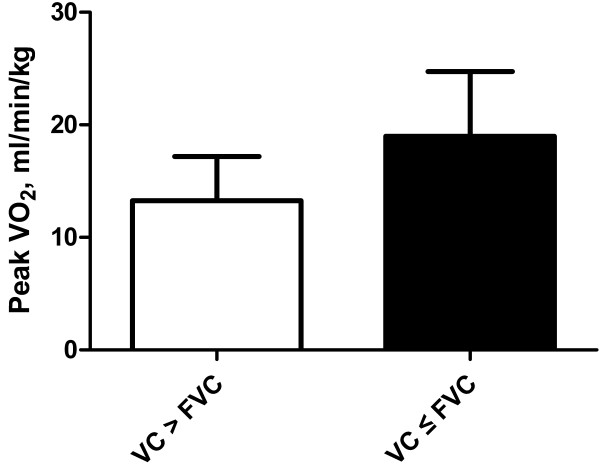
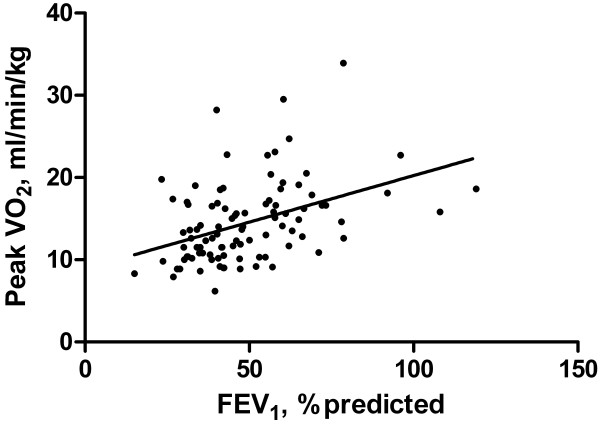
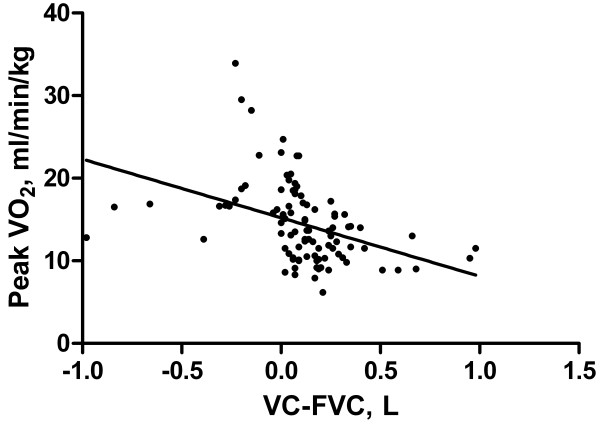
Patients with VC > FVC had lower FEV1 and peak oxygen uptake (VO2/kg) compared with patients with VC ≤ FVC. There was a significant inverse correlation for the entire group between VC-FVC and peak VO2/kg (r = -0.404; p < 0.001). There was also a direct correlation between FEV1% pred and peak VO2/kg (r = 0.418; p < 0.001). The results of the multivariate regression analysis with peak VO2/kg as the dependent variable showed that VC-FVC, FEV1(% pred) and age were all significant independent predictors of peak VO2/kg. The model explained 35.9% of the peak VO2/kg variance.
The difference between VC and FVC, easily measured by spirometry, can be used not only as an index of severity of airflow limitation, but also to predict exercise performance in COPD patients.
与用力肺活量(FVC)相比,较大的慢肺活量(VC)表明小气道塌陷和空气滞留。我们假设 VC 与 FVC 之间的差值(VC-FVC)越大,慢性阻塞性肺疾病(COPD)患者的运动能力受损程度越大。
对 97 例 COPD 患者的肺功能和递增心肺运动反应进行评估。然后,将患者分为两组:VC>FVC 组(n=77)和 VC≤FVC 组(n=20)。
与 VC≤FVC 组相比,VC>FVC 组的 FEV1 和峰值摄氧量(VO2/kg)更低。整个组中,VC-FVC 与峰值 VO2/kg 呈显著负相关(r=-0.404;p<0.001)。FEV1% pred 与峰值 VO2/kg 也呈直接相关(r=0.418;p<0.001)。以峰值 VO2/kg 为因变量的多元回归分析结果表明,VC-FVC、FEV1% pred 和年龄都是峰值 VO2/kg 的独立预测因子。该模型解释了 35.9%的峰值 VO2/kg 变异性。
通过肺活量计测量的 VC 与 FVC 之差不仅可作为气流受限严重程度的指标,还可用于预测 COPD 患者的运动能力。