Center for Motor Neuron Biology and Disease, the Columbia Translational Neuroscience Initiative, and the Columbia Stem Cell Initiative, Columbia University, New York, NY 10032, USA; Department of Pathology and Cell Biology, Columbia University, New York, NY 10032, USA.
Center for Motor Neuron Biology and Disease, the Columbia Translational Neuroscience Initiative, and the Columbia Stem Cell Initiative, Columbia University, New York, NY 10032, USA; Department of Pathology and Cell Biology, Columbia University, New York, NY 10032, USA; Department of Rehabilitation and Regenerative Medicine, Columbia University, New York, NY 10032, USA; Project A.L.S./Jenifer Estess Laboratory for Stem Cell Research, New York, NY 10032, USA.
Neuron. 2014 Mar 5;81(5):1001-1008. doi: 10.1016/j.neuron.2014.01.011. Epub 2014 Feb 6.
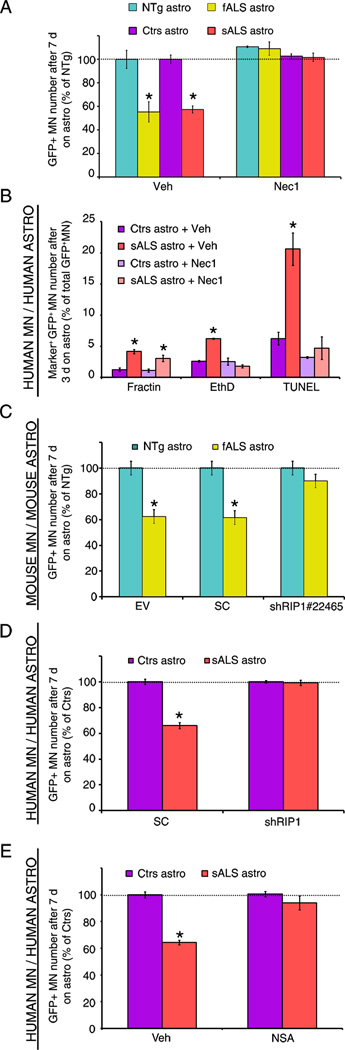
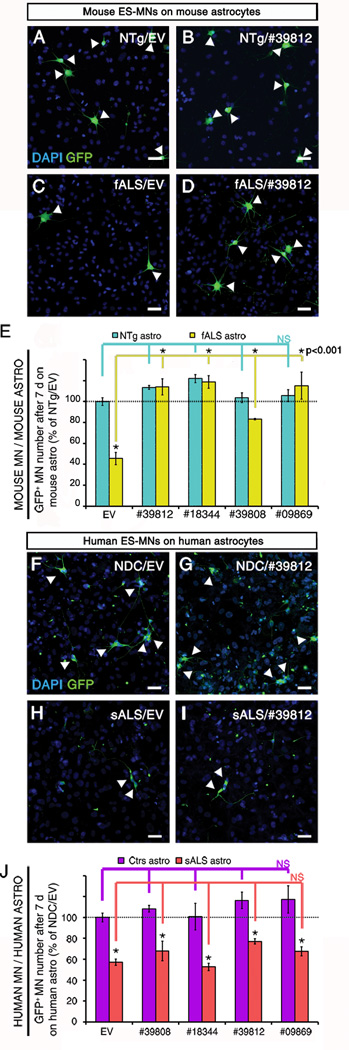
Most cases of neurodegenerative diseases are sporadic, hindering the use of genetic mouse models to analyze disease mechanisms. Focusing on the motor neuron (MN) disease amyotrophic lateral sclerosis (ALS), we therefore devised a fully humanized coculture model composed of human adult primary sporadic ALS (sALS) astrocytes and human embryonic stem-cell-derived MNs. The model reproduces the cardinal features of human ALS: sALS astrocytes, but not those from control patients, trigger selective death of MNs. The mechanisms underlying this non-cell-autonomous toxicity were investigated in both astrocytes and MNs. Although causal in familial ALS (fALS), SOD1 does not contribute to the toxicity of sALS astrocytes. Death of MNs triggered by either sALS or fALS astrocytes occurs through necroptosis, a form of programmed necrosis involving receptor-interacting protein 1 and the mixed lineage kinase domain-like protein. The necroptotic pathway therefore constitutes a potential therapeutic target for this incurable disease.
大多数神经退行性疾病是散发性的,这阻碍了利用遗传小鼠模型来分析疾病机制。因此,我们专注于运动神经元(MN)疾病肌萎缩侧索硬化症(ALS),设计了一种完全由人类成人原发性散发性 ALS(sALS)星形胶质细胞和人胚胎干细胞衍生的 MN 组成的共培养模型。该模型再现了人类 ALS 的主要特征:sALS 星形胶质细胞,但不是来自对照患者的星形胶质细胞,会引发 MN 的选择性死亡。我们在星形胶质细胞和 MN 中研究了这种非细胞自主毒性的机制。尽管 SOD1 在家族性 ALS(fALS)中是病因,但它不会导致 sALS 星形胶质细胞的毒性。sALS 或 fALS 星形胶质细胞引发的 MN 死亡是通过坏死性凋亡发生的,坏死性凋亡是一种涉及受体相互作用蛋白 1 和混合谱系激酶结构域样蛋白的程序性细胞死亡形式。因此,坏死性凋亡途径构成了这种无法治愈疾病的潜在治疗靶点。