Department of Restorative Dental Sciences, College of Dentistry, King Saud University, Riyadh, Kingdom of Saudi Arabia.
BMC Oral Health. 2014 Feb 11;14:12. doi: 10.1186/1472-6831-14-12.
Root canal irrigation carries a risk of extrusion of irrigant into the periapical tissues which can be associated with pain, swelling, and tissue damage. Studies have shown less extrusion with sonic or apical negative pressure devices compared with syringe and side-port needle or passive ultrasonic irrigation with continuous irrigant flow. This study aimed to evaluate the effectiveness of the EndoVac irrigation system, regarding 1) debris removal and 2) the control of apically extruded irrigating solution.
Fifty extracted human single-rooted teeth were used in this study. The teeth were then randomly divided into three experimental groups according to the type of irrigation used and one control group. In group 1, irrigation was performed using the EndoVac irrigation system. In group 2, irrigation was performed using a 30-gauge, tip-vented irrigation needle. In group 3, irrigation was performed using a 30-gauge, side-vented irrigation needle. The control group received instrumentation with no irrigation to serve as a control for cleaning efficiency. Root canal instrumentation was performed using the Profile NiTi rotary system with a crown-down technique. All of the experimental teeth were irrigated with the same amount of 5.25% sodium hypochlorite. The amount of extruded irrigating solution was then measured by subtracting the post-instrumentation weight from the pre-instrumentation weight using an electronic balance. The cleanliness of debris removal was evaluated using scanning electron microscopy.
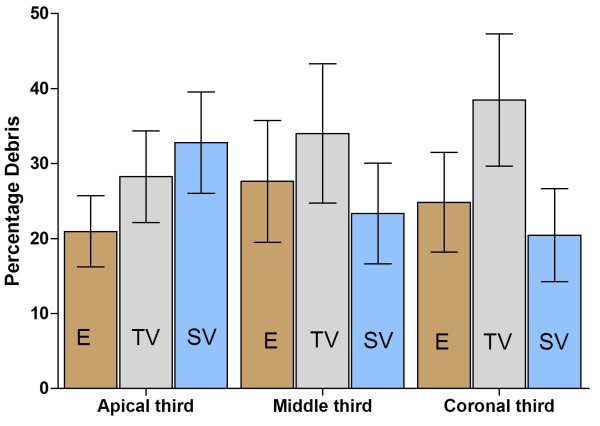
EndoVac irrigation had the least amount of extrusion followed by the side-vented and tip-vented method. The difference between the groups was statistically significant (P <0.01). As for the cleaning results, the debris collection in the EndoVac and tip-vented groups was the least in the apical third. In the control and the side-vented groups, the debris was the greatest in the apical third, but this difference was not significant among the three experimental groups.
The EndoVac irrigation system extruded significantly less irrigant solution than either needle irrigation system. Debris collection was the least in the apical third for the EndoVac irrigation system. No significant difference was found in the cleaning efficiency among the three irrigation systems.
根管冲洗有将冲洗液挤出根尖组织的风险,这可能会导致疼痛、肿胀和组织损伤。研究表明,与注射器和侧口针或连续冲洗液的被动超声冲洗相比,超声或根尖负压设备的挤出量更少。本研究旨在评估 EndoVac 冲洗系统的有效性,包括 1)清除碎屑和 2)控制根尖挤出的冲洗液。
本研究使用了 50 颗离体的单根人牙。然后,根据使用的冲洗类型将这些牙齿随机分为三组实验和一组对照组。在第 1 组中,使用 EndoVac 冲洗系统进行冲洗。在第 2 组中,使用 30 号、尖端通风冲洗针进行冲洗。在第 3 组中,使用 30 号、侧方通风冲洗针进行冲洗。对照组不进行冲洗,作为清洁效率的对照。根管器械使用 Crown-Down 技术的 Profile NiTi 旋转系统进行。所有实验牙齿均用相同量的 5.25%次氯酸钠冲洗。然后通过电子天平从器械前重量中减去器械后重量来测量挤出的冲洗液量。使用扫描电子显微镜评估碎屑去除的清洁度。
EndoVac 冲洗的挤出量最少,其次是侧方通风和尖端通风方法。组间差异具有统计学意义(P<0.01)。至于清洁效果,在根尖三分之一处,EndoVac 和尖端通风组的碎屑收集量最少。在对照组和侧方通风组中,根尖三分之一处的碎屑最多,但三组实验之间差异无统计学意义。
EndoVac 冲洗系统挤出的冲洗液明显少于任何一种针式冲洗系统。EndoVac 冲洗系统在根尖三分之一处的碎屑收集量最少。三种冲洗系统的清洁效率无显著差异。