Sinha Indu, Allen Joshua E, Pinto John T, Sinha Raghu
Department of Biochemistry and Molecular Biology, Penn State College of Medicine, Penn State Hershey Cancer Institute, Hershey, Pennsylvania.
Cancer Med. 2014 Apr;3(2):252-64. doi: 10.1002/cam4.198. Epub 2014 Feb 7.
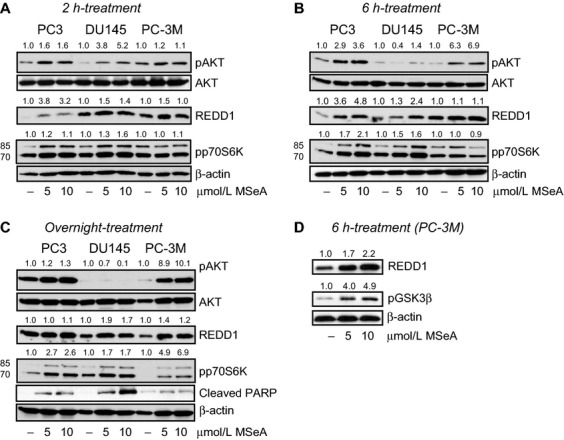
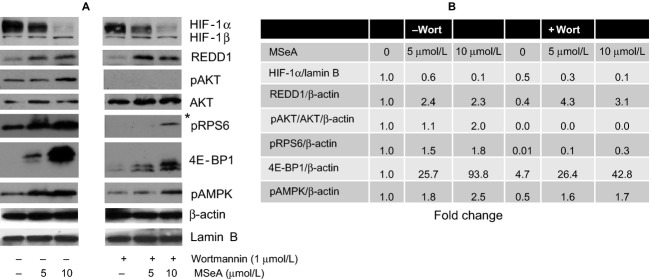
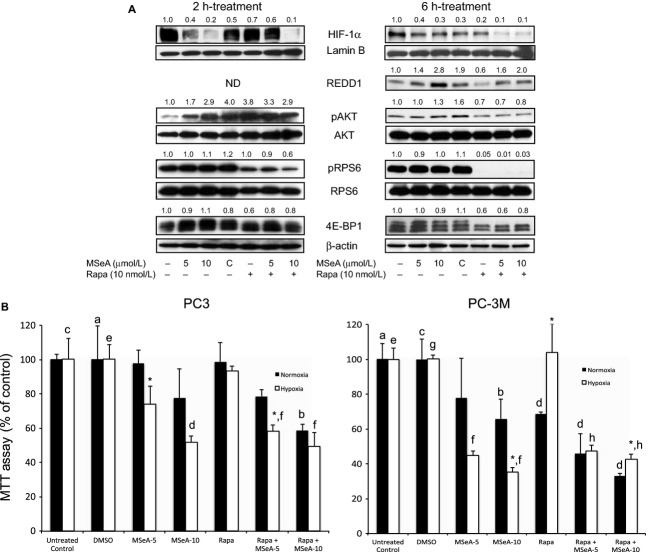
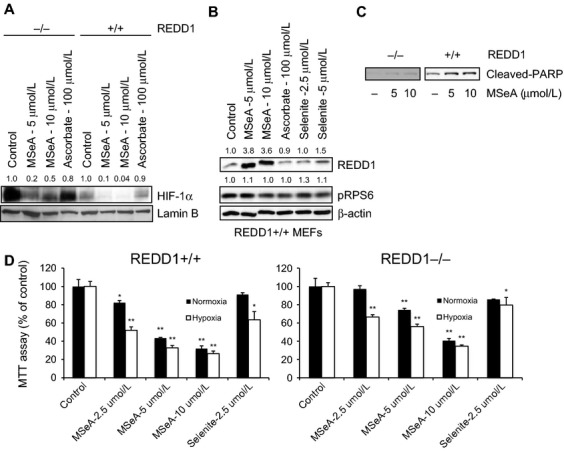
Methylseleninic acid (MSeA) is a monomethylated selenium metabolite theoretically derived from subsequent β-lyase or transamination reactions of dietary Se-methylselenocysteine that has potent antitumor activity by inhibiting cell proliferation of several cancers. Our previous studies showed that MSeA promotes apoptosis in invasive prostate cancer cells in part by downregulating hypoxia-inducible factor HIF-1α. We have now extended these studies to evaluate the impact of MSeA on REDD1 (an mTOR inhibitor) in inducing cell death of invasive prostate cancer cells in hypoxia. In both PTEN+ and PTEN- prostate cancer cells we show that MSeA elevates REDD1 and phosphorylation of AKT along with p70S6K in hypoxia. Furthermore, REDD1 induction by MSeA is independent of AKT and the mTOR inhibition in prostate cancer cells causes partial resistance to MSeA-induced growth reduction in hypoxia. Our data suggest that MSeA induces REDD1 and inhibits prostate cancer cell growth in hypoxia despite activation of AKT and dysregulation of mTOR.
甲基亚硒酸(MSeA)是一种单甲基化的硒代谢产物,理论上源自膳食中的硒甲基硒代半胱氨酸的后续β-裂解酶或转氨反应,它通过抑制多种癌症的细胞增殖而具有强大的抗肿瘤活性。我们之前的研究表明,MSeA部分通过下调缺氧诱导因子HIF-1α来促进侵袭性前列腺癌细胞的凋亡。我们现在扩展了这些研究,以评估MSeA对REDD1(一种mTOR抑制剂)在缺氧诱导侵袭性前列腺癌细胞死亡中的影响。在PTEN阳性和PTEN阴性前列腺癌细胞中,我们均表明MSeA在缺氧条件下会升高REDD1以及AKT和p70S6K的磷酸化水平。此外,MSeA诱导的REDD1独立于AKT,并且前列腺癌细胞中的mTOR抑制导致对MSeA诱导的缺氧条件下生长减少产生部分抗性。我们的数据表明,尽管AKT激活和mTOR失调,但MSeA在缺氧条件下仍能诱导REDD1并抑制前列腺癌细胞生长。