Smith Joshua B, Jenks Jonathan A, Grovenburg Troy W, Klaver Robert W
Department of Natural Resource Management, South Dakota State University, Brookings, South Dakota, United States of America.
Iowa Cooperative Fish and Wildlife Research Unit and Department of Natural Resource Ecology and Management, Iowa State University, Ames, Iowa, United States of America.
PLoS One. 2014 Feb 7;9(2):e88271. doi: 10.1371/journal.pone.0088271. eCollection 2014.
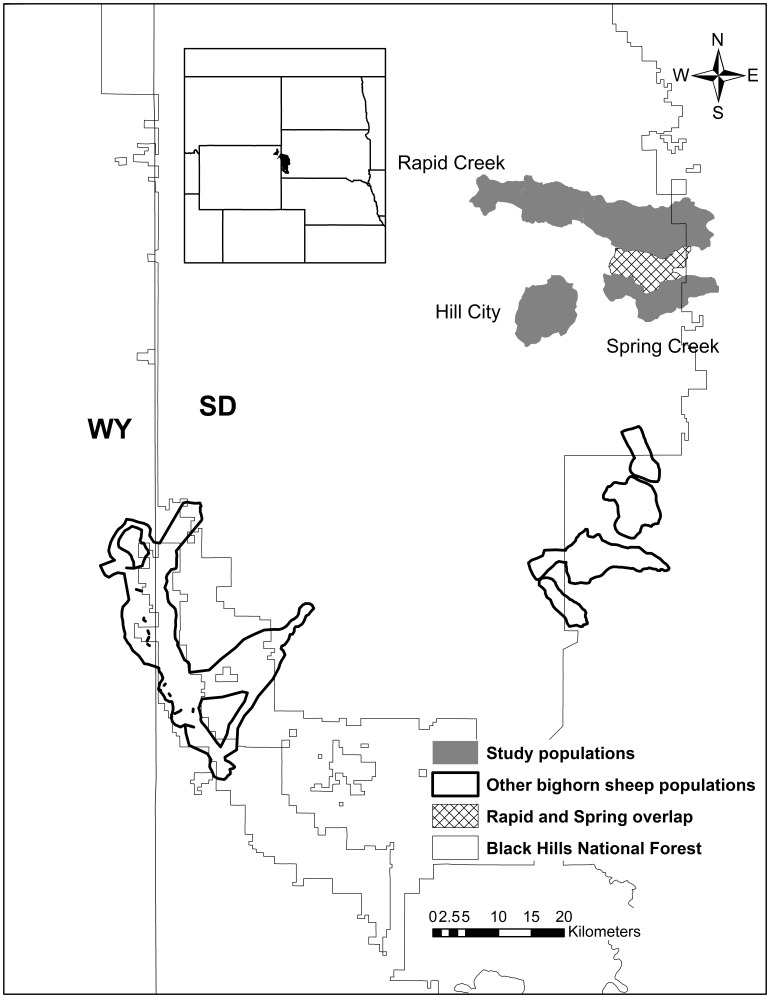
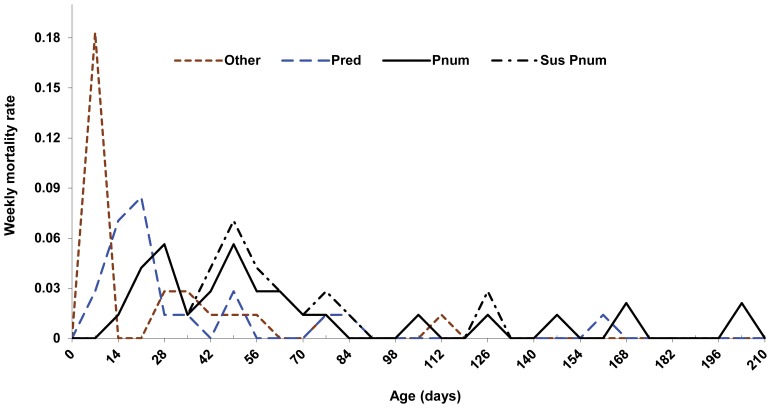
Estimating survival and documenting causes and timing of mortality events in neonate bighorn sheep (Ovis canadensis) improves understanding of population ecology and factors influencing recruitment. During 2010-2012, we captured and radiocollared 74 neonates in the Black Hills, South Dakota, of which 95% (70) died before 52 weeks of age. Pneumonia (36%) was the leading cause of mortality followed by predation (30%). We used known fate analysis in Program MARK to estimate weekly survival rates and investigate the influence of intrinsic variables on 52-week survival. Model {S1 wk, 2-8 wks, >8 wks} had the lowest AIC c (Akaike's Information Criterion corrected for small sample size) value, indicating that age (3-stage age-interval: 1 week, 2-8 weeks, and >8 weeks) best explained survival. Weekly survival estimates for 1 week, 2-8 weeks, and >8 weeks were 0.81 (95% CI = 0.70-0.88), 0.86 (95% CI = 0.81-0.90), and 0.94 (95% CI = 0.91-0.96), respectively. Overall probability of surviving 52 weeks was 0.02 (95% CI = 0.01-0.07). Of 70 documented mortalities, 21% occurred during the first week, 55% during weeks 2-8, and 23% occurred >8 weeks of age. We found pneumonia and predation were temporally heterogeneous with lambs most susceptible to predation during the first 2-3 weeks of life, while the greatest risk from pneumonia occurred from weeks 4-8. Our results indicated pneumonia was the major factor limiting recruitment followed by predation. Mortality from predation may have been partly compensatory to pneumonia and its effects were less pronounced as alternative prey became available. Given the high rates of pneumonia-caused mortality we observed, and the apparent lack of pneumonia-causing pathogens in bighorn populations in the western Black Hills, management activities should be geared towards eliminating contact between diseased and healthy populations.
估算新生大角羊(加拿大盘羊)的存活率,并记录死亡事件的原因和时间,有助于增进对种群生态学以及影响补充率因素的理解。在2010年至2012年期间,我们在南达科他州的黑山捕获了74只新生大角羊并为其佩戴无线电项圈,其中95%(70只)在52周龄前死亡。肺炎(36%)是主要死因,其次是捕食(30%)。我们在MARK程序中使用已知命运分析来估算每周存活率,并研究内在变量对52周存活率的影响。模型{S1周,2 - 8周,>8周}的AICc(针对小样本量校正的赤池信息准则)值最低,表明年龄(三阶段年龄区间:1周、2 - 8周和>8周)最能解释存活率。1周、2 - 8周和>8周的每周存活率估计分别为0.81(95%置信区间=0.70 - 0.88)、0.86(95%置信区间=0.81 - 0.90)和0.94(95%置信区间=0.91 - 0.96)。存活52周的总体概率为0.02(95%置信区间=0.01 - 0.07)。在记录的70例死亡中,21%发生在第一周,55%发生在第2 - 8周,23%发生在>8周龄时。我们发现肺炎和捕食在时间上具有异质性,羔羊在出生后的前2 - 3周最易受到捕食,而肺炎的最大风险发生在第4 - 8周。我们的结果表明,肺炎是限制补充率的主要因素,其次是捕食。捕食造成的死亡可能在一定程度上对肺炎起到了补偿作用,并且随着替代猎物的出现,其影响不太明显。鉴于我们观察到的由肺炎导致的高死亡率,以及在黑山以西的大角羊种群中明显缺乏引起肺炎的病原体,管理活动应致力于消除患病种群与健康种群之间的接触。