Section of Urologic Oncology, Rutgers Cancer Institute of New Jersey and Rutgers, The State University of New Jersey, 195 Little Albany Street no. 4560, New Brunswick, NJ 08901, USA.
1] Section of Urologic Oncology, Rutgers Cancer Institute of New Jersey and Rutgers, The State University of New Jersey, 195 Little Albany Street no. 4560, New Brunswick, NJ 08901, USA [2] Department of Urology, Inje University College of Medicine, Busan, Korea.
Br J Cancer. 2014 Mar 18;110(6):1634-44. doi: 10.1038/bjc.2014.23. Epub 2014 Feb 11.
Androgen ablation is the first-line therapy for patients with metastatic prostate cancer (CaP). However, castration resistance will eventually emerge. In the present study, we have investigated the role of bone morphogenetic protein-6 (BMP-6) in the development of castration-resistant prostate cancer (CRPC) in the context of bone metastases.
We initially investigated the clinical course of 158 men with advanced CaP who were treated with primary androgen deprivation therapy. To elucidate the underlying mechanism of CRPC in the context of bone metastases, we examined the impact of bone stromal cells on CaP in the absence of androgens using a co-culture model.
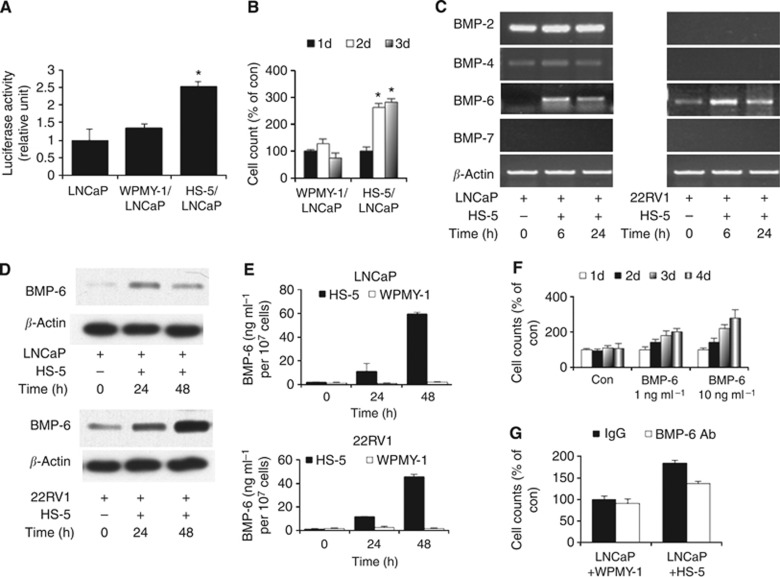
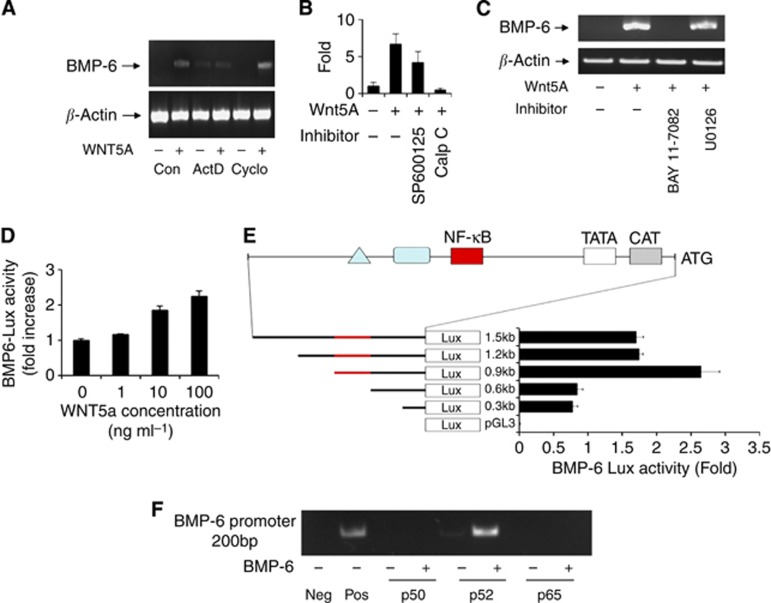
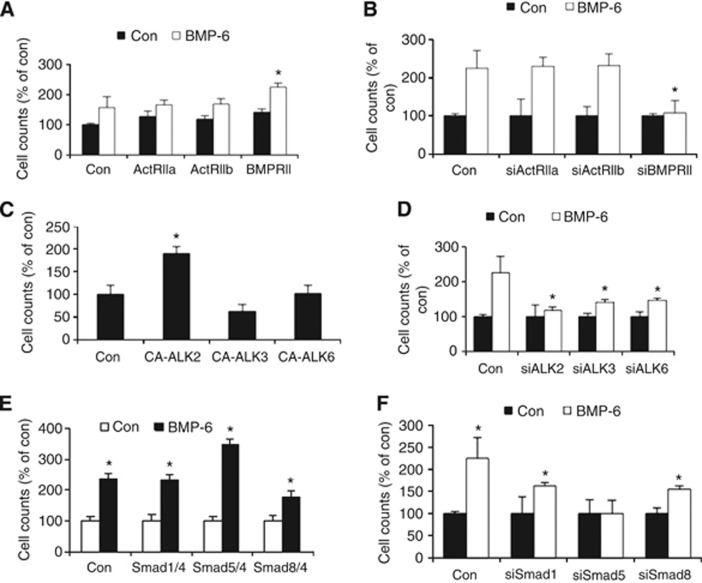
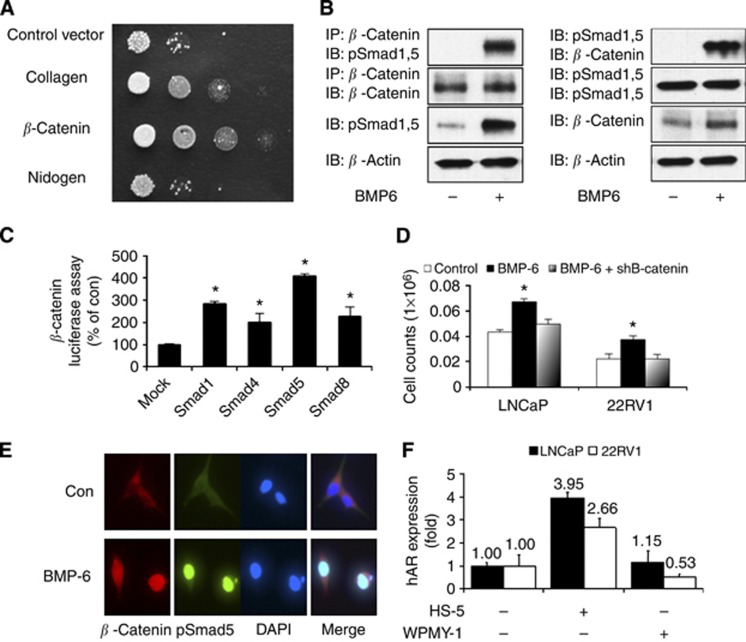
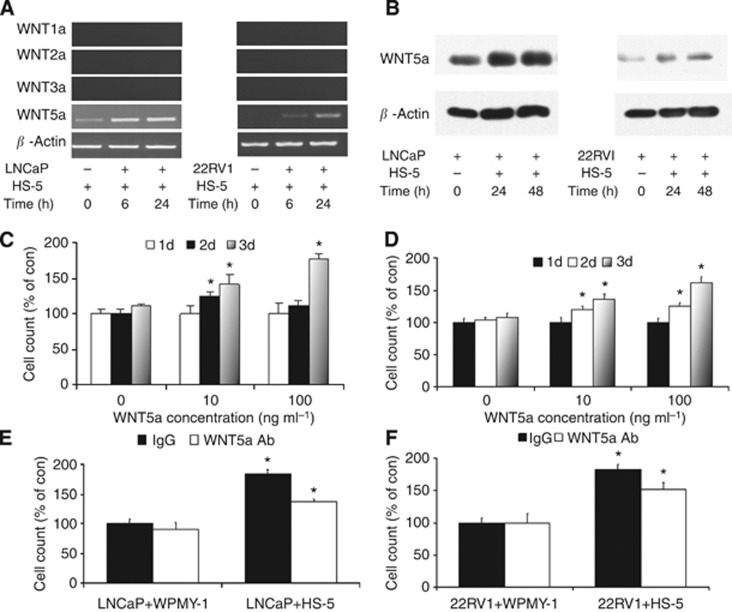
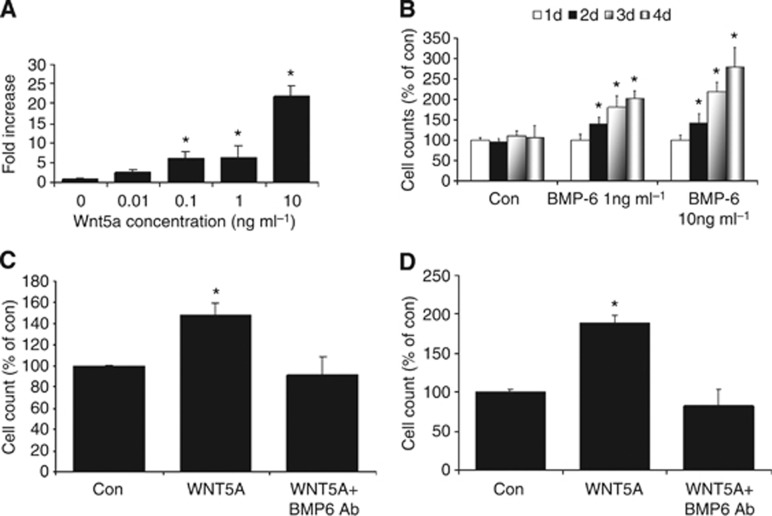
In the 158 patients, we found that the median time to prostate-specific antigen progression was significantly shorter when bone metastases were present (14 months (95% CI, 10.2-17.8 months) vs 57 months (95% CI, 19.4-94.6 months)). These results suggest that bone-tumour interactions may accelerate castration resistance. Consistent with this hypothesis, in vitro co-cultures demonstrated that CaP cells proliferated under an androgen-depleted condition when incubated with bone stromal cells. Mechanistically, gene expression analysis using quantitative polymerase chain reaction arrays showed a dramatic induction of BMP-6 by CaP cell lines in the presence of bone stromal cells. Further studies revealed that WNT5A derived from bone stromal cells induced the expression of BMP-6 by CaP cells; BMP-6 in turn stimulated cellular proliferation of CaP cells in an androgen-deprived media via a physical interaction between Smad5 and β-catenin. Intracellularly, WNT5A increased BMP-6 expression via protein kinase C/NF-κB pathway in CaP cell lines.
These observations suggest that bone-CaP interaction leads to castration resistance via WNT5A/BMP-6 loop.
雄激素剥夺是转移性前列腺癌(CaP)患者的一线治疗方法。然而,去势抵抗最终会出现。在本研究中,我们研究了骨形态发生蛋白 6(BMP-6)在骨转移背景下发生去势抵抗性前列腺癌(CRPC)中的作用。
我们首先研究了 158 名接受原发性雄激素剥夺治疗的晚期 CaP 男性的临床病程。为了阐明骨转移背景下 CRPC 的潜在机制,我们使用共培养模型研究了在没有雄激素的情况下骨基质细胞对 CaP 的影响。
在 158 名患者中,我们发现存在骨转移时前列腺特异性抗原进展的中位时间明显缩短(14 个月(95%CI,10.2-17.8 个月)与 57 个月(95%CI,19.4-94.6 个月))。这些结果表明,骨-肿瘤相互作用可能加速去势抵抗。与该假说一致,体外共培养显示,当与骨基质细胞孵育时,CaP 细胞在雄激素耗尽的条件下增殖。从机制上讲,使用定量聚合酶链反应阵列的基因表达分析显示,在骨基质细胞存在的情况下,CaP 细胞系中 BMP-6 的表达明显增加。进一步的研究表明,骨基质细胞衍生的 WNT5A 诱导 CaP 细胞表达 BMP-6;BMP-6 反过来通过 Smad5 和 β-连环蛋白之间的物理相互作用刺激雄激素剥夺培养基中 CaP 细胞的增殖。在细胞内,WNT5A 通过蛋白激酶 C/NF-κB 通路增加 CaP 细胞系中的 BMP-6 表达。
这些观察结果表明,骨-CaP 相互作用通过 WNT5A/BMP-6 环导致去势抵抗。