School of Biosciences and Biotechnology, Faculty of Science and Technology, University Kebangsaan Malaysia, 43600 Bangi, Selangor, Malaysia.
Department of Orthodontics, Faculty of Dentistry, University Kebangsaan Malaysia, Jalan Raja Muda Abdul Aziz, 50300 Kuala Lumpur, Malaysia.
Cell J. 2014 Feb 3;16(1):31-42.
Our research attempted to show that mouse dental pulp stem cells (DPSCs) with characters such as accessibility, propagation and higher proliferation rate can provide an improved approach for generate bone tissues. With the aim of finding and comparing the differentiation ability of mesenchymal stem cells derived from DPSCs into osteoblast and osteoclast cells; morphological, molecular and biochemical analyses were conducted.
In this experimental study, osteoblast and osteoclast differentiation was induced by specific differentiation medium. In order to induce osteoblast differentiation, 50 μg mL(-1) ascorbic acid and 10 mM β-glycerophosphate as growth factors were added to the complete medium consisting alpha-modified Eagle's medium (α-MEM), 15% fetal bovine serum (FBS) and penicillin/streptomycin, while in order to induce the osteoclast differentiation, 10 ng/mL receptor activator of nuclear factor kappa-B ligand (RANKL) and 5 ng/mL macrophage-colony stimulating factor (M-CSF) were added to complete medium. Statistical comparison between the osteoblast and osteoclast differentiated groups and control were carried out using t test.
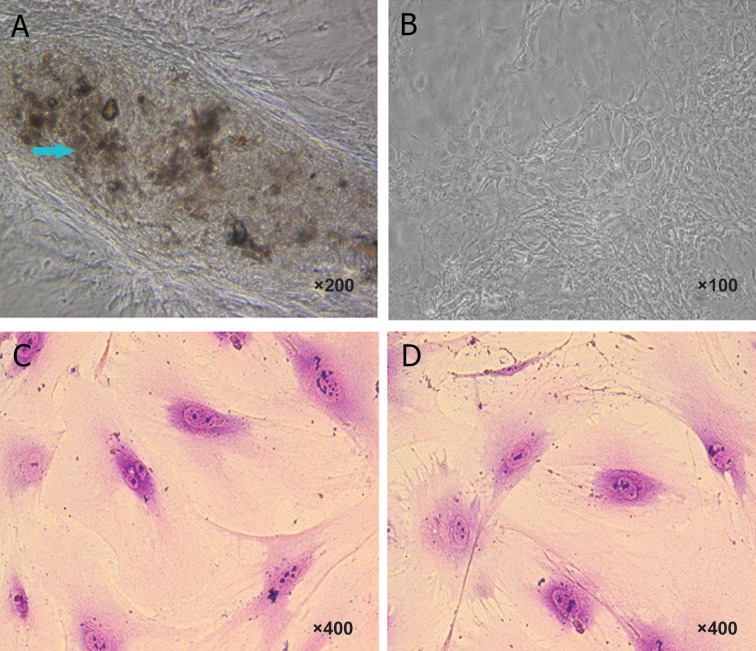
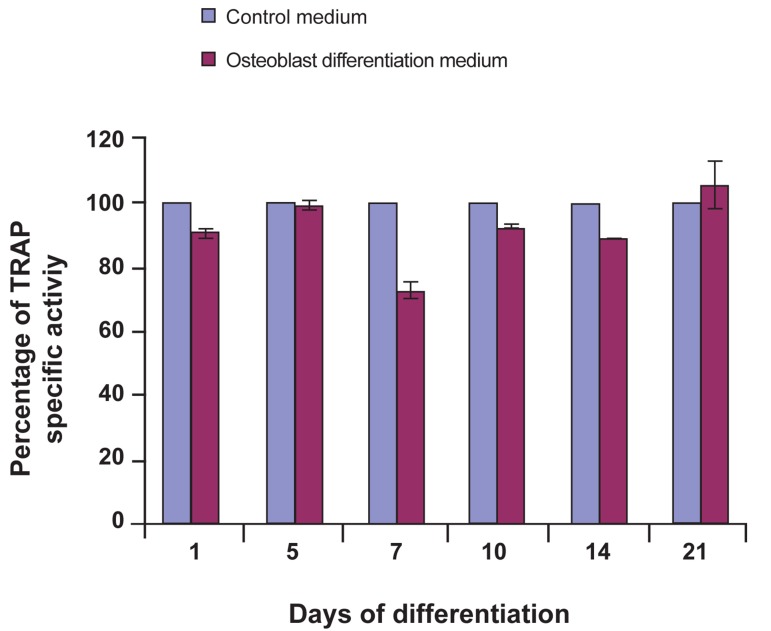
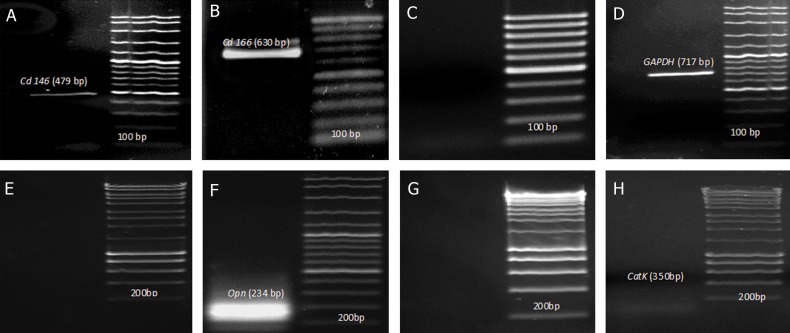
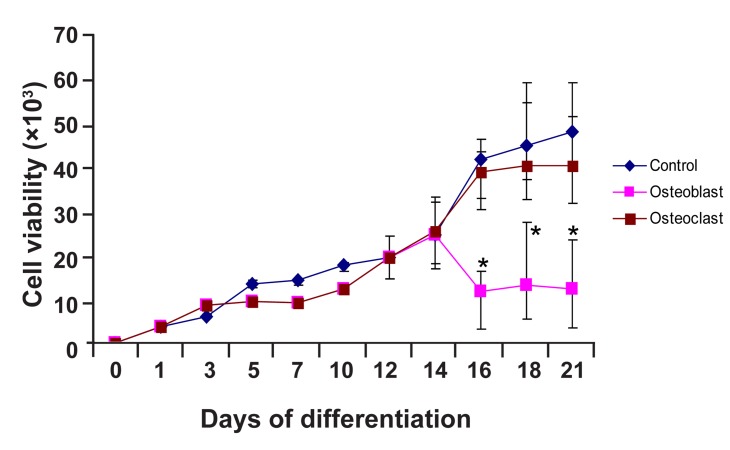
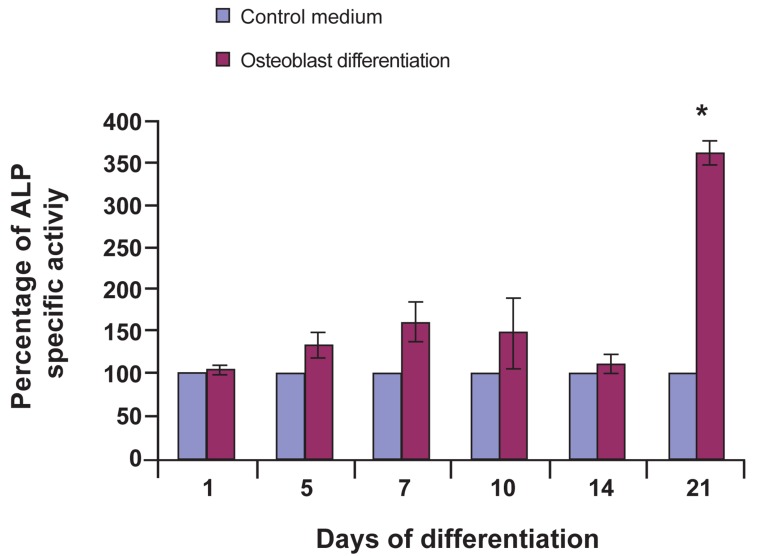
Proliferation activity of cells was estimated by 3-[4,5-dimethylthiazol-2-yl]-2,5 diphenyl tetrazolium bromide (MTT) assay. Statistical results demonstrated significant difference (p<0.05) between the control and osteoblastic induction group, whereas osteoclast cells maintained its proliferation rate (p>0.05). Morphological characterization of osteoblast and osteoclast was evaluated using von Kossa staining and May-Grunwald-Giemsa technique, respectively. Reverse transcription-polymerase chain reaction (RT-PCR) molecular analysis demonstrated that mouse DPSCs expressed Cd146 and Cd166 markers, but did not express Cd31, indicating that these cells belong to mesenchymal stem cells. Osteoblast cells with positive osteopontin (Opn) marker were found after 21 days, whereas this marker was negative for DPSCs. CatK, as an osteoclast marker, was negative in both osteoclast differentiation medium and control group. Biochemical analyses in osteoblast differentiated groups showed alkaline phosphatase (ALP) activity significantly increased on day 21 as compared to control (p<0.05). In osteoclast differentiated groups, tartrate-resistant acid phosphatase (TRAP) activity representing osteoclast biomarker didn't show statistically significant as compared to control (p>0.05).
DPSCs have the ability to differentiate into osteoblast, but not into osteoclast.
我们的研究试图表明,具有易得性、增殖能力和更高增殖率等特征的小鼠牙髓干细胞(DPSCs)可为生成骨组织提供一种改良方法。本研究旨在寻找和比较来源于 DPSCs 的间充质干细胞向成骨细胞和破骨细胞分化的能力;进行了形态学、分子和生化分析。
在这项实验研究中,通过特定的分化培养基诱导成骨细胞和破骨细胞分化。为了诱导成骨细胞分化,在含有α-改良 Eagle 培养基(α-MEM)、15%胎牛血清(FBS)和青霉素/链霉素的完全培养基中加入 50μg/ml 的抗坏血酸和 10mMβ-甘油磷酸作为生长因子,而要诱导破骨细胞分化,则在完全培养基中加入 10ng/ml 核因子κ B 配体受体激活剂(RANKL)和 5ng/ml 巨噬细胞集落刺激因子(M-CSF)。使用 t 检验对成骨细胞和破骨细胞分化组与对照组进行统计学比较。
通过 3-[4,5-二甲基噻唑-2-基]-2,5-二苯基四氮唑溴盐(MTT)测定法估计细胞的增殖活性。统计结果表明,对照组与成骨诱导组之间存在显著差异(p<0.05),而破骨细胞则保持其增殖率(p>0.05)。通过 von Kossa 染色和 May-Grunwald-Giemsa 技术分别评估成骨细胞和破骨细胞的形态特征。逆转录-聚合酶链反应(RT-PCR)分子分析表明,小鼠 DPSCs 表达 Cd146 和 Cd166 标志物,但不表达 Cd31,表明这些细胞属于间充质干细胞。在第 21 天发现具有骨桥蛋白(Opn)标志物阳性的成骨细胞,而 DPSCs 则为阴性。作为破骨细胞标志物的组织蛋白酶 K(CatK)在成骨细胞分化培养基和对照组中均为阴性。在成骨细胞分化组中,碱性磷酸酶(ALP)活性在第 21 天与对照组相比显著增加(p<0.05)。在破骨细胞分化组中,作为破骨细胞生物标志物的抗酒石酸酸性磷酸酶(TRAP)活性与对照组相比没有统计学意义(p>0.05)。
DPSCs 具有分化为成骨细胞的能力,但不能分化为破骨细胞。