Departamento de Fisiologia, Faculdade de Medicina de Ribeirão Preto, Universidade de São Paulo, Ribeirão PretoSP, Brasil, Departamento de Fisiologia, Faculdade de Medicina de Ribeirão Preto, Universidade de São Paulo, Ribeirão Preto, SP, Brasil.
Braz J Med Biol Res. 2014 Feb;47(2):90-100. doi: 10.1590/1414-431X20133326. Epub 2014 Jan 17.
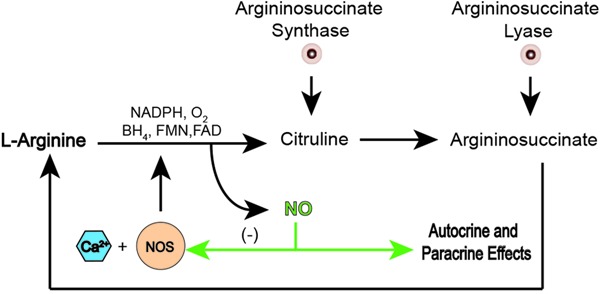
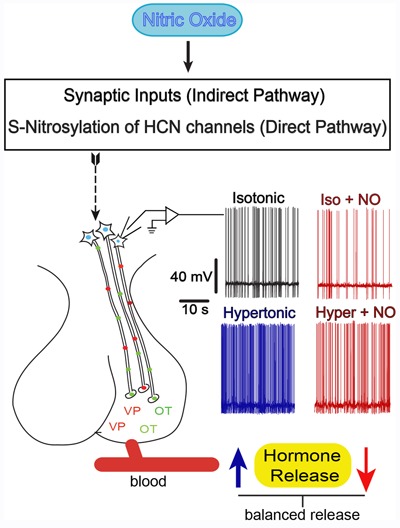
Physiological evidence indicates that the supraoptic nucleus (SON) is an important region for integrating information related to homeostasis of body fluids. Located bilaterally to the optic chiasm, this nucleus is composed of magnocellular neurosecretory cells (MNCs) responsible for the synthesis and release of vasopressin and oxytocin to the neurohypophysis. At the cellular level, the control of vasopressin and oxytocin release is directly linked to the firing frequency of MNCs. In general, we can say that the excitability of these cells can be controlled via two distinct mechanisms: 1) the intrinsic membrane properties of the MNCs themselves and 2) synaptic input from circumventricular organs that contain osmosensitive neurons. It has also been demonstrated that MNCs are sensitive to osmotic stimuli in the physiological range. Therefore, the study of their intrinsic membrane properties became imperative to explain the osmosensitivity of MNCs. In addition to this, the discovery that several neurotransmitters and neuropeptides can modulate their electrical activity greatly increased our knowledge about the role played by the MNCs in fluid homeostasis. In particular, nitric oxide (NO) may be an important player in fluid balance homeostasis, because it has been demonstrated that the enzyme responsible for its production has an increased activity following a hypertonic stimulation of the system. At the cellular level, NO has been shown to change the electrical excitability of MNCs. Therefore, in this review, we focus on some important points concerning nitrergic modulation of the neuroendocrine system, particularly the effects of NO on the SON.
生理学证据表明,视上核(SON)是整合与体液内稳态相关信息的重要区域。该核位于视交叉的两侧,由负责合成和释放血管加压素和催产素到神经垂体的大细胞神经分泌细胞(MNC)组成。在细胞水平上,血管加压素和催产素释放的控制与 MNC 的放电频率直接相关。一般来说,我们可以说这些细胞的兴奋性可以通过两种不同的机制来控制:1)MNC 自身的固有膜特性,2)来自含有渗透压神经元的室周器官的突触输入。已经证明 MNC 对生理范围内的渗透压刺激敏感。因此,研究它们的固有膜特性对于解释 MNC 的渗透压敏感性变得至关重要。除此之外,发现几种神经递质和神经肽可以调节它们的电活动,这极大地增加了我们对 MNC 在体液稳态中所扮演角色的认识。特别是,一氧化氮(NO)可能是体液平衡稳态中的一个重要参与者,因为已经证明,负责其产生的酶在系统受到高渗刺激后活性增加。在细胞水平上,已经表明 NO 会改变 MNC 的电兴奋性。因此,在本综述中,我们重点介绍了有关氮能调制神经内分泌系统的一些重要观点,特别是 NO 对 SON 的影响。