Ullrich Antje, Hauer Johannes, Farin Erik
Medical Center, University of Freiburg, Institute for Quality Management and Social Medicine, Freiburg, Germany.
Patient Prefer Adherence. 2014 Jan 31;8:135-45. doi: 10.2147/PPA.S53474. eCollection 2014.
Communication with patients with fibromyalgia syndrome (FMS) is often considered difficult. The primary objective of this explorative study was to describe the communication preferences of FMS patients in comparison with other chronic diseases, and the secondary objective was to identify patient-related predictors of those communication preferences.
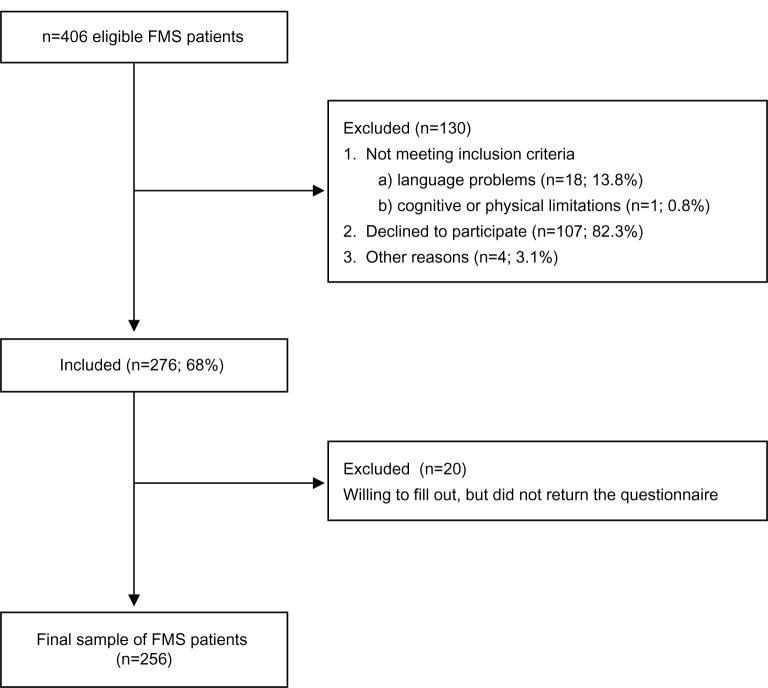
A total of 256 FMS patients were asked to fill out the KOPRA [(Kommunikationspraeferenzen), communication preferences of patients with chronic illness] questionnaire at the beginning of their rehabilitation, answering questions about their communication preferences. The KOPRA's descriptive parameters were calculated and compared with other diagnosis groups. In order to include as many influencing factors as possible, data on patient-related sociodemographic, medical, pain impact and psychologic variables were gathered. A hierarchical regression analysis with four steps was performed to identify patient-related predictors of patients' communication preferences.
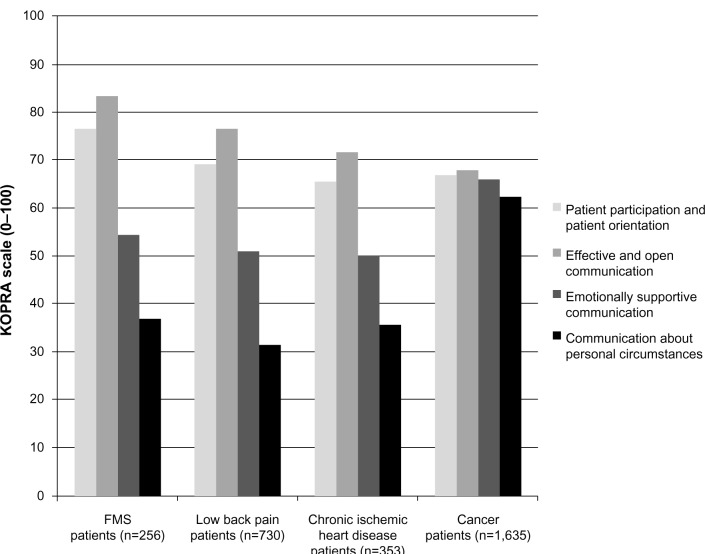
FMS patients consider an open and patient-centered communication style to be especially important. Emotionally supportive communication and communication about personal circumstances are important for FMS patients, but the preferences of individual patients vary widely. FMS patients reveal higher values in all the subdimensions of communication preferences compared with patients with low back pain or chronic ischemic heart disease. Only a few variables appear to predict patient communication preferences. The explained variance ranged from 3.1% to 9.7%. Psychologic variables have been identified as predictors in conjunction with all communication preferences.
Health care providers who communicate with FMS patients should employ an open and patient-centered communication style, and affective communication components should be adapted to accommodate each patient.
与纤维肌痛综合征(FMS)患者的沟通通常被认为具有挑战性。本探索性研究的主要目的是描述FMS患者相较于其他慢性病患者的沟通偏好,次要目的是确定与这些沟通偏好相关的患者因素。
共有256名FMS患者在康复开始时被要求填写KOPRA(慢性病患者的沟通偏好)问卷,回答有关其沟通偏好的问题。计算KOPRA的描述性参数并与其他诊断组进行比较。为了纳入尽可能多的影响因素,收集了与患者相关的社会人口统计学、医学、疼痛影响和心理变量的数据。进行了一个四步分层回归分析,以确定与患者沟通偏好相关的患者因素。
FMS患者认为开放且以患者为中心的沟通方式尤为重要。情感支持性沟通和关于个人情况的沟通对FMS患者很重要,但个体患者的偏好差异很大。与腰痛或慢性缺血性心脏病患者相比,FMS患者在沟通偏好的所有子维度上得分更高。只有少数变量似乎能预测患者的沟通偏好。解释方差范围为3.1%至9.7%。心理变量已被确定为与所有沟通偏好相关的预测因素。
与FMS患者沟通的医护人员应采用开放且以患者为中心的沟通方式,情感沟通成分应根据每位患者进行调整。