Nasiraei-Moghadam Shiva Nasiraei-Moghadam, Parivar Kazem, Ahmadiani Abolhasan, Movahhedin Mansoureh, Vaez Mahdavi Mohammad Reza
Department of Biology, Faculty of Basic Sciences, Science and Research Branch, Islamic Azad University, Tehran, Iran.
Neuroscience Research Center, Shahid Beheshti University of Medical Sciences, Tehran, Iran.
Int J Fertil Steril. 2014 Jan;7(4):313-22. Epub 2013 Dec 22.
The goals of the study are evaluation the effects of food deprivation and isolation situation as a social stress on fertility; and in the following, investigation of the improving effect of melatonin as an antioxidant component.
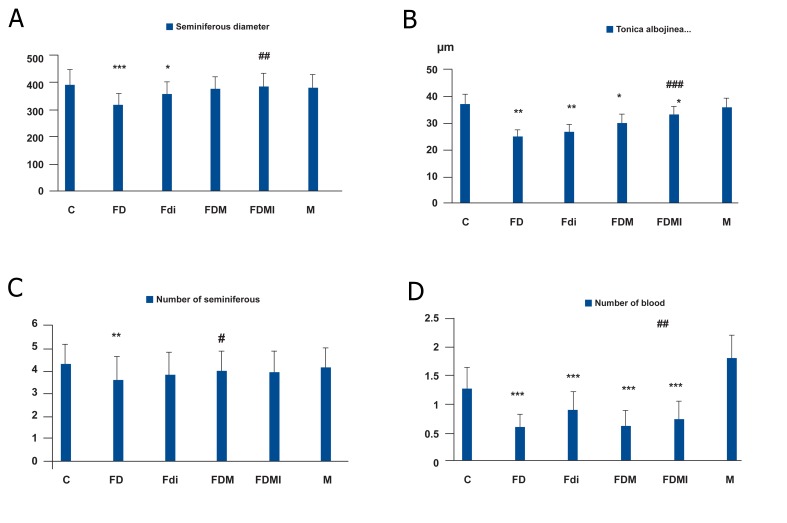
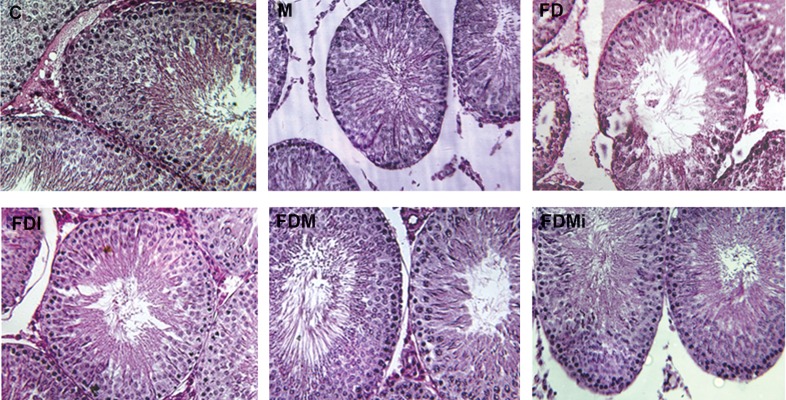
In this experimental study, We investigated histopathological and serological effects of melatonin and social stress (food deprivation and isolation) on different features of sperm and testicular tissue among 42 male rats in 7 groups including control, sham, melatonin received (M), food deprivation (FD), Food deprivation and melatonin treatment (FDM), Food deprivation and isolation situation (FDi), and Food deprivation and melatonin treatment and isolation situation (FDMi) groups. Epididymal sperms of all rats were also counted. Histopathological evaluation of the testes was done under a light microscopy to determine the number of spermiogenic cells. Serological evaluation of testosterone, corticosterone, and melatonin was performed, as well. For statistical analysis, oneway ANOVA and Tukey's post hoc test were used, and the value of p≤0.05 was considered statistically significance.
The result showed that food deprivation increased the number of abnormal, immotile, and dead sperms, while decreased the number of normal sperms (p<0.05). Isolation could improve sperm motility and viability, while enhanced the number of sper- matogenic cells. Melatonin had a protective effect on sperm count, motility, and viability, while reduced sperm abnormality.
Our results demonstrated that melatonin treatment and isolation situation improve the parameters related to epididymal sperms and spermatogenic cells after food deprivation.
本研究的目的是评估食物剥夺和隔离这种社会应激对生育能力的影响;接下来,研究褪黑素作为一种抗氧化成分的改善作用。
在本实验研究中,我们调查了褪黑素和社会应激(食物剥夺和隔离)对7组共42只雄性大鼠精子和睾丸组织不同特征的组织病理学和血清学影响,这7组包括对照组、假手术组、接受褪黑素组(M)、食物剥夺组(FD)、食物剥夺并接受褪黑素治疗组(FDM)、食物剥夺并处于隔离状态组(FDi)以及食物剥夺并接受褪黑素治疗且处于隔离状态组(FDMi)。还对所有大鼠的附睾精子进行了计数。在光学显微镜下对睾丸进行组织病理学评估以确定生精细胞数量。同时也进行了睾酮、皮质酮和褪黑素的血清学评估。对于统计分析,采用单因素方差分析和Tukey事后检验,p≤0.05的值被认为具有统计学意义。
结果表明,食物剥夺增加了异常、不活动和死亡精子的数量,同时减少了正常精子的数量(p<0.05)。隔离可提高精子活力和存活率,同时增加生精细胞数量。褪黑素对精子数量、活力和存活率有保护作用,同时减少精子异常。
我们的结果表明,褪黑素治疗和隔离状态可改善食物剥夺后与附睾精子和生精细胞相关的参数。