Department of Animal and Poultry Sciences, Virginia Tech, Blacksburg, VA USA.
Nutr Metab (Lond). 2014 Feb 12;11(1):10. doi: 10.1186/1743-7075-11-10.
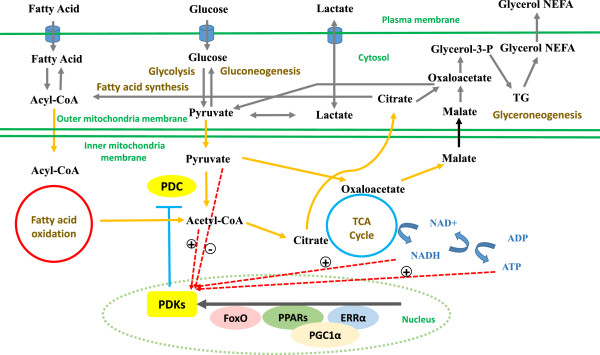
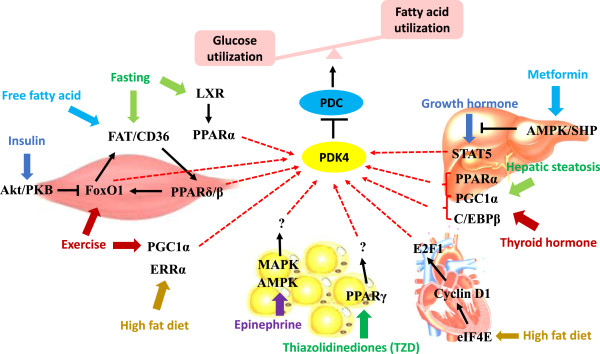
Metabolic flexibility is the capacity of a system to adjust fuel (primarily glucose and fatty acids) oxidation based on nutrient availability. The ability to alter substrate oxidation in response to nutritional state depends on the genetically influenced balance between oxidation and storage capacities. Competition between fatty acids and glucose for oxidation occurs at the level of the pyruvate dehydrogenase complex (PDC). The PDC is normally active in most tissues in the fed state, and suppressing PDC activity by pyruvate dehydrogenase (PDH) kinase (PDK) is crucial to maintain energy homeostasis under some extreme nutritional conditions in mammals. Conversely, inappropriate suppression of PDC activity might promote the development of metabolic diseases. This review summarizes PDKs' pivotal role in control of metabolic flexibility under various nutrient conditions and in different tissues, with emphasis on the best characterized PDK4. Understanding the regulation of PDC and PDKs and their roles in energy homeostasis could be beneficial to alleviate metabolic inflexibility and to provide possible therapies for metabolic diseases, including type 2 diabetes (T2D).
代谢灵活性是指一个系统根据营养物质的可用性来调整燃料(主要是葡萄糖和脂肪酸)氧化的能力。根据营养状态改变底物氧化的能力取决于氧化和储存能力之间受遗传影响的平衡。脂肪酸和葡萄糖在丙酮酸脱氢酶复合物(PDC)水平上发生氧化竞争。PDC 在大多数组织中处于进食状态时通常是活跃的,而通过丙酮酸脱氢酶(PDH)激酶(PDK)抑制 PDC 活性对于哺乳动物在某些极端营养条件下维持能量稳态至关重要。相反,PDC 活性的不当抑制可能会促进代谢疾病的发展。这篇综述总结了 PDK 在各种营养条件下和不同组织中控制代谢灵活性的关键作用,重点介绍了研究最充分的 PDK4。了解 PDC 和 PDKs 的调节及其在能量稳态中的作用可能有助于缓解代谢灵活性,并为包括 2 型糖尿病(T2D)在内的代谢疾病提供可能的治疗方法。