Heiden Susi, Vignon-Zellweger Nicolas, Masuda Shigeru, Yagi Keiko, Nakayama Kazuhiko, Yanagisawa Masashi, Emoto Noriaki
Department of Clinical Pharmacy, Kobe Pharmaceutical University, Kobe, Japan.
Division of Cardiovascular Medicine, Department of Internal Medicine, Kobe University Graduate School of Medicine, Kobe, Japan.
PLoS One. 2014 Feb 11;9(2):e88730. doi: 10.1371/journal.pone.0088730. eCollection 2014.
Endothelin-1 participates in the pathophysiology of heart failure. The reasons for the lack of beneficial effect of endothelin antagonists in heart failure patients remain however speculative. The anti-apoptotic properties of ET-1 on cardiomyocytes could be a reasonable explanation. We therefore hypothesized that blocking the pro-apoptotic TNF-α pathway using pentoxifylline could prevent the deleterious effect of the lack of ET-1 in a model for heart failure.
We performed transaortic constriction (TAC) in vascular endothelial cells specific ET-1 deficient (VEETKO) and wild type (WT) mice (n = 5-9) and treated them with pentoxifylline for twelve weeks.
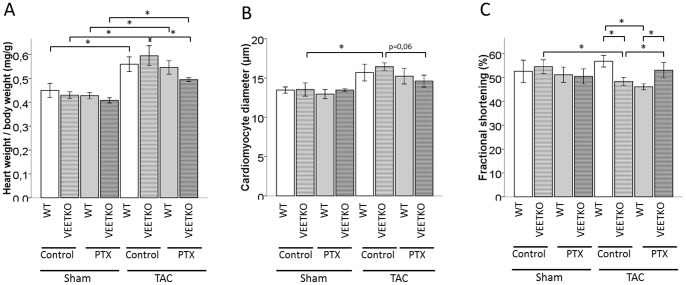
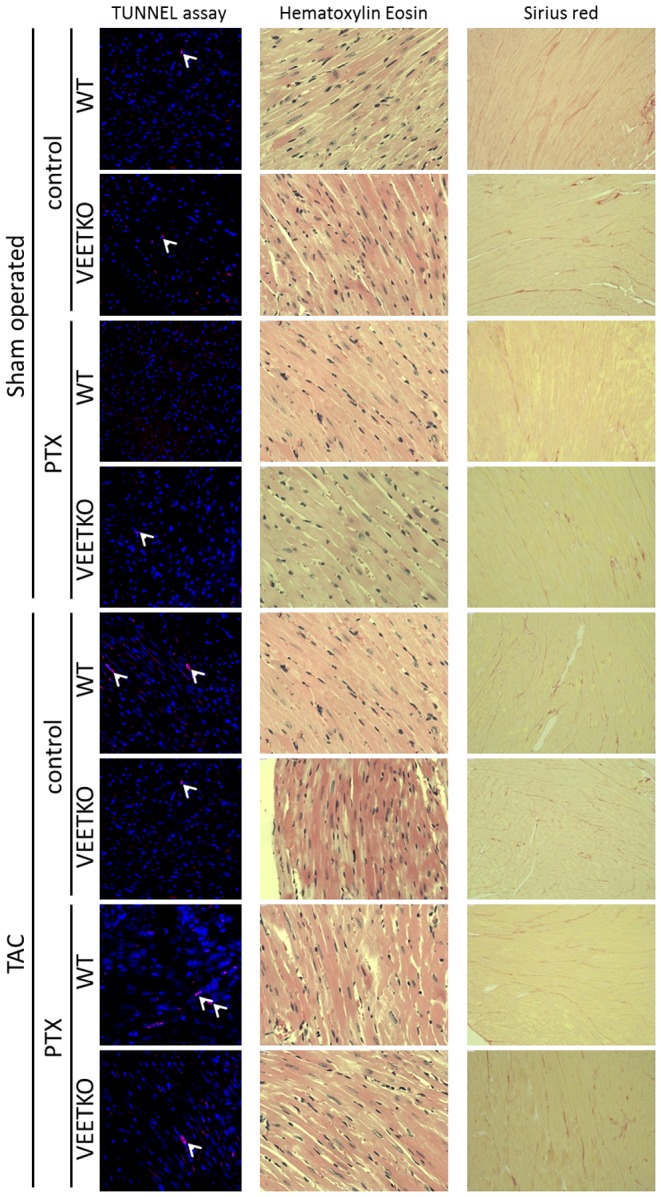
TAC induced a cardiac hypertrophy in VEETKO and WT mice but a reduction of fractional shortening could be detected by echocardiography in VEETKO mice only. Cardiomyocyte diameter was significantly increased by TAC in VEETKO mice only. Pentoxifylline treatment prevented cardiac hypertrophy and reduction of fractional shortening in VEETKO mice but decreased fractional shortening in WT mice. Collagen deposition and number of apoptotic cells remained stable between the groups as did TNF-α, caspase-3 and caspase-8 messenger RNA expression levels. TAC surgery enhanced ANP, BNP and bcl2 expression. Pentoxifylline treatment reduced expression levels of BNP, bcl2 and bax.
Lack of endothelial ET-1 worsened the impact of TAC-induced pressure overload on cardiac function, indicating the crucial role of ET-1 for normal cardiac function under stress. Moreover, we put in light a TNF-α-independent beneficial effect of pentoxifylline in the VEETKO mice suggesting a therapeutic potential for pentoxifylline in a subpopulation of heart failure patients at higher risk.
内皮素-1参与心力衰竭的病理生理过程。然而,内皮素拮抗剂在心力衰竭患者中缺乏有益作用的原因仍属推测。内皮素-1对心肌细胞的抗凋亡特性可能是一个合理的解释。因此,我们假设使用己酮可可碱阻断促凋亡的肿瘤坏死因子-α途径可以预防心力衰竭模型中内皮素-1缺乏的有害影响。
我们对血管内皮细胞特异性内皮素-1缺陷(VEETKO)小鼠和野生型(WT)小鼠(n = 5 - 9)进行经主动脉缩窄(TAC),并用己酮可可碱治疗它们12周。
TAC在VEETKO和WT小鼠中均诱导了心脏肥大,但仅在VEETKO小鼠中通过超声心动图检测到缩短分数降低。仅在VEETKO小鼠中,TAC使心肌细胞直径显著增加。己酮可可碱治疗可预防VEETKO小鼠的心脏肥大和缩短分数降低,但降低了WT小鼠的缩短分数。各组之间的胶原沉积和凋亡细胞数量保持稳定,肿瘤坏死因子-α、半胱天冬酶-3和半胱天冬酶-8信使核糖核酸表达水平也是如此。TAC手术增强了心钠素、脑钠肽和bcl2的表达。己酮可可碱治疗降低了脑钠肽、bcl2和bax的表达水平。
内皮ET-1的缺乏加剧了TAC诱导的压力超负荷对心脏功能的影响,表明ET-1在应激状态下对正常心脏功能起关键作用。此外,我们发现己酮可可碱在VEETKO小鼠中具有不依赖肿瘤坏死因子-α的有益作用,提示己酮可可碱在高危心力衰竭患者亚群中具有治疗潜力。