The Pirbright Institute, Compton, Newbury, Berkshire RG20 7NN, UK.
Vet Res. 2014 Feb 14;45(1):19. doi: 10.1186/1297-9716-45-19.
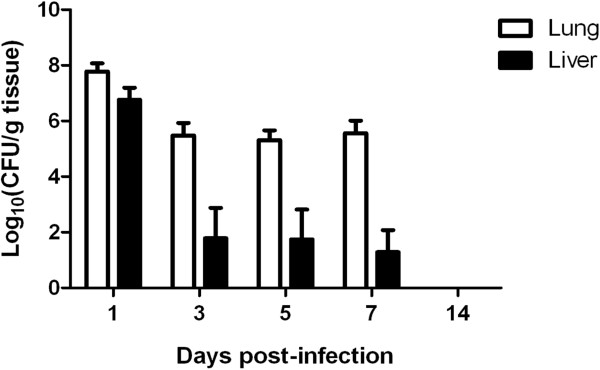
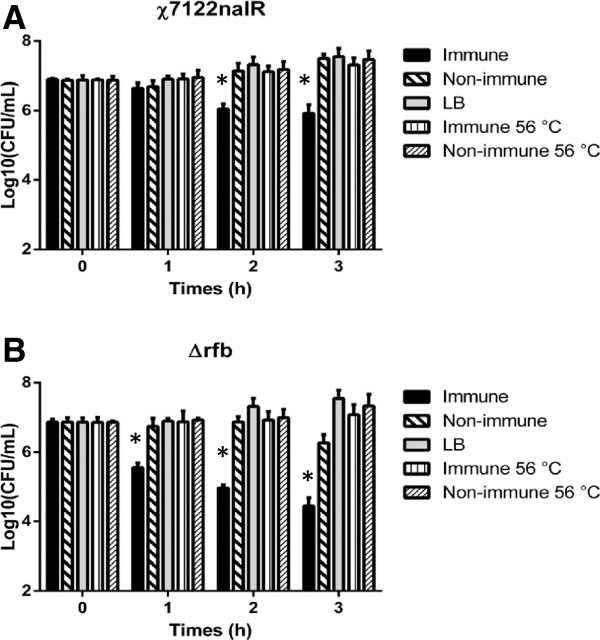
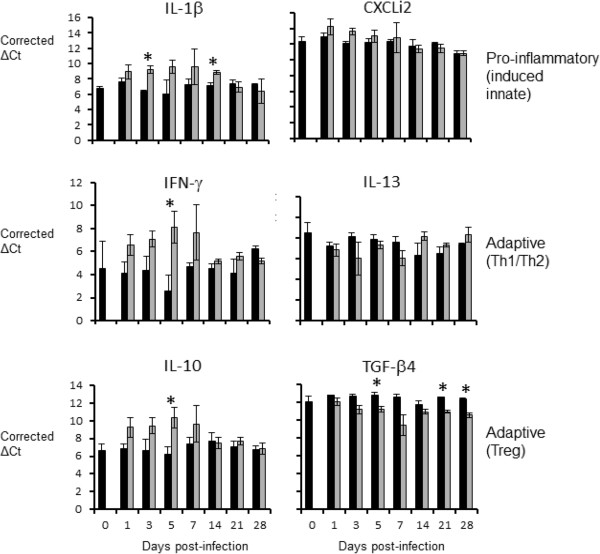
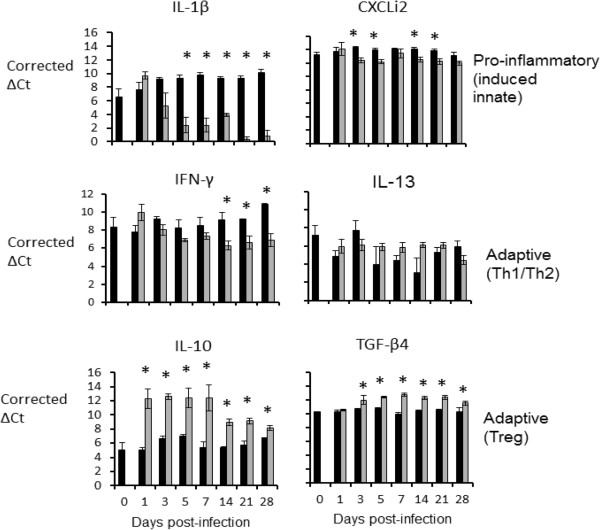
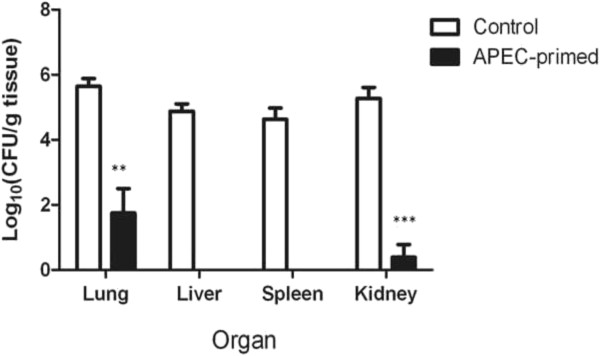
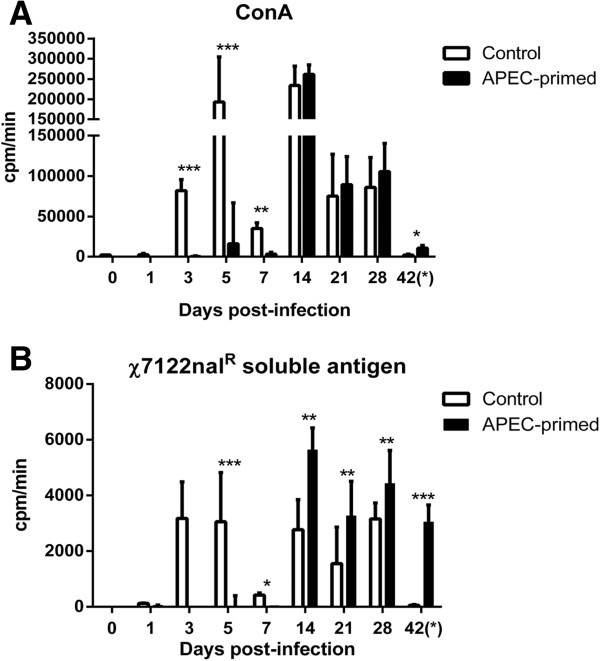
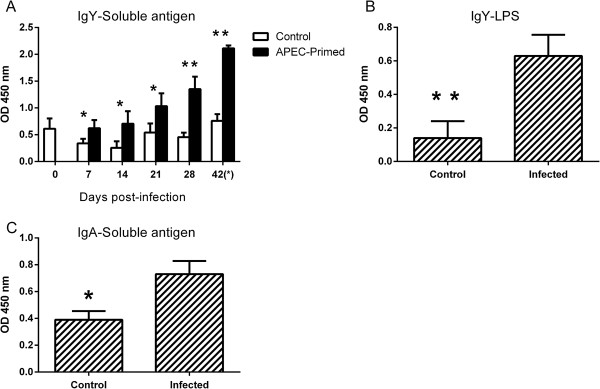
Avian pathogenic Escherichia coli (APEC) cause severe respiratory and systemic disease in poultry yet the nature and consequences of host immune responses to infection are poorly understood. Here, we describe a turkey sub-acute respiratory challenge model and cytokine, cell-mediated and humoral responses associated with protection against homologous re-challenge. Intra-airsac inoculation of turkeys with 105 colony-forming units of APEC O78:H9 strain χ7122nalR induced transient and mild clinical signs of colibacillosis followed by clearance of the bacteria from the lungs and visceral organs. Upon re-challenge with 107 χ7122nalR, primed birds were solidly protected against clinical signs and exhibited negligible bacterial loads in visceral organs, whereas age-matched control birds exhibited high lesion scores and bacterial loads in the organs. Levels of mRNA for signature cytokines suggested induction of a Th1 response in the lung, whereas a distinct anti-inflammatory cytokine profile was detected in the liver. Proliferative responses of splenocytes to either Concanavalin A or soluble χ7122nalR antigens were negligible prior to clearance of bacteria, but APEC-specific responses were significantly elevated at later time intervals and at re-challenge relative to control birds. Primary infection also induced significantly elevated χ7122nalR-specific serum IgY and bile IgA responses which were bactericidal against χ7122nalR and an isogenic Δrfb mutant. Bactericidal activity was observed in the presence of immune, but not heat-inactivated immune serum, indicating that the antibodies can fix complement and are not directed solely at the lipopolysaccharide O-antigen. Such data inform the rational design of strategies to control a recalcitrant endemic disease of poultry.
禽致病性大肠杆菌(APEC)可引起家禽严重的呼吸道和全身疾病,但宿主对感染的免疫反应的性质和后果知之甚少。在这里,我们描述了一个火鸡亚急性呼吸道挑战模型,以及与同源再挑战保护相关的细胞因子、细胞介导和体液反应。用 105 个菌落形成单位的 APEC O78:H9 菌株 χ7122nalR 对火鸡进行气囊内接种,引起短暂和轻度的大肠杆菌病临床症状,随后细菌从肺部和内脏器官清除。用 107 χ7122nalR 对免疫的火鸡进行再挑战,可完全防止临床症状,并使内脏器官中的细菌负荷显著降低,而年龄匹配的对照火鸡则表现出高病变评分和器官中的细菌负荷。特征细胞因子的 mRNA 水平表明在肺部诱导了 Th1 反应,而在肝脏中检测到了明显的抗炎细胞因子谱。在清除细菌之前,脾细胞对刀豆蛋白 A 或可溶性 χ7122nalR 抗原的增殖反应可忽略不计,但在后期时间间隔和再挑战时,相对于对照鸟类,APEC 特异性反应显著升高。初次感染还诱导了显著升高的 χ7122nalR 特异性血清 IgY 和胆汁 IgA 反应,对 χ7122nalR 和同源 rfb 缺失突变体具有杀菌作用。在存在免疫而不是热失活免疫血清的情况下观察到杀菌活性,表明抗体可以固定补体,而不仅仅针对脂多糖 O-抗原。这些数据为控制家禽顽固地方性疾病的策略的合理设计提供了信息。