From the Division of Cancer Therapeutics, Institute of Cancer Research, Sutton, Surrey SM2 5NG, UK.
BMC Biochem. 2014 Feb 13;15:3. doi: 10.1186/1471-2091-15-3.
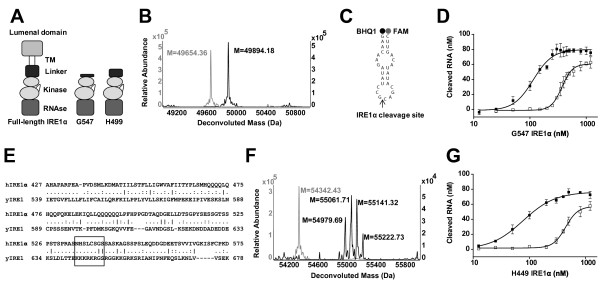
Endoplasmic reticulum stress, caused by the presence of misfolded proteins, activates the stress sensor inositol-requiring enzyme 1α (IRE1α). The resulting increase in IRE1α RNase activity causes sequence-specific cleavage of X-box binding protein 1 (XBP1) mRNA, resulting in upregulation of the unfolded protein response and cellular adaptation to stress. The precise mechanism of human IRE1α activation is currently unclear. The role of IRE1α kinase activity is disputed, as results from the generation of various kinase-inactivating mutations in either yeast or human cells are discordant. Kinase activity can also be made redundant by small molecules which bind the ATP binding site. We set out to uncover a role for IRE1α kinase activity using wild-type cytosolic protein constructs.
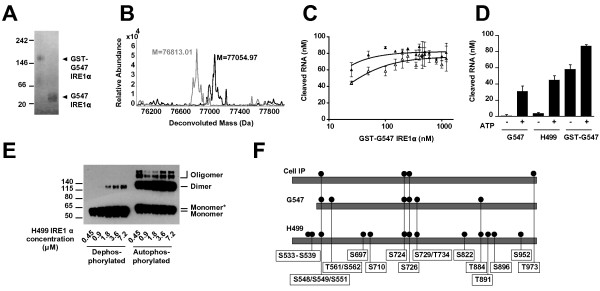
We show that concentration-dependent oligomerisation is sufficient to cause IRE1α cytosolic domain RNase activity in vitro. We demonstrate a role for the kinase activity by showing that autophosphorylation enhances RNase activity. Inclusion of the IRE1α linker domain in protein constructs allows hyperphosphorylation and further enhancement of RNase activity, highlighting the importance of kinase activity. We show that IRE1α phosphorylation status correlates with an increased propensity to form oligomeric complexes and that forced dimerisation causes great enhancement in RNase activity. In addition we demonstrate that even when IRE1α is forced to dimerise, by a GST-tag, phospho-enhancement of activity is still observed.
Taken together these experiments support the hypothesis that phosphorylation is important in modulating IRE1α RNase activity which is achieved by increasing the propensity of IRE1α to dimerise. This work supports the development of IRE1α kinase inhibitors for use in the treatment of secretory cancers.
内质网应激是由错误折叠的蛋白质引起的,它会激活肌醇需求酶 1α(IRE1α)的应激传感器。由此导致的 IRE1α RNA 酶活性增加会导致 X 盒结合蛋白 1(XBP1)mRNA 的序列特异性切割,从而上调未折叠蛋白反应和细胞对应激的适应。目前,人类 IRE1α 激活的确切机制尚不清楚。IRE1α 激酶活性的作用存在争议,因为在酵母或人类细胞中产生的各种激酶失活突变的结果不一致。激酶活性也可以通过与 ATP 结合位点结合的小分子变得冗余。我们着手使用野生型细胞质蛋白构建体来揭示 IRE1α 激酶活性的作用。
我们表明,浓度依赖性寡聚足以在体外引起 IRE1α 细胞质结构域 RNA 酶活性。我们通过显示自磷酸化增强 RNA 酶活性来证明激酶活性的作用。将 IRE1α 连接结构域包含在蛋白质构建体中可以允许过度磷酸化并进一步增强 RNA 酶活性,突出了激酶活性的重要性。我们表明,IRE1α 磷酸化状态与形成寡聚复合物的倾向增加相关,并且强制二聚化导致 RNA 酶活性大大增强。此外,我们还证明,即使 IRE1α 通过 GST 标签强制二聚化,也仍然观察到磷酸化增强活性。
这些实验共同支持了这样一种假设,即磷酸化在调节 IRE1α RNA 酶活性中很重要,这种调节是通过增加 IRE1α 二聚化的倾向来实现的。这项工作支持开发 IRE1α 激酶抑制剂用于治疗分泌性癌症。