Zentrum für Molekulare Biologie der Universität Heidelberg (ZMBH); Deutsches Krebsforschungszentrum (DKFZ)-ZMBH Alliance; Heidelberg, Germany.
RNA Biol. 2014;11(2):95-100. doi: 10.4161/rna.27798. Epub 2014 Feb 5.
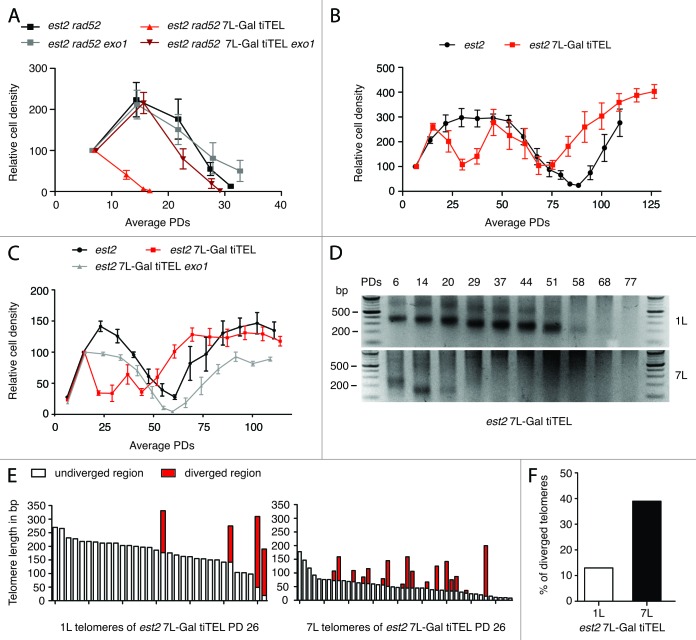
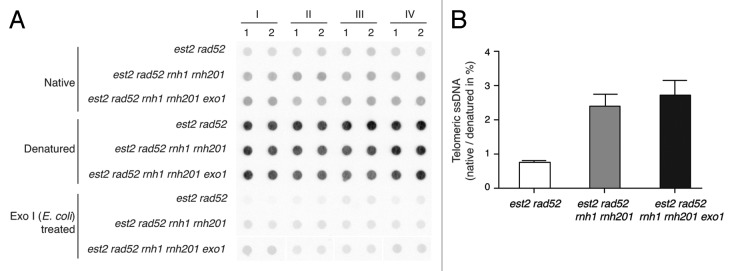
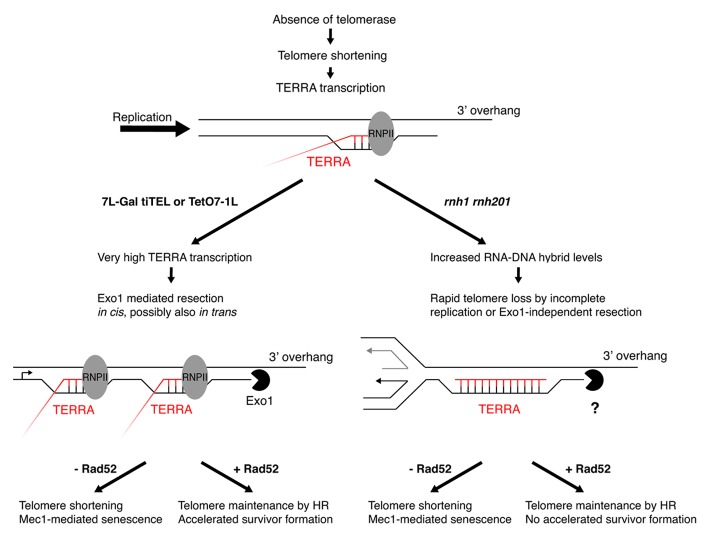
Telomeres are protective nucleoprotein structures at the ends of eukaryotic chromosomes. Despite the heterochromatic state of telomeres they are transcribed, generating non-coding telomeric repeat-containing RNA (TERRA). Strongly induced TERRA transcription has been shown to cause telomere shortening and accelerated senescence in the absence of both telomerase and homology-directed repair (HDR). Moreover, it has recently been demonstrated that TERRA forms RNA-DNA hybrids at chromosome ends. The accumulation of RNA-DNA hybrids at telomeres also leads to rapid senescence and telomere loss in the absence of telomerase and HDR. Conversely, in the presence of HDR, telomeric RNA-DNA hybrid accumulation and increased telomere transcription promote telomere recombination, and hence, delayed senescence. Here, we demonstrate that despite these similar phenotypic outcomes, telomeres that are highly transcribed are not processed in the same manner as those that accumulate RNA-DNA hybrids.
端粒是真核染色体末端的保护性核蛋白结构。尽管端粒处于异染色质状态,但它们也被转录,产生非编码端粒重复含 RNA(TERRA)。大量诱导的 TERRA 转录已被证明会导致端粒缩短和加速衰老,而没有端粒酶和同源定向修复(HDR)的情况下。此外,最近已经证明 TERRA 在染色体末端形成 RNA-DNA 杂交体。端粒中 RNA-DNA 杂交体的积累也会导致在没有端粒酶和 HDR 的情况下快速衰老和端粒丢失。相反,在 HDR 存在的情况下,端粒 RNA-DNA 杂交体的积累和增加的端粒转录促进端粒重组,从而延迟衰老。在这里,我们证明尽管这些表型结果相似,但高度转录的端粒的处理方式与积累 RNA-DNA 杂交体的端粒不同。