University of Leeds & NIHR Leeds Musculoskeletal Biomedical Research Unit, , Leeds, UK.
Ann Rheum Dis. 2014 May;73(5):810-6. doi: 10.1136/annrheumdis-2013-204762. Epub 2014 Feb 13.
To examine the imaging-detected mechanism of reduction of structural joint damage progression by tocilizumab (TCZ) in patients with rheumatoid arthritis (RA) using MRI.
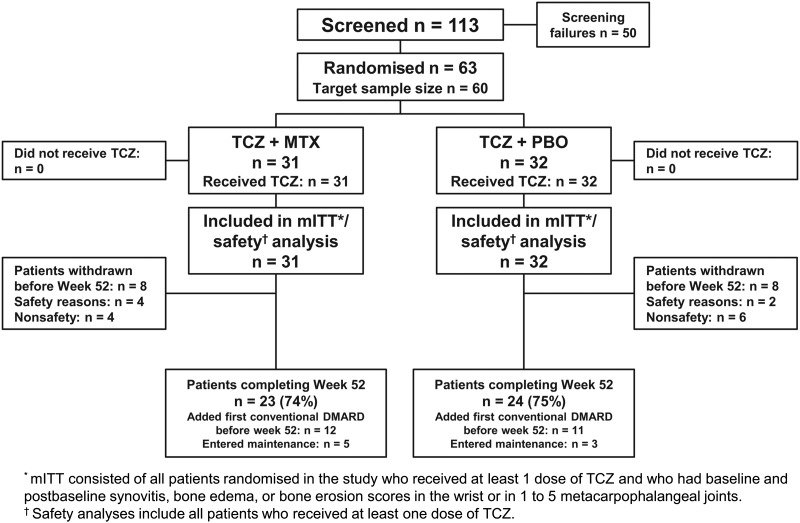
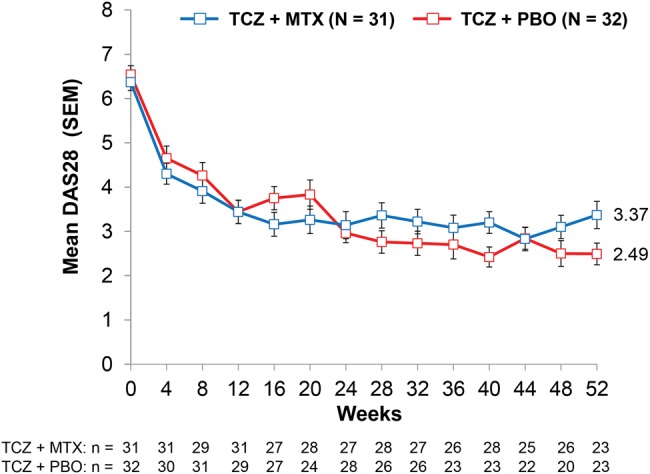
In a substudy of a randomised, double-blind, phase 3b study (ACT-RAY) of biologic-naïve patients with RA who were methotrexate (MTX)-inadequate responders, 63 patients were randomised to continue MTX or receive placebo (PBO), both in combination with TCZ 8 mg/kg every 4 weeks, with optional additional disease-modifying antirheumatic drugs at week 24 if Disease Activity Score of 28 joints < 3.2. The most symptomatic hand was imaged with 0.2 Tesla extremity MRI at weeks 0, 2, 12 and 52. MR images were scored using Outcome Measures in Rheumatology-Rheumatoid Arthritis Magnetic Resonance Imaging Score. Predictors of week 52 erosion progression were determined by logistic regression analysis.
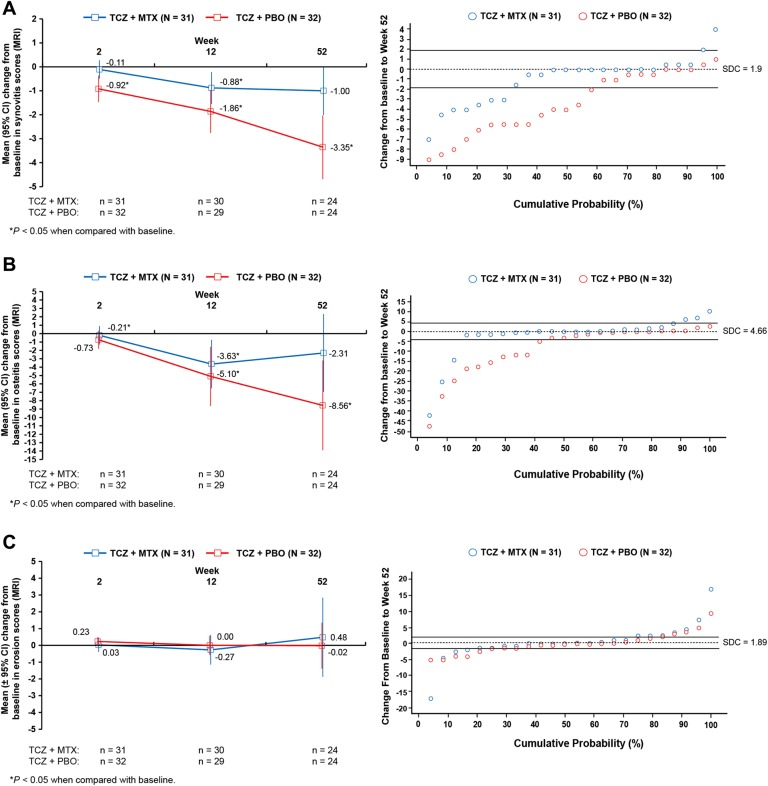
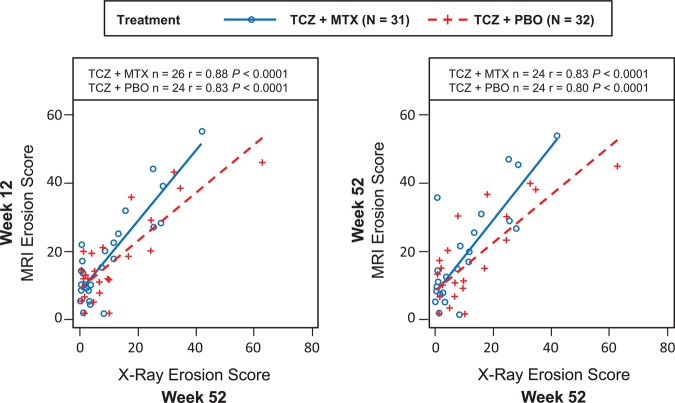
TCZ + PBO (n=32) demonstrated mean improvements in synovitis from baseline to weeks 2 (-0.92; p=0.0011), 12 (-1.86; p<0.0001) and 52 (-3.35; p<0.0001), while TCZ + MTX (n=31) had mean improvements in synovitis at week 12 (-0.88; p=0.0074), but not week 52 (-1.00; p=0.0711). TCZ+PBO demonstrated mean reductions in osteitis at weeks 12 (-5.10; p=0.0022) and 52 (-8.56; p=0.0006), while TCZ+MTX had mean reductions at weeks 2 (-0.21; p<0.05) and 12 (-3.63; p=0.0008), but not week 52 (-2.31; p=0.9749). Mean erosion scores did not worsen in either group. MRI erosion scores at weeks 12 and 52 correlated strongly with radiography erosion scores at week 52 (r>0.80). Baseline synovitis and worsening of osteitis predicted erosion progression.
Rapid suppression of synovitis and osteitis with reduction in structural joint damage progression occurred with TCZ, as monotherapy or in combination with MTX, through week 52.
使用 MRI 检查托珠单抗 (TCZ) 降低类风湿关节炎 (RA) 患者结构关节损伤进展的影像学检测机制。
在一项生物初治、甲氨蝶呤 (MTX) 应答不足的 RA 患者的随机、双盲、3b 期研究 (ACT-RAY) 的子研究中,63 名患者被随机分配继续接受 MTX 或安慰剂 (PBO),同时每 4 周接受 TCZ 8mg/kg,第 24 周时如果 28 个关节疾病活动评分 < 3.2,则可选择加用疾病修饰抗风湿药物。在 0、2、12 和 52 周时,使用 0.2 特斯拉肢体 MRI 对最有症状的手进行成像。使用风湿病学-类风湿关节炎磁共振成像评分 (Outcome Measures in Rheumatology-Rheumatoid Arthritis Magnetic Resonance Imaging Score) 对 MR 图像进行评分。使用逻辑回归分析确定 52 周侵蚀进展的预测因子。
TCZ+PBO(n=32)从基线到第 2、12 和 52 周时滑膜炎的平均改善分别为 -0.92(p=0.0011)、-1.86(p<0.0001)和 -3.35(p<0.0001),而 TCZ+MTX(n=31)在第 12 周时滑膜炎的平均改善为 -0.88(p=0.0074),但第 52 周时无明显改善(-1.00;p=0.0711)。TCZ+PBO 显示第 12 和 52 周时骨炎的平均减少分别为 -5.10(p=0.0022)和 -8.56(p=0.0006),而 TCZ+MTX 则在第 2 和 12 周时平均减少分别为 -0.21(p<0.05)和 -3.63(p=0.0008),但第 52 周时无明显减少(-2.31;p=0.9749)。两组的侵蚀评分均无恶化。第 12 和 52 周的 MRI 侵蚀评分与第 52 周的放射学侵蚀评分密切相关(r>0.80)。基线滑膜炎和骨炎恶化预测侵蚀进展。
TCZ 单药或与 MTX 联合治疗可迅速抑制滑膜炎和骨炎,从而减少结构关节损伤的进展,直至第 52 周。