Department of Hematology and Oncology, Graduate School of Medicine, Kyoto University, 54 Shogoin-Kawahara-cho, Sakyo-ku, Kyoto 606-8507, Japan.
Exp Hematol Oncol. 2014 Feb 17;3(1):6. doi: 10.1186/2162-3619-3-6.
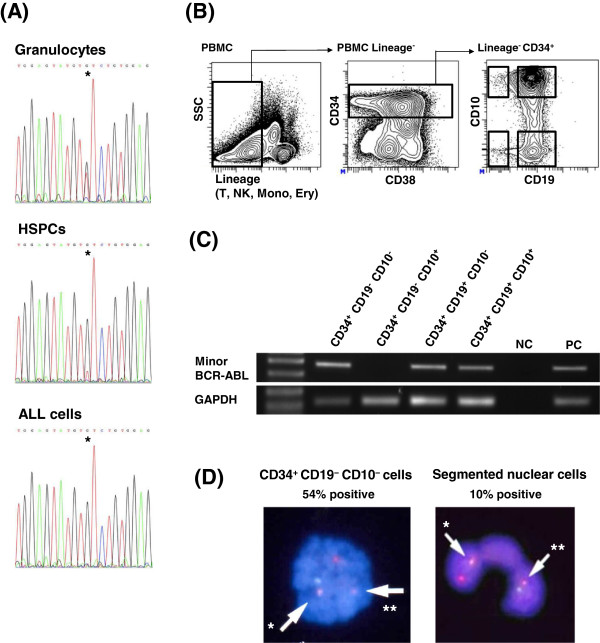
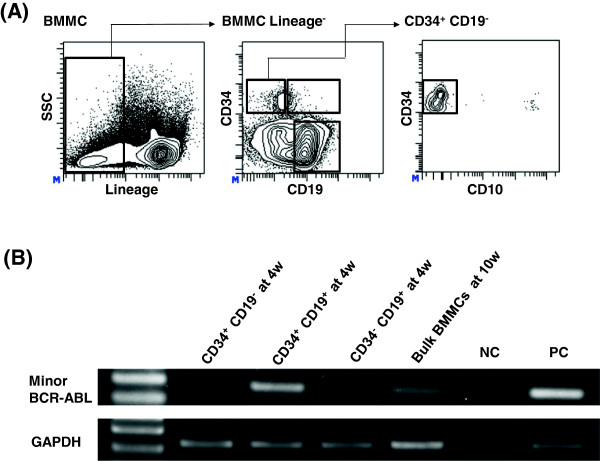
Here we report on a case of Philadelphia chromosome positive B lymphoblastic leukemia (Ph+ALL), which developed following a long duration of essential thrombocythemia (ET). A mutational analysis of Janus Kinase 2 (JAK2) revealed that the V617F mutation was present in granulocytes and in hematopoietic stem and progenitor cells (HSPCs), but not in the CD34+CD19+ population that mostly consists of Ph+ALL cells, indicating that this Ph+ALL clone did not originate from the ET clone carrying the JAK2-V617F mutation. The minor BCR-ABL1 fusion was detected not only in the CD34+CD19+ population but also in HSPCs and granulocytes, indicating that the Philadelphia chromosome was acquired in an early hematopoietic stage at least prior to the commitment to B cell development. Upon dasatinib treatment, the minor BCR-ABL1 transcript rapidly disappeared in HSPCs but persisted in the CD34+CD19+ population. A relapse of Ph+ALL occurred nine months later without the disappearance of the minor BCR-ABL1 transcript in the bone marrow cells during the treatment course, suggesting that a resistant Ph+ALL clone may have arisen or been selected in the committed B cells rather than in HSPCs. This case report may partly contribute to filling the gap between previous data acquired from mice experiments and the phenomenon in real patients.
我们在此报告一例费城染色体阳性 B 淋巴母细胞白血病(Ph+ALL),该患者在原发性血小板增多症(ET)长期发展后发生。Janus 激酶 2(JAK2)的突变分析显示,V617F 突变存在于粒细胞和造血干细胞和祖细胞(HSPCs)中,但不存在于主要由 Ph+ALL 细胞组成的 CD34+CD19+群体中,表明该 Ph+ALL 克隆并非源自携带 JAK2-V617F 突变的 ET 克隆。小 BCR-ABL1 融合不仅在 CD34+CD19+群体中检测到,而且在 HSPCs 和粒细胞中也检测到,表明费城染色体在至少在向 B 细胞发育作出承诺之前的早期造血阶段获得。达沙替尼治疗后,小 BCR-ABL1 转录本在 HSPCs 中迅速消失,但在 CD34+CD19+群体中持续存在。九个月后,Ph+ALL 复发,在治疗过程中骨髓细胞中的小 BCR-ABL1 转录本没有消失,提示在已定向的 B 细胞中可能已经出现或选择了耐药性 Ph+ALL 克隆,而不是在 HSPCs 中。本病例报告可能部分有助于填补从小鼠实验获得的先前数据与真实患者中现象之间的差距。