Liew Ei Leen, Araki Marito, Hironaka Yumi, Mori Seiichi, Tan Tuan Zea, Morishita Soji, Edahiro Yoko, Ohsaka Akimichi, Komatsu Norio
Department of Hematology, Juntendo University School of Medicine, 2-1-1 Hongo, Bunkyo-ku, Tokyo, 113-8421 Japan ; Fujii Memorial Research Institute, Otsuka Pharmaceutical Co., Ltd., Shiga, Japan.
Department of Transfusion Medicine and Stem Cell Regulation, Juntendo University School of Medicine, Tokyo, Japan.
Exp Hematol Oncol. 2016 Jan 28;5:2. doi: 10.1186/s40164-016-0032-7. eCollection 2015.
The gain-of-function mutation JAK2V617F is frequently found in Philadelphia-chromosome-negative myeloproliferative neoplasm (MPN) patients. However, the tumorigenic properties of JAK2V617F have mostly been characterized in in vivo and in vitro murine models due to the lack of appropriate human cell lines.
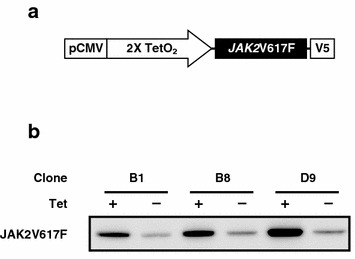
Using the multipotent hematologic cell line UT-7/GM, we established D9, a novel human cell line that expresses JAK2V617F upon tetracycline addition. We assessed cellular differentiation in UT-7/GM cells when JAK2V617F was induced, and we used microarrays to analyze changes in mRNA expression caused by JAK2V617F.
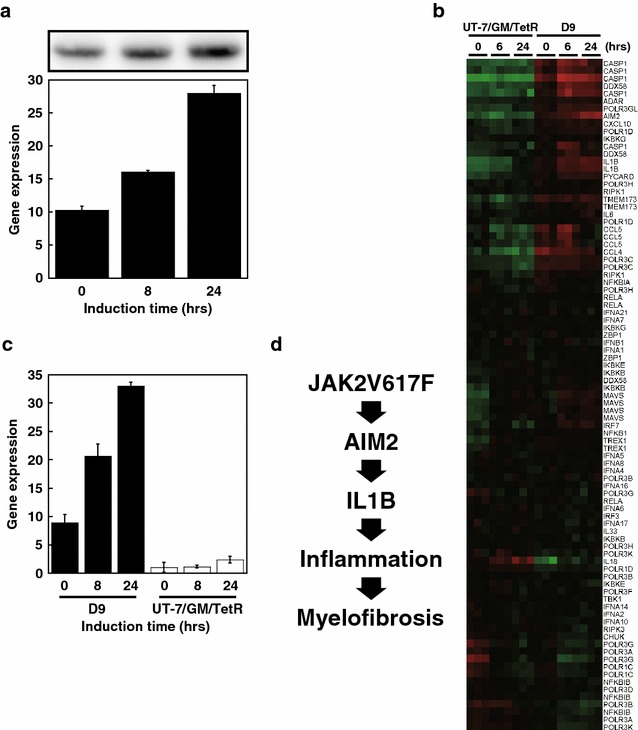
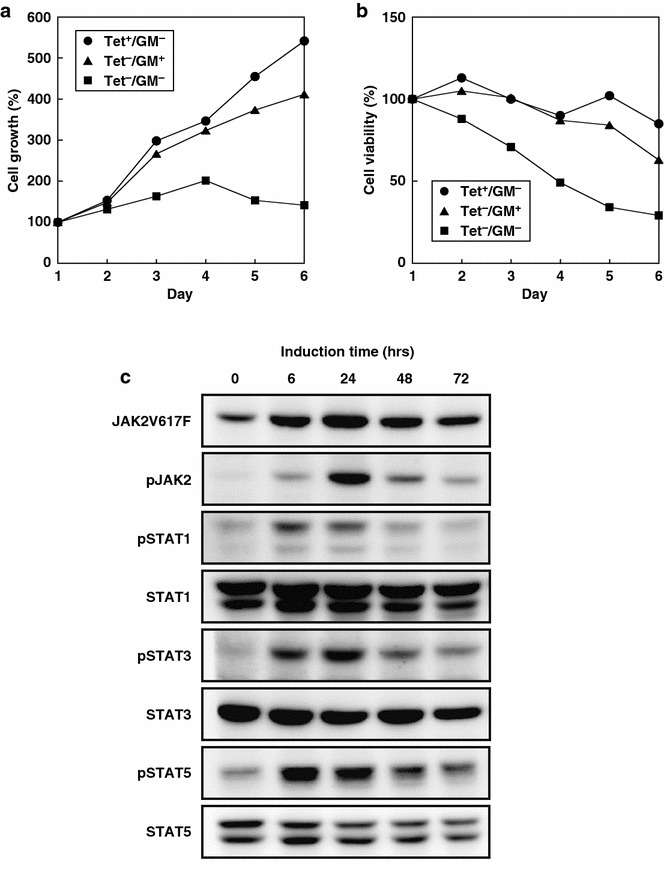
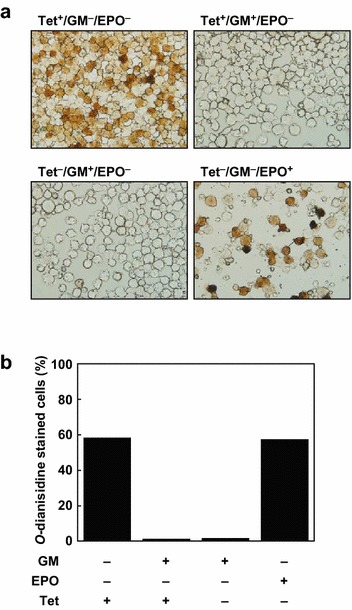
Using the human D9 cell line, we demonstrated that the induction of JAK2V617F leads to cytokine-independent cell growth with increased STAT activation and erythroid differentiation, mimicking the characteristics observed in polycythemia vera, making it a suitable in vitro model for studying this disorder. Interestingly, JAK2V617F-dependent erythroid cell differentiation was blocked when GM-CSF was added to the culture, suggesting that the GM-CSF pathway antagonizes JAK2V617F-induced erythroid cell differentiation. Our microarray analysis identified several genes involved in inflammasome activation, such as AIM2, IL1B, and CASP1, which were significantly up-regulated in JAK2V617F-induced cells.
The observed inflammasome activation following JAK2V617F induction is consistent with a recent report demonstrating the involvement of IL1B in myelofibrosis development in a JAK2V617F model mouse. These results indicate that the D9 cell line should be useful for characterizing the signaling pathways downstream of JAK2V617F, allowing for the identification of effector molecules that contribute to the development of MPN.
功能获得性突变JAK2V617F在费城染色体阴性骨髓增殖性肿瘤(MPN)患者中经常被发现。然而,由于缺乏合适的人类细胞系,JAK2V617F的致瘤特性大多在体内和体外小鼠模型中得到表征。
我们使用多能血液细胞系UT-7/GM建立了D9,这是一种新型人类细胞系,在添加四环素后表达JAK2V617F。我们评估了诱导JAK2V617F时UT-7/GM细胞的细胞分化,并使用微阵列分析JAK2V617F引起的mRNA表达变化。
使用人类D9细胞系,我们证明JAK2V617F的诱导导致细胞因子非依赖性细胞生长,STAT激活增加和红系分化,模拟真性红细胞增多症中观察到的特征,使其成为研究这种疾病的合适体外模型。有趣的是,当向培养物中添加GM-CSF时,JAK2V617F依赖性红系细胞分化被阻断,这表明GM-CSF途径拮抗JAK2V617F诱导的红系细胞分化。我们的微阵列分析鉴定了几个参与炎性小体激活的基因,如AIM2、IL1B和CASP1,它们在JAK2V617F诱导的细胞中显著上调。
JAK2V617F诱导后观察到的炎性小体激活与最近一份报告一致,该报告证明IL1B参与JAK2V617F模型小鼠的骨髓纤维化发展。这些结果表明,D9细胞系应有助于表征JAK2V617F下游的信号通路,从而鉴定有助于MPN发展的效应分子。