Department of Family Medicine and Community Health, and the Center for Clinical Epidemiology and Biostatistics at the Perelman School of Medicine, University of Pennsylvania, 222 Blockley Hall, 423 Guardian Drive, Philadelphia, PA 19104, USA.
BMC Cancer. 2014 Feb 15;14:95. doi: 10.1186/1471-2407-14-95.
Accurate indication classification is critical for obtaining unbiased estimates of colonoscopy effectiveness and quality improvement efforts, but there is a dearth of published systematic classification approaches. The objective of this study was to evaluate the effects of data-source and adjudication on indication classification and on estimates of the effectiveness of screening colonoscopy on late-stage colorectal cancer diagnosis risk.
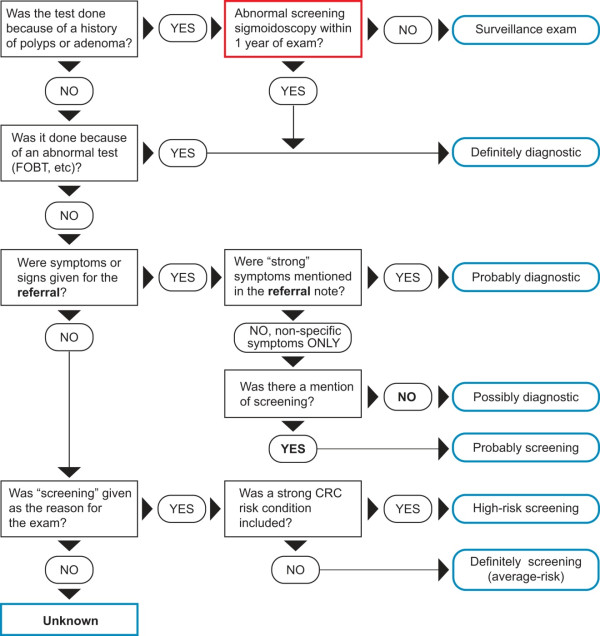
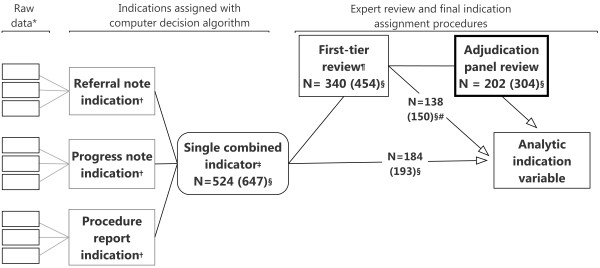
This was an observational study in members of four U.S. health plans. Eligible persons (n = 1039) were age 55-85 and had been enrolled for 5 years or longer in their health plans during 2006-2008. Patients were selected based on late-stage colorectal cancer diagnosis in a case-control design; each case patient was matched to 1-2 controls by study site, age, sex, and health plan enrollment duration. Reasons for colonoscopies received in the 10-year period before the reference date were collected from three medical records sources (progress notes; referral notes; procedure reports) and categorized using an algorithm, with committee adjudication of some tests. We evaluated indication classification concordance before and after adjudication and used logistic regressions with the Wald Chi-square test to compare estimates of the effects of screening colonoscopy on late-stage colorectal cancer diagnosis risk for each of our data sources to the adjudicated indication.
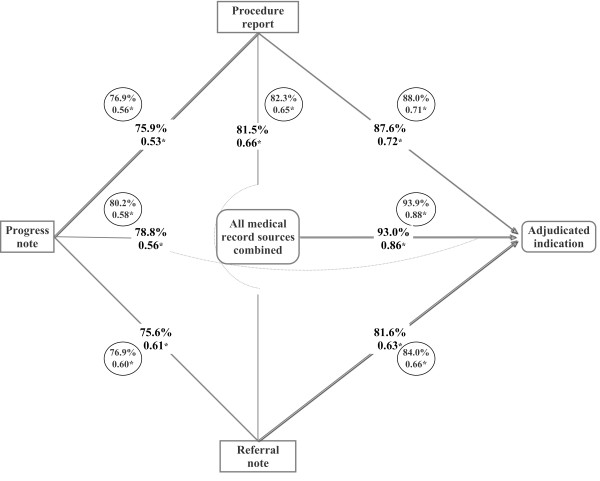
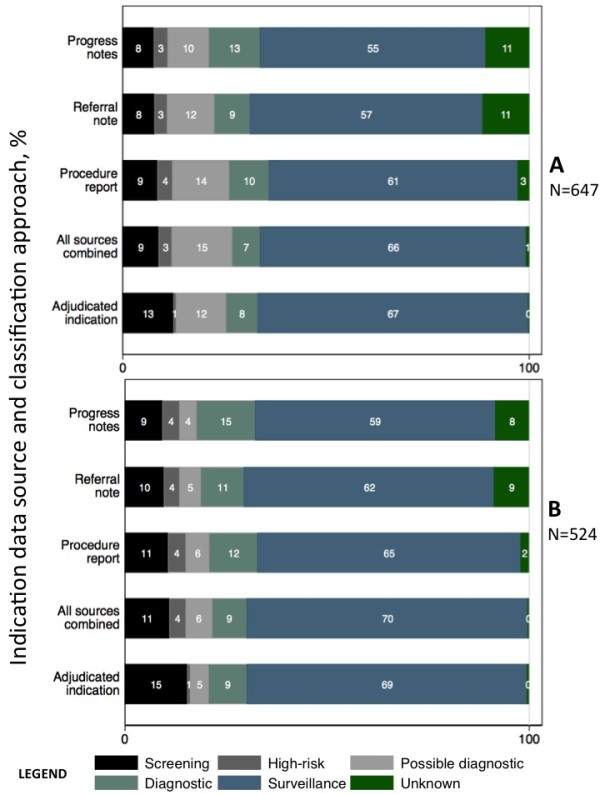
Classification agreement between each data-source and adjudication was 78.8-94.0% (weighted kappa = 0.53-0.72); the highest agreement (weighted kappa = 0.86-0.88) was when information from all data sources was considered together. The choice of data-source influenced the association between screening colonoscopy and late-stage colorectal cancer diagnosis; estimates based on progress notes were closest to those based on the adjudicated indication (% difference in regression coefficients = 2.4%, p-value = 0.98), as compared to estimates from only referral notes (% difference in coefficients = 34.9%, p-value = 0.12) or procedure reports (% difference in coefficients = 27.4%, p-value = 0.23).
There was no single gold-standard source of information in medical records. The estimates of colonoscopy effectiveness from progress notes alone were the closest to estimates using adjudicated indications. Thus, the details in the medical records are necessary for accurate indication classification.
准确的适应证分类对于获得无偏倚的结肠镜检查效果和质量改进效果估计至关重要,但目前发表的系统分类方法却很少。本研究的目的是评估数据源和裁定对适应证分类以及对筛查性结肠镜检查降低晚期结直肠癌诊断风险效果的估计的影响。
这是一项在美国四个健康计划成员中进行的观察性研究。符合条件的人员(n=1039)年龄在 55-85 岁之间,并且在 2006-2008 年期间在其健康计划中登记了 5 年或更长时间。在病例对照设计中,根据晚期结直肠癌的诊断选择患者;每个病例患者按研究地点、年龄、性别和健康计划登记持续时间与 1-2 名对照相匹配。从三份病历来源(病程记录、转诊记录、手术报告)中收集参考日期前 10 年内接受结肠镜检查的原因,并使用算法进行分类,一些检查由委员会裁定。我们评估了裁定前后适应证分类的一致性,并使用逻辑回归和 Wald Chi-square 检验比较了我们每个数据源的筛查性结肠镜检查对晚期结直肠癌诊断风险的影响估计值与裁定适应证的一致性。
每份数据源与裁定之间的分类一致性为 78.8-94.0%(加权 Kappa=0.53-0.72);当同时考虑所有数据源的信息时,一致性最高(加权 Kappa=0.86-0.88)。数据源的选择影响了筛查性结肠镜检查与晚期结直肠癌诊断之间的关联;基于病程记录的估计值最接近基于裁定适应证的估计值(回归系数的差异百分比=2.4%,p 值=0.98),而不是仅基于转诊记录的估计值(系数差异百分比=34.9%,p 值=0.12)或手术报告(系数差异百分比=27.4%,p 值=0.23)。
病历中没有单一的黄金标准信息来源。仅基于病程记录的结肠镜检查效果估计值最接近使用裁定适应证的估计值。因此,为了进行准确的适应证分类,病历中的详细信息是必要的。