Department of Paediatrics, The Chinese University of Hong Kong, Hong Kong Special Administrative Region.
Department of Paediatrics, The Chinese University of Hong Kong, Hong Kong Special Administrative Region.
Vaccine. 2014 Mar 26;32(15):1700-6. doi: 10.1016/j.vaccine.2014.01.065. Epub 2014 Feb 11.
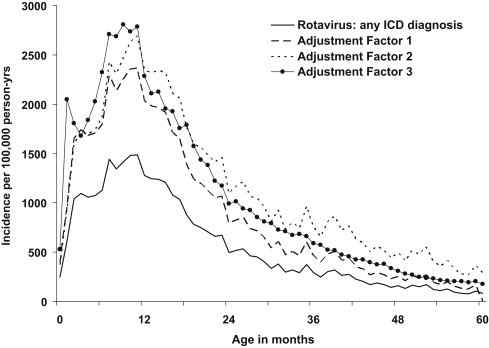
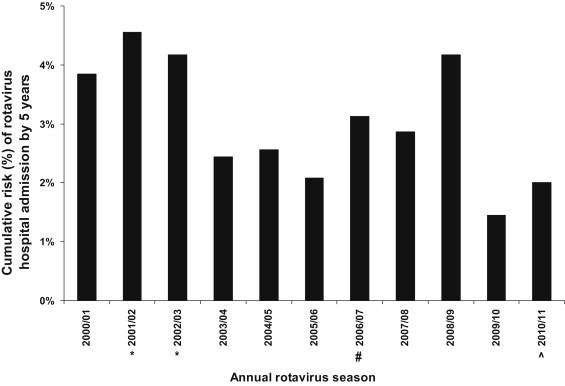
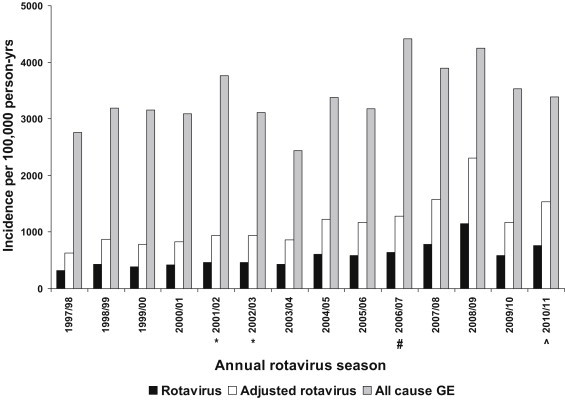
Sentinel laboratory surveillance from one hospital and passive discharge diagnosis (Clinical Management System, CMS) data from all public Hospital Authority (HA) hospitals were used to estimate disease burden and incidence of rotavirus in hospitalised Hong Kong children over 14 rotavirus seasons (1 July 1997 to 31 March 2011). A primary diagnosis of a gastroenteritis-related disorder was noted in 9.8% of children aged below 5 years, and a primary or secondary diagnosis in 11.8%. Any CMS diagnosis of rotavirus (ICD 008.61) was initially used to derive incidence estimates of rotavirus by age group. Rotavirus was recorded as any primary or any secondary diagnosis in 1.6% of children below 5 years of age. The unadjusted incidence rates per 100,000 person-years based on any CMS diagnosis of rotavirus were: 249 (0 to <1m); 612 (1 to <2m); 1066 (2 to <6m); 1383 (6 to <11m); 959 (1 to <2y); 406 (2 to <3y); 233 (3 to <4y); 124 (4 to <5y). Overall the rotavirus incidence was 1071 in children below 2 years and 542 in children below 5 years of age, with the incidence rates trending up during the time period (p=0.001). A similar but less marked upward trend (p=0.046) was noted for the incidence of all-cause gastroenteritis. Laboratory results from a single surveillance hospital (1 July 2000 to 31 March 2011) were then linked to these CMS codes to derive adjustment factors for possible over- and under-diagnosis of rotavirus based on CMS codes alone. This analysis suggested that a CMS diagnosis of rotavirus alone likely under-reported true incidence by a factor of between 1.59 and 2.02 in children below 5 years of age. Despite the availability of rotavirus vaccines in the private sector since 2006, no reduction in the incidence of hospitalisation for either rotavirus or all-cause gastroenteritis was noted in Hong Kong children below 5 years of age over 14 rotavirus seasons (1997-2011).
利用一家医院的哨点实验室监测数据和所有公立医院管理局(HA)医院的被动出院诊断(临床管理系统,CMS)数据,估计了 14 个轮状病毒季节(1997 年 7 月 1 日至 2011 年 3 月 31 日)期间香港住院儿童的疾病负担和轮状病毒发病率。年龄在 5 岁以下的儿童中,有 9.8%被诊断为与胃肠炎相关的疾病,11.8%有原发性或继发性诊断。最初使用 CMS 中任何轮状病毒(ICD008.61)的诊断来推导出轮状病毒的年龄组发病率估计值。年龄在 5 岁以下的儿童中,有 1.6%记录为任何原发性或任何继发性轮状病毒诊断。根据 CMS 中任何轮状病毒的诊断,每 100,000 人年的未经调整发病率为:249(0 至<1 个月);612(1 至<2 个月);1066(2 至<6 个月);1383(6 至<11 个月);959(1 至<2 岁);406(2 至<3 岁);233(3 至<4 岁);124(4 至<5 岁)。总体而言,2 岁以下儿童的轮状病毒发病率为 1071 例,5 岁以下儿童的发病率为 542 例,发病率呈上升趋势(p=0.001)。同样,所有病因引起的胃肠炎发病率也呈上升趋势(p=0.046)。随后,将单一监测医院(2000 年 7 月 1 日至 2011 年 3 月 31 日)的实验室结果与这些 CMS 代码相关联,以根据 CMS 代码单独得出轮状病毒过度诊断和漏诊的调整因素。该分析表明,5 岁以下儿童的 CMS 轮状病毒单独诊断可能低估了真实发病率 1.59 至 2.02 倍。尽管自 2006 年以来私营部门已经提供了轮状病毒疫苗,但在 14 个轮状病毒季节(1997-2011 年)期间,香港 5 岁以下儿童的住院轮状病毒和所有病因引起的胃肠炎发病率均未出现下降。