Department of Biostatistics and Demography, Faculty of Public Health, Khon Kaen University.
J Epidemiol. 2014;24(2):154-60. doi: 10.2188/jea.je20130092. Epub 2014 Feb 15.
The prevalence of alcohol consumption among Thais is high, around 30%. We quantified the relationship between alcohol drinking and mortality in a rural population in the most populous region of Thailand.
The data were from the Khon Kaen Cohort Study. About 24 000 Thai adults were enrolled between 1990 and 2001, and follow-up for vital status continued until March 16, 2012. Mortality data were obtained from the Bureau of Policy and Strategy, Ministry of the Interior, Thailand. A Cox proportional hazards model was used to analyze the association between alcohol drinking and death, controlling for age, education level, and smoking, and floating absolute risk was used to estimate the 95% confidence intervals of hazard ratios.
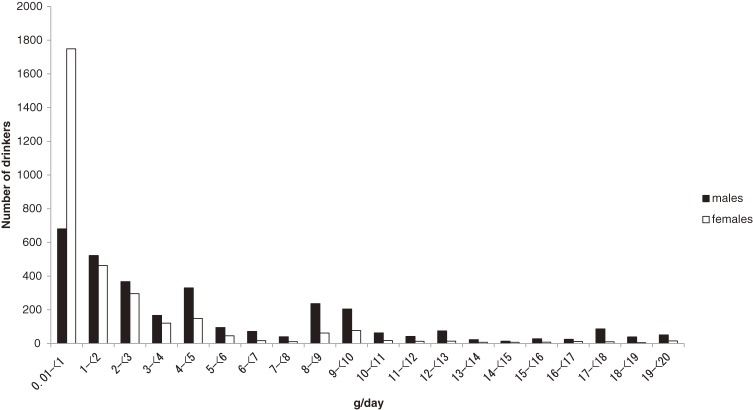
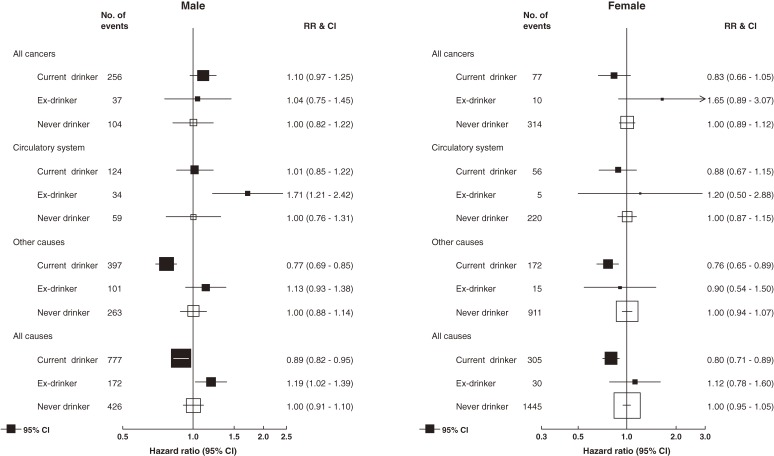
In total, 18 457 participants (5829 men and 12 628 women) were recruited, of whom 3155 died (1375 men and 1780 women) during a median follow-up period of 13.6 years. Although alcohol drinking was common (64% of men and 25% of women), the amounts consumed were very low (average, 4.3 g/day in men and 0.8 g/day in women). As compared with never drinkers, mortality risk was lower among current drinkers and higher among ex-drinkers. Current drinking was not associated with mortality from cancer or diseases of the circulatory system, although ex-drinkers appeared to have a higher risk of death from the latter.
The leading causes of mortality were not associated with current alcohol drinking at the low consumption levels observed in this population.
泰国人饮酒的流行率很高,约为 30%。我们在泰国人口最多的地区的农村人群中定量评估了饮酒与死亡率之间的关系。
数据来自孔敬队列研究。1990 年至 2001 年间,约有 24000 名泰国成年人参与了该研究,随访期持续至 2012 年 3 月 16 日。死亡数据来自内政部政策和战略局。采用 Cox 比例风险模型分析饮酒与死亡之间的关联,控制年龄、教育程度和吸烟状况,并采用浮动绝对风险来估计风险比的 95%置信区间。
共招募了 18457 名参与者(5829 名男性和 12628 名女性),其中 3155 人(1375 名男性和 1780 名女性)在中位随访期 13.6 年内死亡。尽管饮酒很普遍(64%的男性和 25%的女性),但饮酒量非常低(平均男性每天 4.3 克,女性每天 0.8 克)。与从不饮酒者相比,当前饮酒者的死亡率较低,而前饮酒者的死亡率较高。当前饮酒与癌症或循环系统疾病导致的死亡率无关,尽管前饮酒者似乎死于后者的风险更高。
在该人群观察到的低消费水平下,主要死因与当前饮酒无关。