Department of Anesthesiology and Pain Medicine, Anesthesia and Pain Research Institute, Yonsei University College of Medicine, 50-1 Yonsei-ro, Seodaemun-gu, Seoul 120-752, Korea.
Yonsei Med J. 2014 Mar;55(2):508-16. doi: 10.3349/ymj.2014.55.2.508.
Emergence agitation (EA) is frequently observed in children undergoing general anaesthesia. This study tested whether the addition of an intra-operative low-dose infusion of dexmedetomidine to fentanyl treatment reduced the incidence of emergence delirium following desflurane anesthesia in children undergoing strabismus surgery.
A total of 96 children (1-5 years old) undergoing strabismus surgery were enrolled. Anaesthesia was induced with propofol and maintained with desflurane. After induction, fentanyl (1 μg/kg) was administered to all children. During surgery, patients were infused with 0.2 μg/(kg·h)⁻¹ dexmedetomidine (Group FD, n=47) or normal saline (Group F, n=47). Postoperative objective pain score (OPS), Paediatric Agitation and Emergence Delirium (PAED) score, and EA score were documented every 10 minutes in the post-anaesthesia care unit.
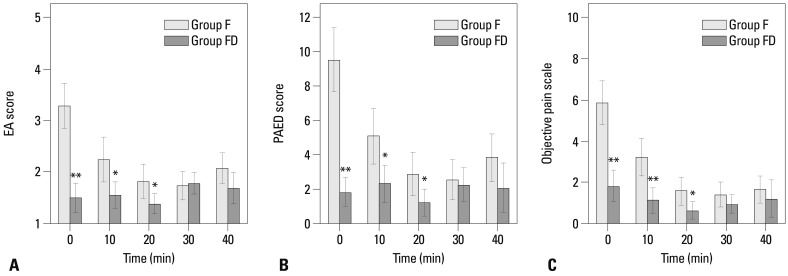
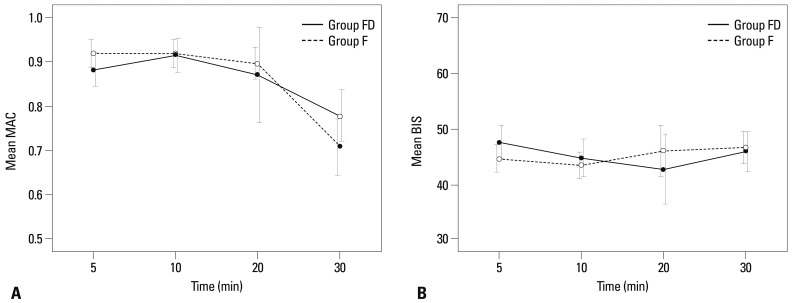
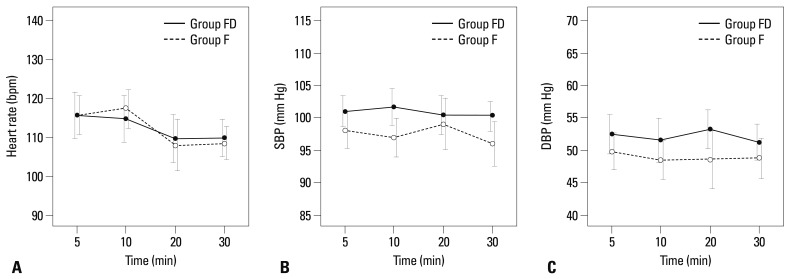
There were no significant differences between the two groups in demographic characteristics and haemodynamic changes. The mean values of maximum EA, maximum PAED, and maximum OPS score were significantly lower in Group FD than in Group F at 0, 10, and 20 minutes after arrival at the post-anaesthesia care unit (p<0.001). The frequency of fentanyl rescue was lower in Group FD than in Group F (p<0.001). The incidence of severe EA was significantly lower in Group FD than in Group F (12.8% vs. 74.5%, p<0.001).
Intra-operative low-dose infusion of dexmedetomidine in addition to fentanyl reduces EA following desflurane anaesthesia in children undergoing strabismus surgeries.
全身麻醉下的儿童常出现苏醒期躁动(EA)。本研究旨在测试在斜视手术患儿中,氟烷麻醉期间输注小剂量右美托咪定是否能降低舒芬太尼治疗后苏醒期谵妄的发生率。
共纳入 96 名(1-5 岁)行斜视手术的患儿。麻醉诱导采用丙泊酚,维持采用氟烷。诱导后,所有患儿均给予芬太尼(1μg/kg)。手术期间,患者分别接受 0.2μg/(kg·h)⁻¹右美托咪定(FD 组,n=47)或生理盐水(F 组,n=47)输注。术后在麻醉后监护室每 10 分钟记录一次患儿术后客观疼痛评分(OPS)、小儿躁动和苏醒期谵妄(PAED)评分和 EA 评分。
两组患儿在人口统计学特征和血流动力学变化方面无显著差异。FD 组患儿在到达麻醉后监护室后 0、10 和 20 分钟时的最大 EA、最大 PAED 和最大 OPS 评分均值均显著低于 F 组(p<0.001)。FD 组患儿芬太尼解救的频率显著低于 F 组(p<0.001)。FD 组患儿严重 EA 的发生率显著低于 F 组(12.8% vs. 74.5%,p<0.001)。
在斜视手术患儿中,氟烷麻醉期间输注小剂量右美托咪定可减少舒芬太尼治疗后 EA 的发生。