Veldhuis Lydian, van Grieken Amy, Renders Carry M, Hirasing Remy A, Raat Hein
Department of Public and Occupational Health, EMGO Institute for Health and Care Research, VU University Medical Centre, Amsterdam, The Netherlands ; Department of Public Health, Erasmus MC - University Medical Center Rotterdam, Rotterdam, The Netherlands.
Department of Public Health, Erasmus MC - University Medical Center Rotterdam, Rotterdam, The Netherlands.
PLoS One. 2014 Feb 12;9(2):e88486. doi: 10.1371/journal.pone.0088486. eCollection 2014.
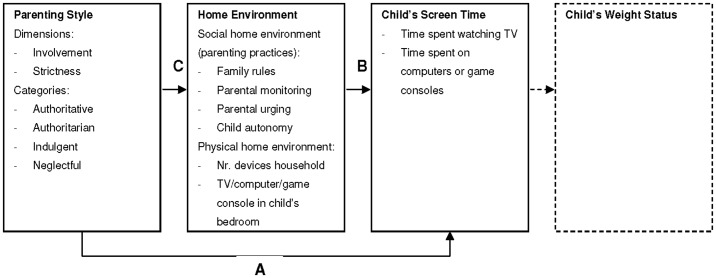
The global increase in childhood overweight and obesity has been ascribed partly to increases in children's screen time. Parents have a large influence on their children's screen time. Studies investigating parenting and early childhood screen time are limited. In this study, we investigated associations of parenting style and the social and physical home environment on watching TV and using computers or game consoles among 5-year-old children.
This study uses baseline data concerning 5-year-old children (n = 3067) collected for the 'Be active, eat right' study.
Children of parents with a higher score on the parenting style dimension involvement, were more likely to spend >30 min/day on computers or game consoles. Overall, families with an authoritative or authoritarian parenting style had lower percentages of children's screen time compared to families with an indulgent or neglectful style, but no significant difference in OR was found. In families with rules about screen time, children were less likely to watch TV>2 hrs/day and more likely to spend >30 min/day on computers or game consoles. The number of TVs and computers or game consoles in the household was positively associated with screen time, and children with a TV or computer or game console in their bedroom were more likely to watch TV>2 hrs/day or spend >30 min/day on computers or game consoles.
The magnitude of the association between parenting style and screen time of 5-year-olds was found to be relatively modest. The associations found between the social and physical environment and children's screen time are independent of parenting style. Interventions to reduce children's screen time might be most effective when they support parents specifically with introducing family rules related to screen time and prevent the presence of a TV or computer or game console in the child's room.
全球儿童超重和肥胖现象的增加部分归因于儿童屏幕使用时间的增加。父母对孩子的屏幕使用时间有很大影响。关于育儿方式与幼儿屏幕使用时间的研究有限。在本研究中,我们调查了育儿方式以及家庭社会和物理环境与5岁儿童看电视、使用电脑或游戏机之间的关联。
本研究使用了为“积极运动,合理饮食”研究收集的5岁儿童(n = 3067)的基线数据。
在育儿方式维度“参与度”上得分较高的父母的孩子,每天花在电脑或游戏机上的时间超过30分钟的可能性更大。总体而言,与放任或忽视型育儿方式的家庭相比,权威型或专制型育儿方式的家庭中孩子屏幕使用时间的百分比更低,但未发现比值比有显著差异。在有屏幕使用时间规定的家庭中,孩子每天看电视超过2小时的可能性较小,而每天花在电脑或游戏机上超过30分钟的可能性较大。家庭中电视、电脑或游戏机的数量与屏幕使用时间呈正相关,卧室里有电视、电脑或游戏机的孩子每天看电视超过2小时或花在电脑或游戏机上超过30分钟的可能性更大。
研究发现,育儿方式与5岁儿童屏幕使用时间之间的关联程度相对较小。社会和物理环境与儿童屏幕使用时间之间的关联独立于育儿方式。减少儿童屏幕使用时间的干预措施在专门支持父母制定与屏幕使用时间相关的家庭规则并防止孩子房间里出现电视、电脑或游戏机时可能最有效。