Carlsen Jonathan Frederik, Ewertsen Caroline, Săftoiu Adrian, Lönn Lars, Nielsen Michael Bachmann
Department of Radiology, Rigshospitalet Copenhagen University Hospital, Copenhagen, Denmark.
Research Center of Gastroenterology and Hepatology, University of Medicine and Pharmacy, Craiova, Romania ; Department of Endoscopy, Gastrointestinal Unit, Copenhagen University Hospital Herlev, Herlev, Denmark.
PLoS One. 2014 Feb 12;9(2):e88699. doi: 10.1371/journal.pone.0088699. eCollection 2014.
The aim of this study was to evaluate the performance of strain elastography in an elasticity phantom and to assess which factors influenced visual scoring, strain histograms and strain ratios. Furthermore this study aimed to evaluate the effect of observer experience on visual scorings.
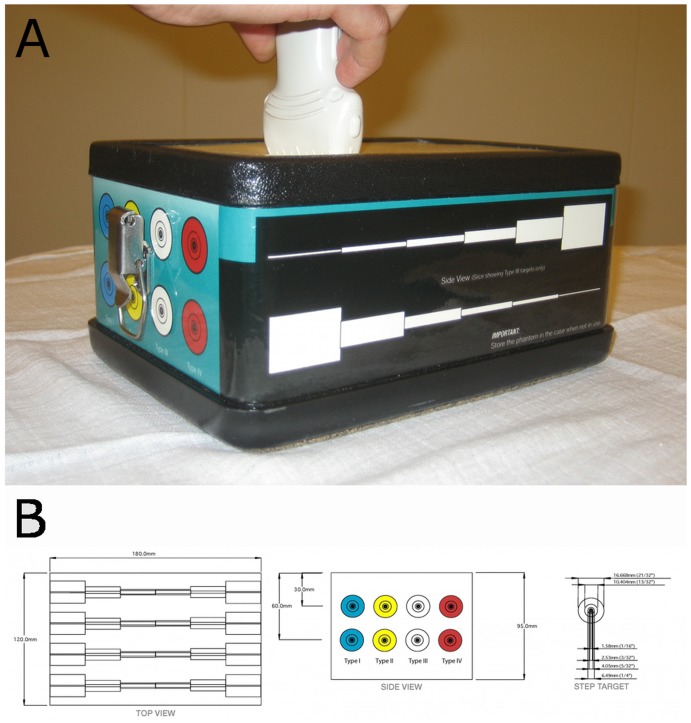
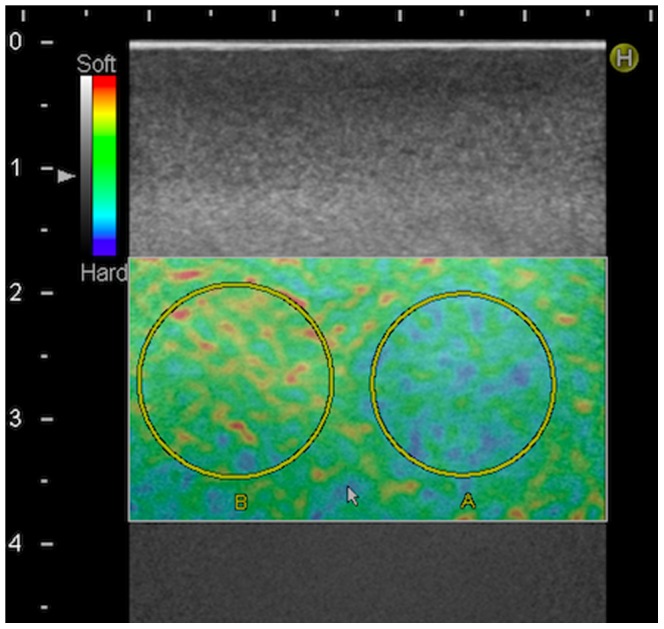
Two operators examined 20 targets of various stiffness and size (16.7 to 2.5 mm) in an elasticity phantom at a depth of 3.5 cm with a 5-18 MHz transducer. Two pre-settings were used yielding 80 scans. Eight evaluators, four experienced, four inexperienced, performed visual scorings. Cut-offs for semi-quantitative methods were established for prediction of target stiffness. Data was pooled in two categories allowing calculations of sensitivity and specificity. Statistical tests chi-square test and linear regression as relevant.
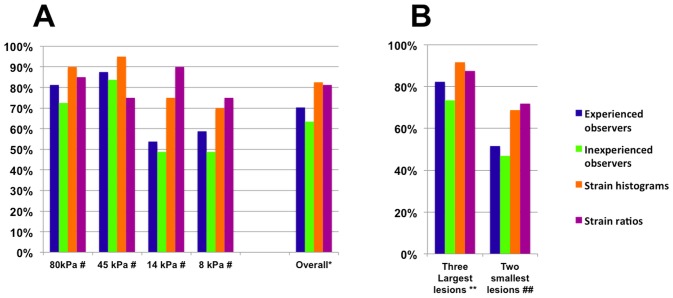
Strain ratios and strain histograms were superior to visual scorings of both experienced and inexperienced observers (p = 0.025, strain histograms vs. experienced observers, p<0.001, strain histograms vs. inexperienced observers, p = 0.044 strain ratios vs. experienced observers and p = 0.002 strain ratios vs. inexperienced observers). No significant difference in predicting target stiffness between strain ratios and strain histograms (p = 0.83) nor between experienced and inexperienced observers (p = 0.054) was shown when using four categories. When pooling data in two groups (80 kPa/45 kPa vs. 14/8 kPa) the difference between the observers became significant (p<0.001). Target size had a significant influence on strain ratios measurements (p = 0.017) and on visual scorings (p<0.001) but not on the strain histograms(p = 0.358). Observer experience had significant effect on visual scorings(p = 0.003).
Strain ratios and strain histograms are superior to visual scoring in assessing target stiffness in a phantom. Target size had a significant impact on strain ratios and visual scoring, but not on strain histograms. Experience influenced visual scorings but the difference between experienced and inexperienced observers was only significant when looking at two classes of target stiffness.
本研究旨在评估应变弹性成像在弹性体模中的性能,并评估哪些因素会影响视觉评分、应变直方图和应变比。此外,本研究旨在评估观察者经验对视觉评分的影响。
两名操作人员使用5-18MHz的换能器,在深度为3.5cm的弹性体模中检查20个不同硬度和大小(16.7至2.5mm)的目标。使用两种预设参数进行80次扫描。八名评估人员,四名经验丰富,四名经验不足,进行视觉评分。建立半定量方法的临界值用于预测目标硬度。数据汇总为两类,以计算敏感性和特异性。根据相关性进行卡方检验和线性回归等统计测试。
应变比和应变直方图优于经验丰富和经验不足的观察者的视觉评分(p = 0.025,应变直方图与经验丰富的观察者相比,p<0.001,应变直方图与经验不足的观察者相比,p = 0.044应变比与经验丰富的观察者相比,p = 0.002应变比与经验不足的观察者相比)。当使用四类时,应变比和应变直方图在预测目标硬度方面没有显著差异(p = 0.83),经验丰富和经验不足的观察者之间也没有显著差异(p = 0.054)。当将数据汇总为两组(80kPa/45kPa与14/8kPa)时,观察者之间的差异变得显著(p<0.001)。目标大小对应变比测量有显著影响(p = 0.017),对视觉评分也有显著影响(p<0.001),但对应变直方图没有影响(p = 0.358)。观察者经验对视觉评分有显著影响(p = 0.003)。
在评估体模中的目标硬度时,应变比和应变直方图优于视觉评分。目标大小对应变比和视觉评分有显著影响,但对应变直方图没有影响。经验影响视觉评分,但经验丰富和经验不足的观察者之间的差异仅在观察两类目标硬度时才显著。