MIVEGEC (UM1/UM2-CNRS5290-IRD224) Institut de Recherche pour le Développement (IRD), BP 64501, 34394 Montpellier Cedex 5, France.
Unidade de Parasitologia Médica (UPM), Centro de Malária e outras Doenças Tropicais (CMDT), Instituto de Higiene e Medicina Tropical (IHMT), Universidade Nova de Lisboa (UNL), Rua da Junqueira, 100, 1349-008 Lisboa, Portugal.
Int J Parasitol Drugs Drug Resist. 2012 Sep 3;2:200-3. doi: 10.1016/j.ijpddr.2012.07.003. eCollection 2012 Dec.
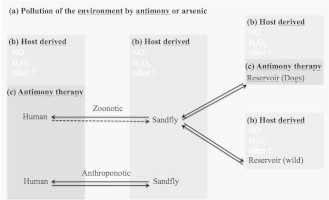
Leishmania drug resistance and particularly antimony resistance still continues to emerge in different part of the world. Because visceral and cutaneous leishmaniasis are transmitted in foci with zoonotic or anthroponotic life-cycles, the link between chemotherapeutic resistance and the selection for drug resistance, through drug consumption, cannot be as obvious for all forms of leishmaniasis. The underlying factors that trigger the selection of antimony resistant parasites are poorly studied in regard to environmental aspects. Recently, a correlation between the emergence of antimony unresponsiveness in India and water arsenic contamination has been raised. The presence of some yet unidentified environmental factors driving the selection of antimony resistant Leishmania populations in a zoonotic context of leishmaniasis is also currently questioned. The identification of key molecules involved in the selection of antimony resistance and their importance in the selective process have to be re-evaluated in light of the environment were all the hosts of Leishmania (mammalian and arthropod) evolved. These new insights will help to (i) address the risk of therapeutic failure associated with the emergence of drug-resistance and (ii) propose new therapeutic protocols to aim at reducing the risk of resistance in endemic areas.
利什曼原虫耐药性,尤其是抗锑耐药性在世界不同地区仍不断出现。由于内脏利什曼病和皮肤利什曼病在具有动物源或人际传播生命周期的病灶中传播,因此,通过药物消耗,化疗耐药性与耐药性选择之间的联系对于所有形式的利什曼病并不明显。在环境方面,对于触发抗锑寄生虫选择的潜在因素的研究还很不完善。最近,人们提出了印度抗锑不敏感性的出现与水砷污染之间的相关性。在利什曼病的动物源背景下,一些尚未确定的环境因素是否会驱动抗锑利什曼原虫种群的选择,目前也受到质疑。在所有利什曼原虫宿主(哺乳动物和节肢动物)进化的环境中,必须重新评估参与选择抗锑耐药性的关键分子及其在选择过程中的重要性。这些新的见解将有助于:(i) 解决与耐药性出现相关的治疗失败风险,以及 (ii) 提出新的治疗方案,旨在降低流行地区的耐药风险。