Parasitology Division, Moredun Research Institute, Pentlands Science Park, Bush Loan, Penicuik EH26 0PZ, Scotland, United Kingdom.
Biomathematics and Statistics Scotland, James Clerk Maxwell Building, The King's Buildings, Edinburgh EH9 3JZ, Scotland, United Kingdom.
Int J Parasitol Drugs Drug Resist. 2013 Mar 6;3:77-84. doi: 10.1016/j.ijpddr.2013.02.001. eCollection 2013 Dec.
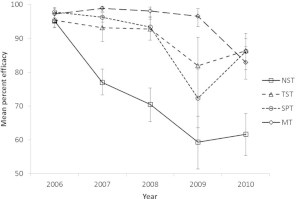
Refugia-based drenching regimes have been widely recommended to slow development of anthelmintic resistance but there are few comparisons between different treatment approaches in the UK. The impact of four ivermectin treatment regimes on drug efficacy, lamb body weight and nematode contamination during a 154 day grazing season were evaluated in a consecutive five year field study. Regimes were whole-flock treatment every 4 weeks (NST), targeted selective treatment (TST) based on individual performance, strategic whole-flock treatments at pre-determined times (SPT) or whole-flock treatment when clinical signs were apparent (MT). Mean numbers of ivermectin drenches administered per season were 4.0, 1.8, 2.0 and 1.4 for NST, TST, SPT and MT groups, respectively. The mean anthelmintic efficacy (AE) for each treatment group was based on faecal egg count reduction post-treatment employing a bootstrap sampling based algorithm. Mean AE was 95-98% for all groups in 2006 and mean AE (95% confidence limits) for NST declined to 62% (55%, 68%) in 2010. In comparison, AE for TST, SPT and MT in 2010 were 86% (81%, 92%), 86% (83%, 90%) and 83% (78%, 88%), respectively. Body weight in TST and SPT was similar to NST in all years (p > 0.05), however MT lambs were lighter than NST in 2006-2008 (p ⩽ 0.04). Tracer lamb worm burdens was lowest in NST but was not significantly different between other groups. Overall, both the TST and SPT regimes appeared to maintain animal performance and conserve anthelmintic efficacy compared with a neo-suppressive anthelmintic treatment regime.
基于避难所的浸泡处理方案已被广泛推荐用于减缓抗寄生虫药物耐药性的发展,但在英国,不同治疗方法之间的比较很少。在连续五年的田间研究中,评估了伊维菌素四种治疗方案对药物疗效、羔羊体重和线虫污染的影响,该方案在 154 天的放牧季节进行。方案包括每 4 周进行一次全羊群处理(NST)、基于个体表现的靶向选择性处理(TST)、在预定时间进行的策略性全羊群处理(SPT)或出现临床症状时进行的全羊群处理(MT)。每个季节 NST、TST、SPT 和 MT 组分别使用伊维菌素滴注的平均次数为 4.0、1.8、2.0 和 1.4。每个治疗组的平均驱虫药疗效(AE)是基于治疗后粪便卵计数减少,采用基于引导抽样的算法。2006 年,所有组的平均 AE 均为 95-98%,而 NST 的平均 AE(95%置信区间)在 2010 年下降至 62%(55%,68%)。相比之下,TST、SPT 和 MT 在 2010 年的 AE 分别为 86%(81%,92%)、86%(83%,90%)和 83%(78%,88%)。在所有年份中,TST 和 SPT 的体重与 NST 相似(p>0.05),但 MT 羔羊在 2006-2008 年比 NST 羔羊轻(p ⩽0.04)。NST 中的示踪羔羊的蠕虫负荷最低,但与其他组之间没有显著差异。总体而言,与新抑制性驱虫治疗方案相比,TST 和 SPT 方案似乎都能保持动物的生产性能并保留驱虫药的疗效。