Department of Biomedical Sciences and Veterinary Public Health, Section for Parasitology, Swedish University of Agricultural Sciences, SE-751 89 Uppsala, Sweden.
Vidilab, Enköping, Sweden.
Int J Parasitol Drugs Drug Resist. 2013 Jul 18;3:129-34. doi: 10.1016/j.ijpddr.2013.06.002. eCollection 2013 Dec.
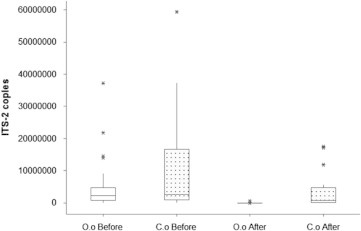
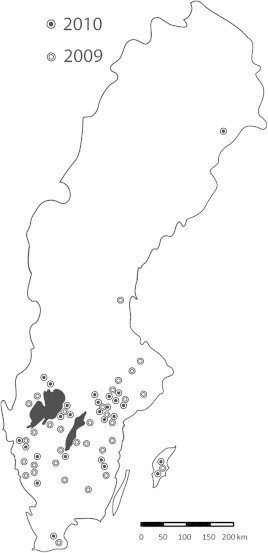
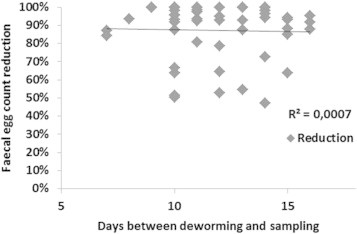
A study on the effect of topical macrocyclic lactones (ML) against gastrointestinal nematodes (GIN) in Swedish first season grazing cattle (FSG) was performed during the grazing seasons of 2009 and 2010. Herds were recruited through farming press and both dairy and beef cattle farms were invited. A questionnaire revealed that 64% of participating farmers dewormed their animals in previous years, and of these 76% used topical formulations with ML. Four to six weeks after turnout, 107 (2009) and 64 (2010) farmers sent in individual faecal samples from 6-10 FSG. Faecal egg counts (FEC) were determined by the FECPAK®-method in 2009 and the McMaster-method in 2010, when also larvae were cultured. Average FEC of ⩾100 eggs per gram faeces (EPG) was seen in 39% of the herds in 2009 and 42% in 2010 and with arithmetic means of 258 ± 110 and 252 ± 350 EPG, respectively. Interestingly, FSG in dairy and beef herds had similar mean FEC. In herds with mean FEC of ⩾100 EPG, farmers dewormed all FSG in the tested grazing group with ivermectin (IVM) or doramectin (DOR) pour-on. In 2009, 33 (31%), and in 2010, 26 (40%) of the herds were retested 7-16 days post treatment. Mean reduction was 89% and 88%, respectively, and in only 12 (36%) and 10 (38%) herds it was ⩾95%. Beef herds had mean reductions similar to those of the dairy herds. No significant difference (P = 0.66) in reduction was seen between the groups treated with three different pour-on formulations, nor was there any correlation between the previous year's usage of anthelmintics and the efficacy. Larvae from post-treatment cultures analysed in 2010 with a species-specific ITS2 qPCR showed that Cooperia oncophora was the predominant species after deworming. Four (15%) groups also harboured surviving Ostertagia ostertagi post treatment.
2009 年和 2010 年放牧季期间,对瑞典首季放牧牛(FSG)中局部大环内酯类(ML)对胃肠道线虫(GIN)的效果进行了研究。通过农业新闻界招募了牛群,邀请了奶牛和肉牛场参与。调查问卷显示,64%的参与农民在过去几年中对动物进行了驱虫,其中 76%使用了 ML 局部制剂。在放牧后 4 至 6 周,107 名(2009 年)和 64 名(2010 年)农民从 6-10 只 FSG 中寄来了单独的粪便样本。2009 年使用 FECPAK®-方法,2010 年使用 McMaster 方法确定粪便卵计数(FEC),同时还培养幼虫。2009 年 39%的牛群平均 FEC ⩾100 个卵/克粪便(EPG),2010 年为 42%,算术平均值分别为 258 ± 110 和 252 ± 350 EPG。有趣的是,奶牛和肉牛群的 FSG 具有相似的平均 FEC。在平均 FEC ⩾100 EPG 的牛群中,农民用伊维菌素(IVM)或多拉菌素(DOR)浇泼剂对所有 FSG 进行了驱虫。2009 年,33 个(31%),2010 年,26 个(40%)的牛群在治疗后 7-16 天进行了重新测试。平均减少率分别为 89%和 88%,只有 12 个(36%)和 10 个(38%)牛群减少率 ⩾95%。肉牛群的平均减少率与奶牛群相似。用三种不同的浇泼制剂治疗的组之间的减少率没有显著差异(P=0.66),也没有观察到前一年驱虫药的使用与疗效之间的相关性。2010 年,用种特异性 ITS2 qPCR 分析治疗后培养的幼虫显示,驱虫后优势物种为奥斯特利线虫(Cooperia oncophora)。四个(15%)组在治疗后还存在存活的奥斯特利线虫(Ostertagia ostertagi)。