Settle William, Soumaré Mohamed, Sarr Makhfousse, Garba Mohamed Hama, Poisot Anne-Sophie
AGPM Division, United Nations Food and Agriculture Organization (UNFAO), , Viale delle Terme di Caracalla, Rome 00153, Italy.
Philos Trans R Soc Lond B Biol Sci. 2014 Feb 17;369(1639):20120277. doi: 10.1098/rstb.2012.0277. Print 2014 Apr 5.
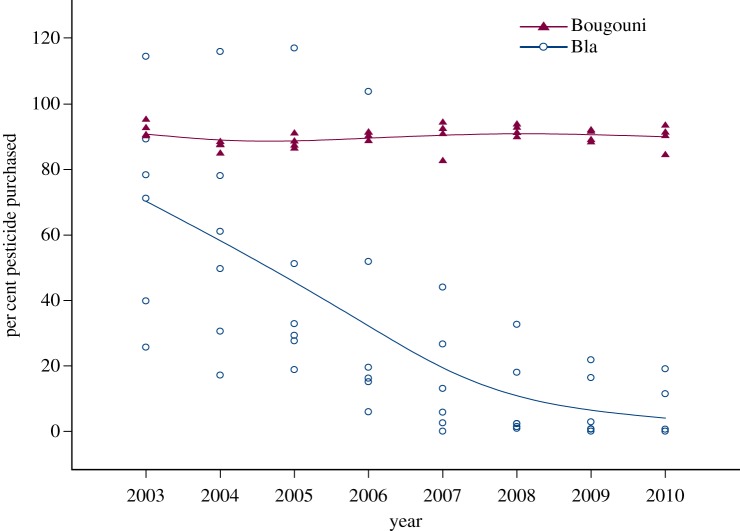
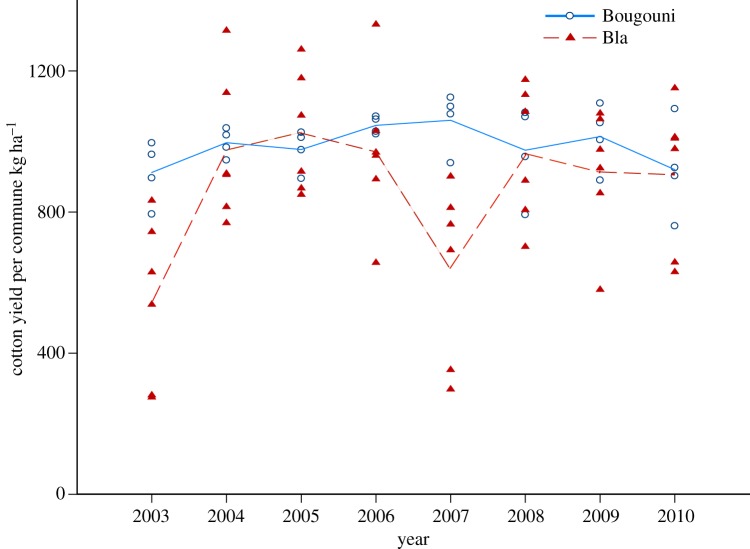
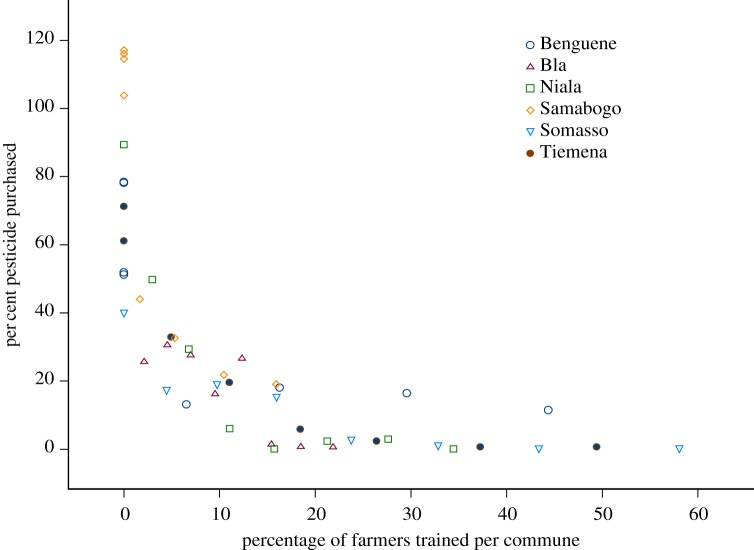
We provide results from a study of two separate sectors within the cotton-growing region of southern Mali. In one sector, farmers have engaged in a farmer field school (FFS) training programme since 2003--the other not. One goal of the training was the adoption of alternatives to the use of hazardous insecticides, through integrated pest management (IPM) methods. Over an 8-year period, analysis showed that with roughly 20% of the 4324 cotton-growing farm households having undergone training, hazardous insecticide use for the entire sector fell by 92.5% compared with earlier figures and with the second (control) sector. Yields for cotton in both sectors were highly variable over time, but no evidence was found for changes in yield owing to shifts in pest management practices. Evidence is presented for a likely diffusion of new practices having taken place, from FFS participants to non-participants. We discuss strengths and weaknesses of the FFS approach, in general, and highlight the need for improved baseline survey and impact analyses to be integrated into FFS projects.
我们提供了对马里南部棉花种植区两个不同区域的研究结果。在一个区域,自2003年以来农民参与了农民田间学校(FFS)培训项目——另一个区域则没有。培训的一个目标是通过综合害虫管理(IPM)方法采用替代使用有害杀虫剂的方法。在8年的时间里,分析表明,在4324个棉花种植农户中,约20%接受了培训,与早期数据以及第二个(对照)区域相比,整个区域的有害杀虫剂使用量下降了92.5%。两个区域的棉花产量随时间变化波动很大,但未发现因害虫管理做法的改变而导致产量变化的证据。有证据表明新做法可能已从FFS参与者传播到非参与者。我们总体讨论了FFS方法的优缺点,并强调需要将改进的基线调查和影响分析纳入FFS项目。