Department of Ecology and Evolutionary Biology, Cornell University, Ithaca, NY, USA.
Philos Trans R Soc Lond B Biol Sci. 2010 Sep 27;365(1554):2959-71. doi: 10.1098/rstb.2010.0143.
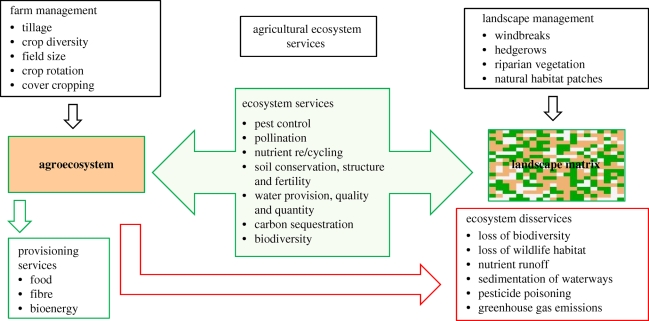
Agricultural ecosystems provide humans with food, forage, bioenergy and pharmaceuticals and are essential to human wellbeing. These systems rely on ecosystem services provided by natural ecosystems, including pollination, biological pest control, maintenance of soil structure and fertility, nutrient cycling and hydrological services. Preliminary assessments indicate that the value of these ecosystem services to agriculture is enormous and often underappreciated. Agroecosystems also produce a variety of ecosystem services, such as regulation of soil and water quality, carbon sequestration, support for biodiversity and cultural services. Depending on management practices, agriculture can also be the source of numerous disservices, including loss of wildlife habitat, nutrient runoff, sedimentation of waterways, greenhouse gas emissions, and pesticide poisoning of humans and non-target species. The tradeoffs that may occur between provisioning services and other ecosystem services and disservices should be evaluated in terms of spatial scale, temporal scale and reversibility. As more effective methods for valuing ecosystem services become available, the potential for 'win-win' scenarios increases. Under all scenarios, appropriate agricultural management practices are critical to realizing the benefits of ecosystem services and reducing disservices from agricultural activities.
农业生态系统为人类提供食物、饲料、生物能源和药品,对人类福祉至关重要。这些系统依赖于自然生态系统提供的生态系统服务,包括授粉、生物防治病虫害、维持土壤结构和肥力、养分循环和水文服务。初步评估表明,这些生态系统服务对农业的价值巨大,但往往被低估。农业生态系统还产生各种生态系统服务,如调节土壤和水质、碳封存、支持生物多样性和文化服务。根据管理实践,农业也可能是许多不利服务的来源,包括野生动物栖息地丧失、养分流失、水道淤积、温室气体排放以及农药毒害人类和非目标物种。在权衡供应服务与其他生态系统服务和不利服务时,应考虑空间尺度、时间尺度和可逆性。随着更有效的生态系统服务价值评估方法的出现,“双赢”情景的可能性增加。在所有情景下,适当的农业管理实践对于实现生态系统服务的效益和减少农业活动的不利影响至关重要。