• 文献检索
  • 文档翻译
  • 深度研究
  • 学术资讯
  • Suppr Zotero 插件Zotero 插件
  • 邀请有礼
  • 套餐&价格
  • 历史记录
应用&插件
Suppr Zotero 插件Zotero 插件浏览器插件Mac 客户端Windows 客户端微信小程序
定价
高级版会员购买积分包购买API积分包
服务
文献检索文档翻译深度研究API 文档MCP 服务
关于我们
关于 Suppr公司介绍联系我们用户协议隐私条款
关注我们

Suppr 超能文献

核心技术专利:CN118964589B侵权必究
粤ICP备2023148730 号-1Suppr @ 2026

文献检索

告别复杂PubMed语法,用中文像聊天一样搜索,搜遍4000万医学文献。AI智能推荐,让科研检索更轻松。

立即免费搜索

文件翻译

保留排版,准确专业,支持PDF/Word/PPT等文件格式,支持 12+语言互译。

免费翻译文档

深度研究

AI帮你快速写综述,25分钟生成高质量综述,智能提取关键信息,辅助科研写作。

立即免费体验

建立抑郁症状的通用指标:将贝克抑郁量表第二版(BDI-II)、流调中心用抑郁量表(CES-D)和患者健康问卷-9(PHQ-9)与患者报告结果测量信息系统(PROMIS)抑郁相联系。

Establishing a common metric for depressive symptoms: linking the BDI-II, CES-D, and PHQ-9 to PROMIS depression.

作者信息

Choi Seung W, Schalet Benjamin, Cook Karon F, Cella David

机构信息

Psychometric Services, CTB/McGraw-Hill.

Department of Medical Social Sciences, Northwestern University Feinberg School of Medicine.

出版信息

Psychol Assess. 2014 Jun;26(2):513-27. doi: 10.1037/a0035768. Epub 2014 Feb 17.

DOI:10.1037/a0035768
PMID:24548149
原文链接:https://pmc.ncbi.nlm.nih.gov/articles/PMC5515387/
Abstract

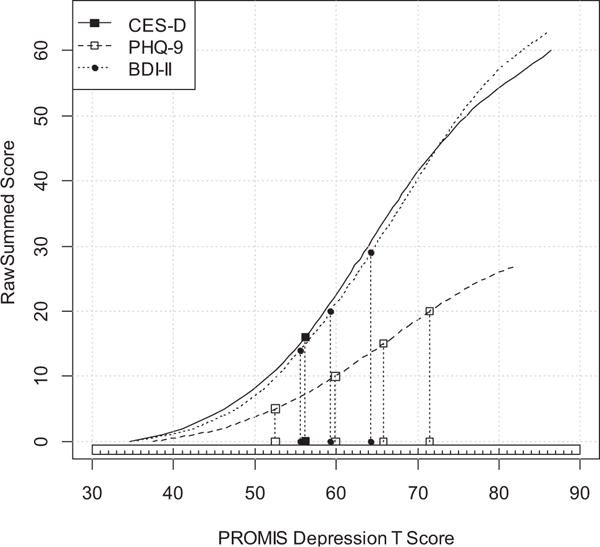
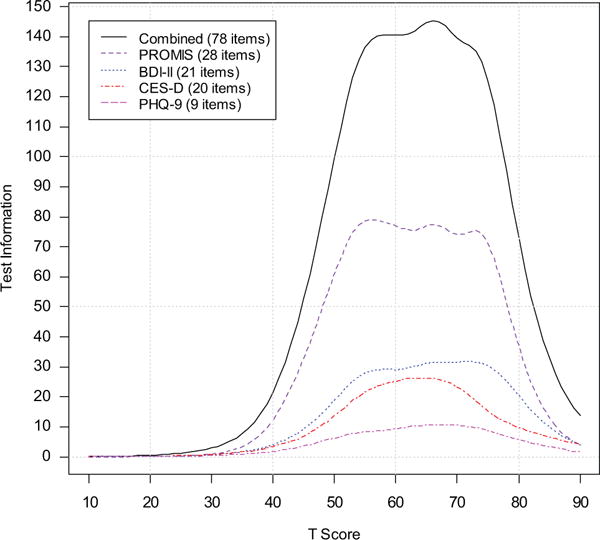
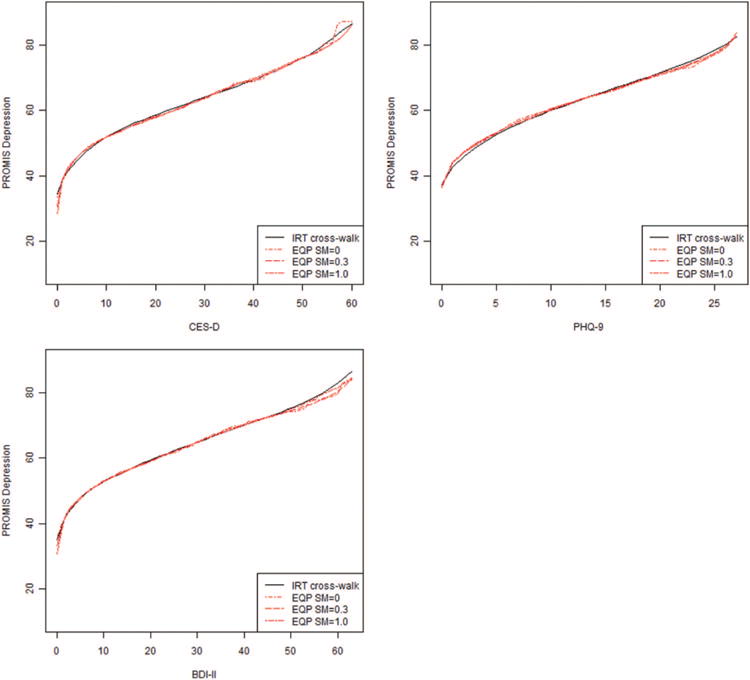
Interest in measuring patient-reported outcomes has increased dramatically in recent decades. This has simultaneously produced numerous assessment options and confusion. In the case of depressive symptoms, there are many commonly used options for measuring the same or a very similar concept. Public and professional reporting of scores can be confused by multiple scale ranges, normative levels, and clinical thresholds. A common reporting metric would have great value and can be achieved when similar instruments are administered to a single sample and then linked to each other to produce cross-walk score tables (e.g., Dorans, 2007; Kolen & Brennan, 2004). Using multiple procedures based on item response theory and equipercentile methods, we produced cross-walk tables linking 3 popular "legacy" depression instruments-the Center for Epidemiologic Studies Depression Scale (Radloff, 1977; N = 747), the Beck Depression Inventory-II (Beck, Steer, & Brown, 1996; N = 748), and the 9-item Patient Health Questionnaire (Kroenke, Spitzer, & Williams, 2001; N = 1,120)-to the depression metric of the National Institutes of Health (NIH) Patient-Reported Outcomes Measurement Information System (PROMIS; Cella et al., 2010). The PROMIS Depression metric is centered on the U.S. general population, matching the marginal distributions of gender, age, race, and education in the 2000 U.S. census (Liu et al., 2010). The linking relationships were evaluated by resampling small subsets and estimating confidence intervals for the differences between the observed and linked PROMIS scores; in addition, PROMIS cutoff scores for depression severity were estimated to correspond with those commonly used with the legacy measures. Our results allow clinicians and researchers to retrofit existing data of 3 popular depression measures to the PROMIS Depression metric and vice versa.

摘要

近几十年来,对测量患者报告结局的兴趣急剧增加。这同时带来了众多评估选项和困惑。就抑郁症状而言,有许多常用选项来测量相同或非常相似的概念。多个量表范围、常模水平和临床阈值可能会使分数的公开和专业报告产生混淆。一个通用的报告指标将具有很大价值,当对单个样本使用相似工具并相互关联以生成交叉得分表时即可实现(例如,多兰斯,2007年;科伦和布伦南,2004年)。我们使用基于项目反应理论和等百分位方法的多种程序,生成了交叉表,将3种常用的“传统”抑郁工具——流行病学研究中心抑郁量表(拉德洛夫,1977年;样本量N = 747)、贝克抑郁量表第二版(贝克、斯泰尔和布朗,1996年;样本量N = 748)以及9项患者健康问卷(克伦克、斯皮策和威廉姆斯,2001年;样本量N = 1120)——与美国国立卫生研究院(NIH)患者报告结局测量信息系统(PROMIS;塞拉等人,2010年)的抑郁指标相联系。PROMIS抑郁指标以美国普通人群为中心,与2000年美国人口普查中的性别、年龄、种族和教育程度的边缘分布相匹配(刘等人,2010年)。通过对小子集进行重采样并估计观察到的PROMIS分数与关联分数之间差异的置信区间来评估关联关系;此外,还估计了与传统测量方法常用的抑郁严重程度对应的PROMIS临界分数。我们的结果使临床医生和研究人员能够将3种常用抑郁测量方法的现有数据转换为PROMIS抑郁指标,反之亦然。
https://cdn.ncbi.nlm.nih.gov/pmc/blobs/2313/5515387/80a5ab317b86/nihms875500f3.jpg
https://cdn.ncbi.nlm.nih.gov/pmc/blobs/2313/5515387/47f3a82d8be8/nihms875500f1.jpg
https://cdn.ncbi.nlm.nih.gov/pmc/blobs/2313/5515387/3ba340a9fb61/nihms875500f2.jpg
https://cdn.ncbi.nlm.nih.gov/pmc/blobs/2313/5515387/80a5ab317b86/nihms875500f3.jpg
https://cdn.ncbi.nlm.nih.gov/pmc/blobs/2313/5515387/47f3a82d8be8/nihms875500f1.jpg
https://cdn.ncbi.nlm.nih.gov/pmc/blobs/2313/5515387/3ba340a9fb61/nihms875500f2.jpg
https://cdn.ncbi.nlm.nih.gov/pmc/blobs/2313/5515387/80a5ab317b86/nihms875500f3.jpg

相似文献

1
Establishing a common metric for depressive symptoms: linking the BDI-II, CES-D, and PHQ-9 to PROMIS depression.建立抑郁症状的通用指标:将贝克抑郁量表第二版(BDI-II)、流调中心用抑郁量表(CES-D)和患者健康问卷-9(PHQ-9)与患者报告结果测量信息系统(PROMIS)抑郁相联系。
Psychol Assess. 2014 Jun;26(2):513-27. doi: 10.1037/a0035768. Epub 2014 Feb 17.
2
Establishing a common metric for self-reported anxiety: linking the MASQ, PANAS, and GAD-7 to PROMIS Anxiety.建立一个自我报告焦虑的通用指标:将 MASQ、PANAS 和 GAD-7 与 PROMIS 焦虑联系起来。
J Anxiety Disord. 2014 Jan;28(1):88-96. doi: 10.1016/j.janxdis.2013.11.006. Epub 2013 Dec 1.
3
Translating CESD-20 and PHQ-9 Scores to PROMIS Depression.将 CESD-20 和 PHQ-9 评分转换为 PROMIS 抑郁。
Assessment. 2017 Apr;24(3):300-307. doi: 10.1177/1073191115607042. Epub 2016 Jul 28.
4
Comparisons across depression assessment instruments in adolescence and young adulthood: an item response theory study using two linking methods.青少年和青年期抑郁评估工具的跨比较:使用两种链接方法的项目反应理论研究。
J Abnorm Child Psychol. 2013 Nov;41(8):1267-77. doi: 10.1007/s10802-013-9756-6.
5
Comparing CESD-10, PHQ-9, and PROMIS depression instruments in individuals with multiple sclerosis.比较多发性硬化症患者的 CESD-10、PHQ-9 和 PROMIS 抑郁量表。
Rehabil Psychol. 2014 May;59(2):220-229. doi: 10.1037/a0035919. Epub 2014 Mar 24.
6
Establishing a common metric for self-reported pain: linking BPI Pain Interference and SF-36 Bodily Pain Subscale scores to the PROMIS Pain Interference metric.建立自我报告疼痛的通用指标:将简明疼痛问卷(BPI)疼痛干扰项和SF-36身体疼痛分量表得分与患者报告结果测量信息系统(PROMIS)疼痛干扰指标相联系。
Qual Life Res. 2015 Oct;24(10):2305-18. doi: 10.1007/s11136-015-0987-6. Epub 2015 Apr 18.
7
Establishing a common metric for self-reported anxiety in patients with prostate cancer: Linking the Memorial Anxiety Scale for Prostate Cancer with PROMIS Anxiety.建立前列腺癌患者自评焦虑的通用指标:将前列腺癌记忆焦虑量表与 PROMIS 焦虑量表相联系。
Cancer. 2019 Sep 15;125(18):3249-3258. doi: 10.1002/cncr.32189. Epub 2019 May 15.
8
Establishing a Common Metric for Physical Function: Linking the HAQ-DI and SF-36 PF Subscale to PROMIS(®) Physical Function.建立身体功能的通用指标:将健康评估问卷残疾指数(HAQ-DI)和SF-36身体功能分量表与患者报告结果测量信息系统(PROMIS®)身体功能相联系。
J Gen Intern Med. 2015 Oct;30(10):1517-23. doi: 10.1007/s11606-015-3360-0.
9
Developing a common metric for depression across adulthood: Linking PROMIS depression with the Edinburgh Postnatal Depression Scale.开发成年期抑郁症的通用度量标准:将 PROMIS 抑郁症与爱丁堡产后抑郁量表联系起来。
Psychol Assess. 2021 Jul;33(7):610-618. doi: 10.1037/pas0001009. Epub 2021 May 31.
10
Validation of the depression item bank from the Patient-Reported Outcomes Measurement Information System (PROMIS) in a three-month observational study.在一项为期三个月的观察性研究中对患者报告结局测量信息系统(PROMIS)中抑郁项目库的验证。
J Psychiatr Res. 2014 Sep;56:112-9. doi: 10.1016/j.jpsychires.2014.05.010. Epub 2014 May 29.

引用本文的文献

1
Behavioral Therapy as an Adjunct to Buprenorphine Treatment for Opioid Use Disorder: A Secondary Analysis of 4 Randomized Clinical Trials.行为疗法作为丁丙诺啡治疗阿片类物质使用障碍的辅助手段:4项随机临床试验的二次分析
JAMA Netw Open. 2025 Aug 1;8(8):e2528529. doi: 10.1001/jamanetworkopen.2025.28529.
2
Identifying psychological distress data available in nationally representative surveys: A scoping review and case study of Australian surveys.识别全国代表性调查中可用的心理困扰数据:一项范围综述及澳大利亚调查的案例研究。
Soc Psychiatry Psychiatr Epidemiol. 2025 Aug 11. doi: 10.1007/s00127-025-02981-6.
3
Exploring the capabilities of repetitive transcranial magnetic stimulation in major depressive disorder: Dynamic causal modeling of the neural network.

本文引用的文献

1
Psychometric comparison of the PHQ-9 and BDI-II for measuring response during treatment of depression.用于测量抑郁症治疗期间反应的患者健康问卷-9(PHQ-9)和贝克抑郁量表第二版(BDI-II)的心理测量学比较
Cogn Behav Ther. 2011;40(2):126-36. doi: 10.1080/16506073.2010.550059.
2
NIH toolbox for assessment of neurological and behavioral function.NIH 神经行为功能评估工具包。
Neurology. 2013 Mar 12;80(11 Suppl 3):S2-6. doi: 10.1212/WNL.0b013e3182872e5f.
3
Patient-Centered Revisions to the DSM-5.以患者为中心的《精神疾病诊断与统计手册》第五版修订版
探索重复经颅磁刺激在重度抑郁症中的作用:神经网络的动态因果模型
Transl Psychiatry. 2025 Jul 25;15(1):257. doi: 10.1038/s41398-025-03480-7.
4
Positive Affect Is Associated With Well-Being Among Sexual and Gender Minorities and Couples.积极情绪与性少数群体和夫妻的幸福感相关。
Psychol Sex Orientat Gend Divers. 2024 Aug 12. doi: 10.1037/sgd0000763.
5
Developing meditation practice in individuals with elevated psychological distress via a meditation app intervention: An implementation science-informed qualitative investigation of barriers and facilitators.通过冥想应用程序干预,在心理困扰程度较高的个体中培养冥想练习:一项基于实施科学的障碍与促进因素定性调查。
Psychol Serv. 2025 Jul 10. doi: 10.1037/ser0000980.
6
Designing a Visual Analytics Tool to Support Data Analysis Tasks of Digital Mental Health Interventions: Case Study.设计一个视觉分析工具以支持数字心理健康干预的数据分析任务:案例研究
JMIR Hum Factors. 2025 Jul 2;12:e64967. doi: 10.2196/64967.
7
Cross-Sectional Reference Data From 29 European Countries for 6 Frequently Used Depression Measures.来自29个欧洲国家的6种常用抑郁症测量方法的横断面参考数据。
JAMA Netw Open. 2025 Jun 2;8(6):e2517394. doi: 10.1001/jamanetworkopen.2025.17394.
8
Conditions associated with reduced harsh parenting among mothers with depressive symptoms or antisocial behavior.与有抑郁症状或反社会行为的母亲减少严厉育儿相关的状况。
Child Abuse Negl. 2025 Jun 21;167:107516. doi: 10.1016/j.chiabu.2025.107516.
9
Mapping and Linking between the EQ-5D-5L and the PROMIS Domains in the United States.美国EQ-5D-5L与患者报告结果测量信息系统(PROMIS)领域之间的映射与关联
Med Decis Making. 2025 Aug;45(6):740-752. doi: 10.1177/0272989X251340990. Epub 2025 Jun 13.
10
Patient-Reported Outcomes Measurement Information System (PROMIS) outcomes: Higher odds of adverse mental health when physical function is impaired.患者报告结局测量信息系统(PROMIS)结果:身体功能受损时出现不良心理健康状况的几率更高。
J Vestib Res. 2025 May 19:9574271251335958. doi: 10.1177/09574271251335958.
Virtual Mentor. 2011 Dec 1;13(12):873-9. doi: 10.1001/virtualmentor.2011.13.12.stas1-1112.
4
Assessment of self-reported negative affect in the NIH Toolbox.评估 NIH 工具包中自我报告的负面情绪。
Psychiatry Res. 2013 Mar 30;206(1):88-97. doi: 10.1016/j.psychres.2012.09.034. Epub 2012 Oct 22.
5
Comparing the Beck Depression Inventory-II (BDI-II) and Patient Health Questionnaire (PHQ-9) depression measures in an integrated mood disorders practice.在综合心境障碍门诊中比较贝克抑郁自评量表 II (BDI-II)和患者健康问卷 9 项(PHQ-9)抑郁量表。
J Affect Disord. 2013 Mar 5;145(3):341-3. doi: 10.1016/j.jad.2012.08.017. Epub 2012 Sep 25.
6
Measuring fatigue in persons with multiple sclerosis: creating a crosswalk between the Modified Fatigue Impact Scale and the PROMIS Fatigue Short Form.测量多发性硬化症患者的疲劳:建立改良疲劳影响量表与 PROMIS 疲劳简短量表之间的转换关系。
Qual Life Res. 2012 Sep;21(7):1123-33. doi: 10.1007/s11136-011-0040-3. Epub 2011 Nov 3.
7
How to compare scores from different depression scales: equating the Patient Health Questionnaire (PHQ) and the ICD-10-Symptom Rating (ISR) using Item Response Theory.如何比较不同抑郁量表的分数:使用项目反应理论对患者健康问卷 (PHQ) 和国际疾病分类第 10 版症状评定量表 (ISR) 进行等距。
Int J Methods Psychiatr Res. 2011 Dec;20(4):203-14. doi: 10.1002/mpr.350. Epub 2011 Oct 20.
8
Item banks for measuring emotional distress from the Patient-Reported Outcomes Measurement Information System (PROMIS®): depression, anxiety, and anger.用于测量患者报告结局测量信息系统(PROMIS®)情感困扰的项目库:抑郁、焦虑和愤怒。
Assessment. 2011 Sep;18(3):263-83. doi: 10.1177/1073191111411667. Epub 2011 Jun 21.
9
Migrating from a legacy fixed-format measure to CAT administration: calibrating the PHQ-9 to the PROMIS depression measures.从传统的固定格式量表向计算机自适应测验(CAT)管理迁移:将 PHQ-9 校准到 PROMIS 抑郁量表。
Qual Life Res. 2011 Nov;20(9):1349-57. doi: 10.1007/s11136-011-9882-y. Epub 2011 Mar 16.
10
Using the PedsQL™ 3.0 asthma module to obtain scores comparable with those of the PROMIS pediatric asthma impact scale (PAIS).使用 PedsQLTM 3.0 哮喘模块获得与 PROMIS 儿童哮喘影响量表 (PAIS) 可比的分数。
Qual Life Res. 2011 Nov;20(9):1497-505. doi: 10.1007/s11136-011-9874-y. Epub 2011 Mar 8.